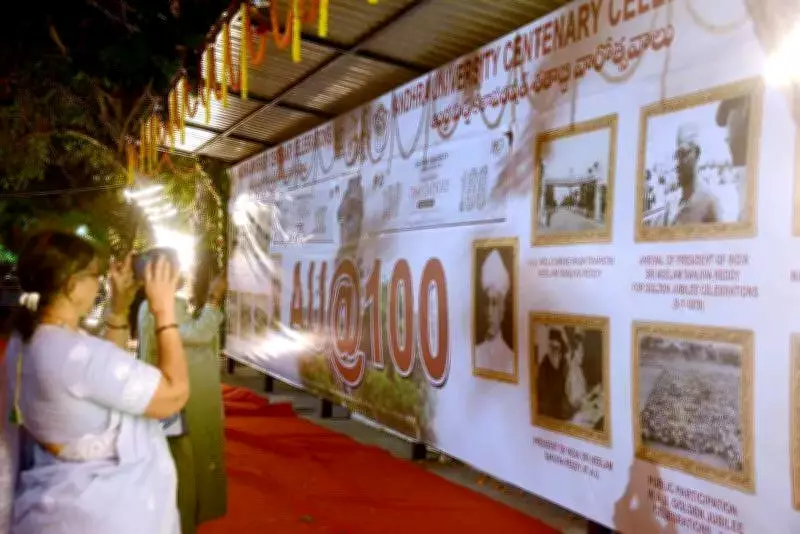
Visakhapatnam: Andhra University completed its 100 years of existence on Sunday, marking a major milestone that reflects its rich legacy while also highlighting the many challenges ahead.
Historical Significance
Established in 1926, the university once served the entire coastal Andhra region, from Srikakulam to Nellore, and was a leading centre for higher education. Over time, however, new universities have come up in almost every district, reducing their jurisdiction and overall academic reach.
Academic and Cultural Contributions
The university has played an important role in shaping intellectual and cultural life in the region, especially through its strengths in humanities, sciences, and regional studies. But this legacy is now under pressure. A key concern is the lack of faculty recruitment over the past 15 years. At present, the university has only about 20% of the required teaching staff, which has affected academic standards, research output, and its ability to offer modern, industry-relevant courses.

Competitive Landscape
At the same time, the higher education ecosystem in Andhra Pradesh has undergone a significant transformation. The rise of private and deemed universities across the state over the past two decades has introduced a new level of competition. These institutions often offer specialised, industry-oriented programmes and benefit from greater autonomy in recruitment, curriculum design, and governance – advantages that remain largely constrained within the public university framework. The post-bifurcation period has further intensified this competitive environment.
The establishment of premier central institutions such as the Indian Institute of Technology Tirupati, National Institute of Technology Andhra Pradesh, Indian Institute of Management Visakhapatnam, and the Central University of Andhra Pradesh has created additional avenues for students and faculty, often drawing talent away from traditional state universities like Andhra University.
Infrastructure and Financial Challenges
Infrastructure presents another critical challenge. As a century-old institution, many of its buildings and facilities are showing signs of age and require substantial renovation or replacement. While periodic repairs are undertaken, the absence of a comprehensive, well-funded infrastructure development plan continues to hinder the university's ability to provide a modern learning environment. This is compounded by financial constraints. With a reduced jurisdiction, internal revenue streams have diminished. The annual block grants from the state government are largely consumed by salaries and pensions, leaving little room for capital investment or academic innovation.
Shifts in Academic Focus
Andhra University has long been known for its multidisciplinary offerings, spanning arts, fine arts, performing arts, linguistics, sciences, and technology. However, over the past few decades, there has been a pronounced shift towards STEM and professional programmes across Andhra Pradesh. This trend has led to declining enrolments in traditional disciplines, further exacerbated by faculty shortages. For instance, while the university was originally established with core programmes in Telugu and history, the history department today functions without regular faculty.
Centenary as an Opportunity
Despite these constraints, the centenary moment offers an opportunity for introspection and renewal. Aligning curricula with emerging fields such as data science, artificial intelligence, environmental studies, and interdisciplinary research could help the university regain relevance. Even during the centenary celebrations, the absence of firm funding commitments from either the state or central government has been a matter of concern. The university has pinned its hopes on a possible announcement of a 'heritage university' tag from the Centre, along with special financial assistance from the Andhra Pradesh government, during the closing ceremony of its centenary celebrations on April 27.

Future Planning
AU vice-chancellor Prof GP Rajasekhar said that the centenary would not mark the end of the celebrations, but would instead guide future planning. 'For the next year, we will work on the preparation of a master plan. This master plan will guide us over the next 20 years. We will focus on strengthening academic standards, research, and infrastructure. The aim is to ensure that the university remains relevant and competitive in the years ahead,' said Prof Rajasekhar.