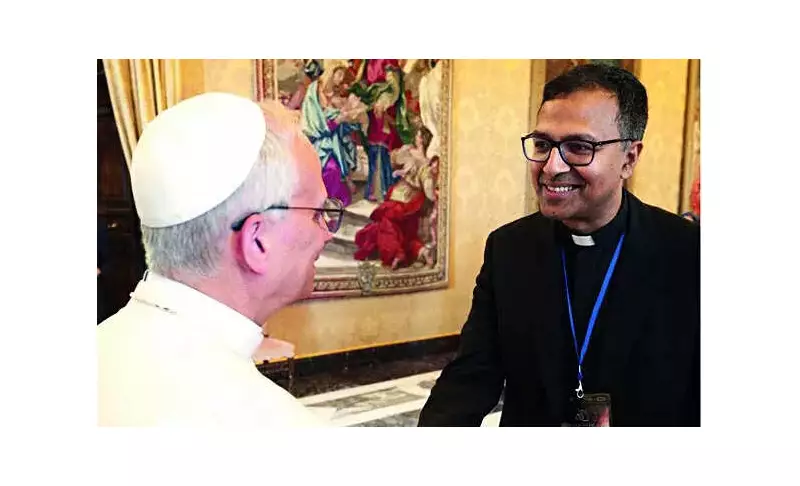
In the historic halls of the Vatican Observatory, a Jesuit priest from Goa is reconstructing the cosmic drama of galactic cannibalism, where massive galaxies devour their smaller neighbours. This scientist is Fr Richard D'Souza, a 46-year-old who combines his spiritual calling with the rigours of astrophysics to act as a galactic archaeologist.
From Goa's Skies to Galactic Histories
Born in Pune in 1978 and raised between Kuwait and Goa, D'Souza's journey to the stars began under clear night skies. His early fascination with the heavens was nurtured during camping trips away from city lights while studying at St Britto's and later during his novitiate in the remote Belagavi countryside. At 18, he joined the Society of Jesus, an order renowned for intellectual pursuit, which recognised and nurtured his scientific curiosity.
His academic path was a unique blend of spirituality and science. After a physics degree from St Xavier's College, Mumbai, he pursued a master's in Heidelberg, working at the Max Planck Institute for Astronomy. Jesuit formation then took him through philosophy studies in Pune and theology, before a gravitational pull back to astrophysics for his doctorate at the Max Planck Institute for Astrophysics in Munich.

A Landmark Discovery in Galactic Archaeology
D'Souza's significant breakthrough came in 2018, with research published in the prestigious journal Nature Astronomy. Collaborating with Eric Bell, he proposed a timeline for one of the most violent events in our galactic neighbourhood. Their work suggested that the Andromeda galaxy's most major merger—a colossal collision that reshaped our Milky Way's closest neighbour—occurred roughly 2 billion years ago.
"My work is basically to understand the histories of galaxies. I try to be a galactic archaeologist, so I put on this Indiana Jones cap and I try to see how galaxies grow to the massive size that they are," D'Souza explained, describing his approach to piecing together cosmic evolution.
Bridging Faith, Science, and Community
Fr D'Souza's life reflects a constant oscillation between the cosmic and the communal. In 2007, between his philosophical and theological studies, he helped establish St Paul's Community College in Belagavi for school dropouts, engaging directly in social action.
Since 2022, he has served as the superior of the Jesuit community at the Vatican Observatory and is now the director of the observatory itself—one of the world's oldest astronomical institutes, founded in 1774. He estimates that 80-90% of his time is dedicated to scientific research: collecting data, running analyses, and attending conferences. The remaining 10% is devoted to a crucial mission within the Church: reminding the institution that faith and science must journey together.
At a recent event in Porvorim, Goa, when inevitably asked about extraterrestrial life, D'Souza blended humour with pragmatism: "I was waiting for this question and my response is, thank God I am not an expert on that." His work continues at Castel Gandolfo, an ancient castle that once hosted popes, where he deciphers the universe's violent past while navigating his unique path at the intersection of celestial wonder and spiritual devotion.