Hyderabad Students Receive IIT Mentorship for Groundbreaking PFAS Research
Two class 11 students from Indus International School in Hyderabad have embarked on a remarkable scientific journey with mentorship and institutional support from the prestigious Indian Institute of Technology Hyderabad. Tanish Veernapalli and Saketh Babu Kollipara are conducting innovative research focused on breaking down PFAS (per- and polyfluoroalkyl substances), a group of persistent 'forever chemicals' that are increasingly contaminating water sources worldwide.
The PFAS Challenge: Persistent Environmental Threat
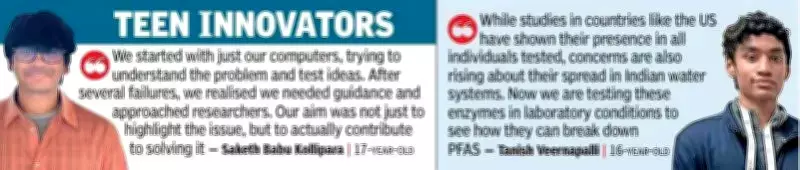
PFAS represent a significant environmental challenge due to their synthetic nature and extremely strong carbon-fluorine bonds, which make them highly resistant to natural degradation processes. "Because they do not easily break down, they accumulate in the environment and the human body, and long-term exposure has been linked to serious health risks, including cancer," explained 16-year-old Tanish Veernapalli.
The global scale of this problem is alarming. While studies in countries such as the United States have demonstrated PFAS presence in nearly all individuals tested, concerns are rapidly growing about their spread within Indian water systems. These chemicals have earned their 'forever' nickname due to their persistence in the environment and biological systems.

From School Project to Serious Research
What began as a modest after-school initiative has transformed into a comprehensive research effort with significant scientific implications. The students employed bioinformatics and machine learning techniques to analyze extensive environmental datasets, systematically identifying molecules with potential PFAS-degrading capabilities.
"We started with just our computers, trying to understand the problem and test ideas. After several failures, we realized we needed guidance and approached researchers," said 17-year-old Saketh Babu Kollipara. "Our aim was not just to highlight the issue, but to actually contribute to solving it."
Their computational work yielded impressive results, narrowing down nearly 20 promising molecular candidates for further investigation. The most significant breakthrough emerged with the identification of epoxide hydrolases—a class of enzymes not previously associated with PFAS degradation—as potential candidates capable of breaking down these stubborn chemicals.
Scientific Recognition and Laboratory Validation
The students' work has already garnered significant recognition across multiple prestigious science platforms. Their achievements include:
- A gold medal at the Indian National Science and Engineering Fair
- A silver medal at the Initiative for Research and Innovation in STEM
- Selection among the top 28 entries at the Stockholm Junior Water Prize India
- Qualification to represent India at the international Genius Olympiad
"When I first learned about PFAS, I was surprised by how widespread yet overlooked the problem was," Saketh added. "Working with mentors helped us take our idea further. Now we are testing these enzymes in laboratory conditions to see how effectively they can break down PFAS," explained Tanish.
Expert Guidance from IIT Hyderabad
Hanuman Singh Dagur, a researcher from IIT Hyderabad who is mentoring both students, expressed enthusiasm about their work. "It is very encouraging to see such young students take up a complex and globally relevant problem like PFAS. What they have done is a strong preliminary step, identifying promising gene candidates through computational work."
The researcher outlined the next phase of their scientific journey: "The next stage is to experimentally validate these findings, which involves expressing the genes, isolating the proteins, and testing whether they can actually break down fluorine-containing compounds. This is a time-intensive process, but their work provides a valuable starting point."
The students are currently continuing validation of their findings with ongoing support from IIT Hyderabad, bridging the gap between computational prediction and laboratory verification in their quest to address one of modern environmental science's most persistent challenges.