IIT Delhi Conference Sparks Controversy Over Dalit-Palestinian Comparison
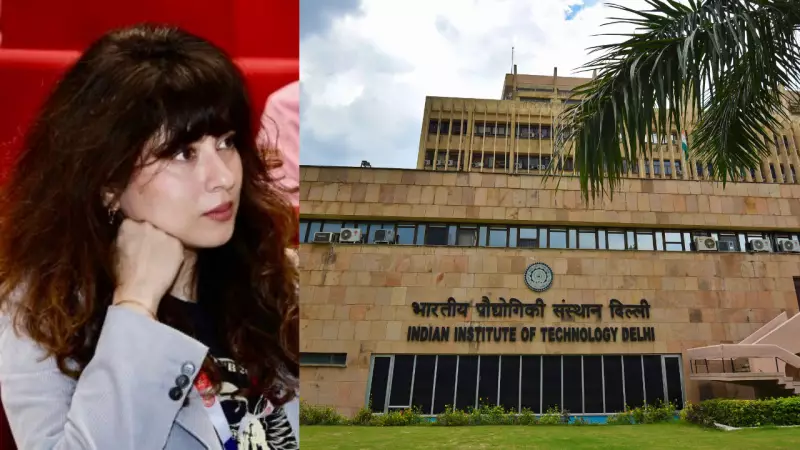
For three consecutive days, the Indian Institute of Technology Delhi hosted a significant academic gathering focused on caste and race studies. The event, titled Critical Philosophy of Caste & Race (CPCR3): Celebrating 25 Years of Durban: Indian Contributions to Combatting Caste and Racism, was scheduled from January 16 to 18. Initially intended as a scholarly dialogue among academics, the conference unexpectedly transformed into a public examination of institutional judgment and academic freedom.
The Flashpoint: A Single Paper Title
The controversy erupted not from a speech, protest, or demonstration, but from a simple paper title listed in the conference program. A screenshot began circulating widely on social media platforms showing a session phrased as: What's common between Dalits and Palestinians? This single line became the focal point of intense criticism and debate across digital platforms.
In the current Indian context, such screenshots often strip away academic nuance and present isolated content as representing institutional intent. Critics interpreted the comparison not as an intellectual exercise but as a political statement, connecting domestic caste issues with the ongoing international conflict involving Palestinians. The involvement of IIT Delhi's institutional authority was seen as amplifying what many perceived as a controversial alignment.

Escalating Criticism and Institutional Response
The online reaction quickly moved beyond typical academic criticism. One prominent social media post accused IIT Delhi's humanities department of embracing what it termed woke activism, alleging the conference promoted a one-sided view on caste through sessions featuring radical activists. The discourse intensified when former interim CBI director M. Nageswara Rao addressed a letter to IIT Delhi director Rangan Banerjee on social media platform X.
Rao's communication bypassed academic arguments entirely, labeling the conference organizers as part of an anti-Hindu deep state initiative and describing their work as anti-national and destabilising. He explicitly demanded the disbanding of the organizing group, asserting that hosting the event in the Senate Hall implied institutional endorsement.
IIT Delhi responded with characteristic institutional caution. In an official statement released on X, the institute announced it had constituted a fact-finding committee and sought explanations from faculty organizers. The carefully worded declaration stated that appropriate actions will be initiated in accordance with institutional protocols, based on the committee's findings. This neutral formulation neither defended the conference nor endorsed the criticism, signaling the matter had transitioned from public debate to formal institutional scrutiny.
Divya Dwivedi: The Scholar at the Center
At the heart of this controversy sits Divya Dwivedi, an IIT Delhi professor who helped organize the conference. A faculty member in the Department of Humanities and Social Sciences, Dwivedi teaches philosophy and literature. Her academic trajectory at the institute has followed a conventional path: assistant professor from 2012 to 2020, associate professor from 2020 to 2024, and professor from 2025 onward.
However, her scholarly work consistently transcends purely academic boundaries. Dwivedi's research focuses on power structures, identity formation, caste dynamics, and the linguistic mechanisms through which political ideas become normalized. She employs tools from narratology and deconstruction not merely as theoretical frameworks but as analytical methods to examine how societies construct hierarchy and belonging.
Her publications reflect this interdisciplinary approach. Two notable co-authored works with Shaj Mohan include Gandhi and Philosophy: On Theological Anti-Politics (2019) and Indian Philosophy, Indian Revolution: On Caste and Politics (2024). These titles indicate her engagement with political philosophy, caste studies, and theoretical examinations of power structures.

A Pattern of Public Engagement
This is not the first instance where Dwivedi's academic perspectives have generated public controversy. Her arguments have repeatedly moved from scholarly forums into broader political discourse through various media platforms.
In 2019, during a television debate on NDTV concerning Gandhi and politics, Dwivedi made remarks that attracted significant criticism. She argued that the Hindu right is the corollary of the idea that India is a Hindu majority population and this is a false majority, suggesting that the Hindu religion was invented in the early 20th century to hide the fact that lower caste people are the real majority of India. She further connected this analysis to Gandhi's political role, stating he helped construct a false Hindu majority and a new Hindu identity.
The following year, these ideas appeared in expanded form in The Caravan magazine, where Dwivedi co-authored an essay titled The Hindu Hoax: How upper castes invented a Hindu majority. The piece presented a structural argument that India's majority is not merely demographic but historically constructed through caste-based power dynamics.
By 2023, Dwivedi reiterated similar themes in an international context during an interview with France 24. Responding to questions about India's economic growth, she characterized anecdotal success stories as media-tised and refocused the discussion on structural inequalities. India has been shaped over 300 years by the racialised order of caste where 10% of the upper caste minority occupy 90% of powerful positions, she stated, adding that it was my philosophical compulsion and intellectual duty to bring attention to this.
Broader Implications for Academic Institutions
The current controversy at IIT Delhi reflects a larger pattern affecting Indian academic institutions. Campuses increasingly operate before dual audiences: the academic community that engages with arguments as intellectual discourse, and the public sphere that often interprets scholarly positions as political stances. When public scrutiny intensifies, institutions frequently resort to procedural responses—committees, explanations, protocols—as protective measures.
This incident underscores the challenges facing scholars whose work addresses socially and politically sensitive topics. The movement of academic ideas into public debate, often stripped of their methodological context and theoretical frameworks, creates tensions between institutional autonomy, academic freedom, and public accountability.
The fact-finding committee's eventual findings and IIT Delhi's subsequent actions will likely be watched closely, not only for their specific conclusions but for what they signal about the space available for critical scholarship within India's premier educational institutions.