Healthcare's New Frontier: Where Medicine Meets Entrepreneurship
Healthcare is undergoing a fundamental transformation, moving beyond the traditional domains of hospitals, clinicians, and public health systems. Today, the sector is increasingly being shaped by founders, engineers, and operators who are building sophisticated products at the complex intersection of medicine, data science, regulation, and business strategy. This evolution spans digital diagnostics, remote patient care, advanced medical devices, and comprehensive health analytics, signaling a decisive shift toward innovation-led delivery models.
India's Healthcare Market at a Pivotal Juncture
India stands at a particularly crucial moment in this global transformation. According to industry estimates referenced by government agencies and market research bodies, the Indian healthcare market is projected to surpass USD 600 billion within the next decade. This explosive growth is fueled by powerful demographic shifts, a rising burden of chronic diseases, and the rapid adoption of digital technologies across the population.
However, alongside this tremendous opportunity lies a series of complex challenges. Healthcare ventures must operate within strict regulatory frameworks, navigate fragmented supply chains, and function in deeply human contexts where there is minimal tolerance for error. These conditions have exposed a significant and widening leadership gap within the industry.

The Multidisciplinary Leadership Deficit
Many experienced healthcare professionals possess deep clinical knowledge but often lack exposure to product development cycles, commercial strategy formulation, or the economics of scaling a venture. Conversely, entrepreneurs and technologists frequently struggle with navigating regulatory pathways, ensuring patient safety, and achieving real-world adoption within hospital systems and care settings.
What the sector urgently requires is a new breed of leader—one who can move fluidly between clinical insight, technological design, and business execution. This need highlights the structural challenges that continue to hinder healthcare innovation.
Structural Bottlenecks in Healthcare Innovation
In the realm of healthcare innovation, promising research breakthroughs too often remain confined to laboratory settings. Viable prototypes stall due to unclear regulatory planning, and startups struggle to articulate value propositions that resonate simultaneously with providers, payers, and patients.
Several persistent bottlenecks plague the ecosystem:
- Uneven Digital Adoption: Despite the availability of advanced tools, digital adoption rates remain inconsistent across the healthcare landscape.
- Data and Security Concerns: Legitimate concerns about data privacy and cybersecurity significantly slow down the deployment of new solutions.
- Funding Gaps: Early-stage healthcare ventures face funding challenges, as they typically require longer validation and regulatory cycles compared to consumer technology startups.
- Talent Shortage: Above all, there is a critical shortage of multidisciplinary leadership talent that comprehends healthcare as both a human-centered service and a complex system.
These are not isolated issues; they reflect a deep structural need for education that transcends theoretical knowledge and case discussions. True healthcare entrepreneurship demands a practical, working understanding of the entire lifecycle—from product conception and design to testing, regulation, pricing, and commercialization—all within a single, coherent framework.
A Program Designed to Bridge the Critical Gap
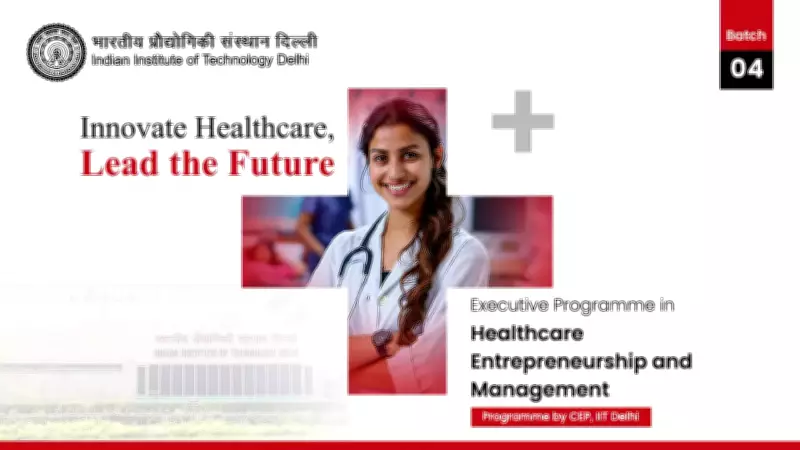
The Executive Programme in Healthcare Entrepreneurship and Management, offered by the Continuing Education Programme (CEP) at IIT Delhi, has been meticulously designed with this exact reality in mind. Rather than treating healthcare as a generic industry vertical, the program addresses it as a complex, heavily regulated, and profoundly human-centered domain that demands specialized leadership capabilities.

Delivered over five months in a live online format, the program allows working professionals to participate fully without having to step away from their current roles. Its structure mirrors the complete lifecycle of healthcare innovation, guiding participants from identifying unmet clinical needs to launching and scaling viable products and services.
Emphasis on Applied, Real-World Learning
What truly distinguishes this program is its unwavering emphasis on applied learning. Candidates are not merely introduced to concepts like design thinking, product-market fit, and business model innovation. They are required to actively apply these frameworks to real healthcare contexts, working through hands-on exercises in product conception, prototyping, user testing, and go-to-market strategy planning.
Navigating the Healthcare Innovation Stack
The comprehensive curriculum is organized around six interconnected stages:
- Conception: Participants learn to examine healthcare problems through multiple lenses—patient personas, clinical perspectives, and market data—emphasizing empathy-led design and structured opportunity identification.
- Design & Prototyping: Modules cover product specifications, user experience (UX) design, medical app development, and physical device design, using modern tools for rapid prototyping and iterative optimization.
- Testing & Regulation: This critical component covers clinical testing protocols, ethical reviews, quality standards, and compliance frameworks, teaching participants to plan for regulation proactively.
- Business & Commercialization: Candidates engage with business model development, funding strategies, intellectual property management, and deployment planning.
The program culminates in a capstone project where teams develop a product alongside a tested commercialization plan, often incorporating direct insights from hospitals and healthcare institutions.
Faculty-Led, Practice-Oriented Instruction
The program is anchored by IIT Delhi faculty from the Centre for Biomedical Engineering, with active involvement from practicing clinicians, researchers, and industry leaders. This faculty blend brings deep research credentials together with real-world entrepreneurial experience, ensuring the instruction remains both rigorous and directly relevant to practical constraints.
This combination is especially valuable in healthcare, where credibility is paramount. Candidates benefit from exposure to integrated perspectives across engineering, medicine, and management, rather than learning through a single, narrow disciplinary lens.
The live online format fosters meaningful interaction and discussion, while project-based learning encourages collaboration among peers from diverse backgrounds. Past cohorts have included doctors, biomedical engineers, startup founders, healthcare managers, and researchers, creating a classroom dynamic that reflects the multidisciplinary teams essential for successful healthcare ventures.
Who Should Enroll in This Program?
This program is designed for:
- Aspiring healthcare entrepreneurs
- Medical professionals seeking to expand into innovation and leadership roles
- Biomedical and biotech engineers
- Researchers interested in translating laboratory work into market-ready solutions
- Professionals in healthtech, medical devices, diagnostics, and healthcare services who wish to deepen their strategic and commercial understanding
Candidates who successfully complete the program and meet all assessment criteria receive a certificate of successful completion from CEP, IIT Delhi. Beyond the credential, they gain a structured, responsible framework for thinking about healthcare innovation—one that balances ambitious vision with operational and ethical responsibility.
Shaping the Future of Indian Healthcare
India's healthcare future will be shaped not only by public policy and investment but also by the quality of entrepreneurship emerging from its talent pool. Programs that effectively combine technical understanding, managerial skill, and ethical awareness play a quiet yet critical role in defining this future.
The Executive Programme in Healthcare Entrepreneurship and Management by IIT Delhi positions itself squarely within this mission. It does not offer shortcuts or promise instant success. Instead, it provides a structured, credible pathway for professionals committed to building responsible, scalable, and impactful healthcare ventures. In a sector where the human and financial costs of poor decisions are exceptionally high, such comprehensive preparation is not merely beneficial—it is foundational and absolutely necessary.