

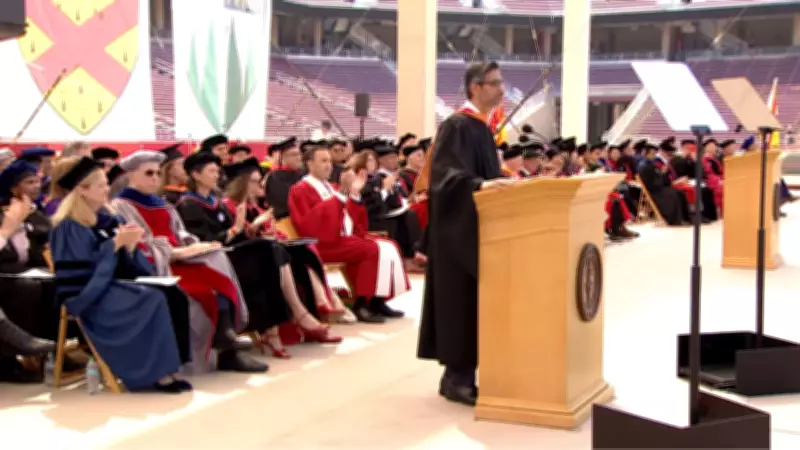
More than 200 Stanford graduates walked out on Google CEO Sundar Pichai as he stepped up to deliver the university's commencement address on Sunday, chanting "Free, free Palestine" while boos and cries of "shame on you" cut through the crowd. Students waved Palestinian flags, blew whistles and raised banners before filing out mid-speech, turning what should have been a marquee moment for one of Stanford's most prominent alumni into a public rebuke.
Pichai had been coached on what not to say to avoid the AI backlash that has dogged other tech executives this graduation season, and he stuck to the script, skipping any mention of the technology Google is racing to build. But the protest that greeted him had nothing to do with AI. It was about one Google contract: Project Nimbus, the company's cloud deal with the Israeli government.
Why Stanford students protested Sundar Pichai's speech
The walkout was organized by Stanford's Students for Justice in Palestine chapter and the No Tech for Apartheid campaign. Their target was Project Nimbus, Google's $1.2 billion cloud-computing deal with the Israeli government, signed in 2021 alongside Amazon. Protesters condemned the contract for supplying services to Israel's Defense Ministry and other state agencies during the war in Gaza.

"We don't need another tech billionaire to tell us how to get rich off of the killing and surveillance of Palestinians," Stanford SJP said in a statement.
Around 200 students walked, according to SFGate, before joining smaller groups already demonstrating in the audience. The BBC caught Pichai afterward and asked for his reaction to the walkout. He said little.
Stanford's Gaza protests stretch into a third year
Sunday's demonstration followed a pattern. For at least the third straight year, Stanford commencements have drawn protests over Israel's war in Gaza and the university's crackdown on pro-Palestinian activism on campus. And for the second year running, students who walked out held their own "People's Commencement" nearby.
This year's alternative ceremony featured Mahmoud Khalil as keynote speaker. Khalil, a pro-Palestinian organizer during Columbia University's 2024 protests, was detained by US Immigration and Customs Enforcement for more than 100 days last year as the government moved to deport him over his activism.
Pichai, a Stanford alum who earned his master's here before rising through Google, didn't address the protest from the stage. He waited it out. Once the demonstrators cleared and the noise faded, the soft-spoken executive won over much of the room, drawing laughter and applause as he recounted immigrating to California, swapping his doctorate for a master's, and finding his footing in his early Google years.
What Sundar Pichai told Stanford graduates instead
His speech ran on personal story, not industry talking points. Pichai urged graduates to "choose optimism," returning to the anecdote of arriving in California expecting lush greenery and finding only brown hills, until his host told him the right word was "golden." The takeaway, he said, was learning to reframe something unappealing as something full of promise. He closed by telling the Class of 2026 to "set your heart ablaze."
The caution was deliberate. Pichai's predecessor Eric Schmidt got booed at the University of Arizona last month for praising AI, part of a wider student revolt against executives hyping a technology graduates increasingly see as a threat to their careers. Scott Borchetta, the music executive who helped launch Taylor Swift, drew the same treatment at Middle Tennessee State University. Pichai dodged that landmine cleanly.
The other one he couldn't avoid. For a large share of the Class of 2026, the issue with Google's CEO isn't his pitch on AI. It's the company's business with Israel.






