NEP 2020's 4-Year Degree Dilemma: Mumbai Students Hesitate as Colleges Scramble
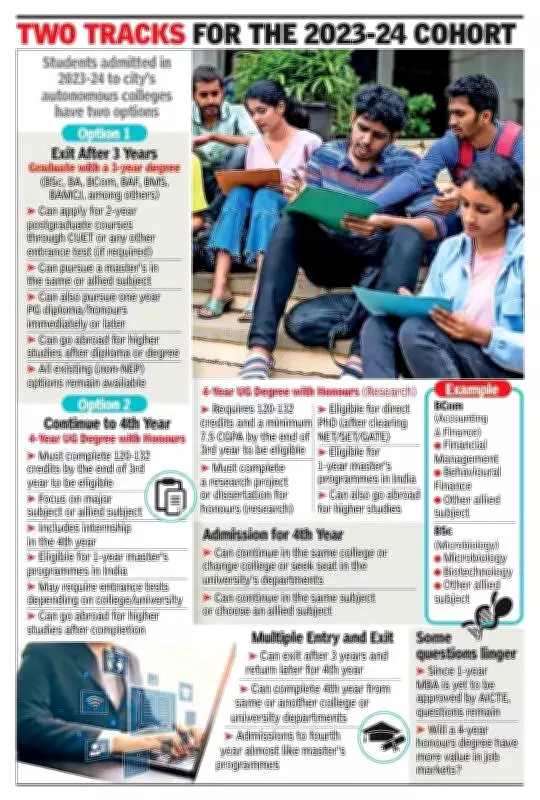
As the inaugural cohort under the National Education Policy (NEP) 2020 reaches a pivotal decision point, students in Mumbai's autonomous colleges are grappling with a critical choice: graduate after three years or continue for a fourth year to pursue an honours degree. This hesitation stems from deep-seated concerns about academic outcomes and future career prospects in a rapidly evolving higher education landscape.
Student Uncertainty and Market Value Questions
Supriya finds herself at a crossroads that could define her academic trajectory. With options to enter a master's programme or extend her undergraduate studies, the decision is far from simple. She is not alone in this dilemma. Rachel V, another student, voices common anxieties: "Does an honours programme hold any value in the future? Will it make a difference in placements? Will it be valued more than the traditional 3+2 track in the job market?"
For Akshat L, a BAF student from a suburban college aiming for an MBA, confusion abounds. He wonders if a one-year MBA will be available after completing the fourth year and is perplexed because his college is likely to offer an honours programme in an allied subject instead of continuing BAF. The state government has clarified that colleges offering postgraduate programmes will only be permitted to provide the fourth-year honours option, adding another layer of complexity.

Colleges Navigate Structural Challenges
Around 130 colleges affiliated with the University of Mumbai are autonomous, but only about 75 to 80, along with the university's own departments, are offering the fourth-year option this year. Institutions that gained autonomy after 2023 will see their first NEP cohort enter the fourth year next year. Delayed notifications from the government and university have forced colleges to scramble, aligning the new honours programmes with existing structures.
Institutions like R A Podar College of Commerce and Economics, which typically fill their postgraduate seats to capacity, now face a conundrum. With an intake of around 160 seats for master's programmes, the same limited pool must be divided between students opting for the B Com (Honours) pathway and those seeking M Com admission. Without an expansion in overall capacity, this becomes a zero-sum game, forcing difficult allocation decisions.
Administrative Insights and Student Preferences
Principal Vinita Krishnakumar from R A Podar College emphasizes that clarity will take time. "This is the first year, and it will take at least one batch to pass out for there to be complete clarity on this matter," she notes. A recent survey at the college revealed that most students prefer pursuing a master's programme over the four-year honours option, though responses were mixed. "While many students were unsure, some opted for the fourth-year undergraduate programme, and many others chose M Com, which continues to be more popular at our college," Krishnakumar adds.
At Mithibai College, principal Krutika Desai reports that only about 10 to 15% of students, with a maximum of 25%, are inclined toward the extended undergraduate route. The college has taken a pragmatic approach, allowing students to opt for honours in the subject they have studied over three years. For science students like A Namboodri, a microbiology student with a 7.5 CGPA, the choice is clear: she plans to pursue an honours with research programme. "Many universities abroad prefer a four-year study programme after 12th. This would be helpful," she explains. Additionally, in India, this path allows direct eligibility for a PhD after NET/SET, saving a year compared to the master's route.
Broader Implications and Future Outlook
The hesitation among students, with only 15-25% currently opting for the fourth year, reflects broader uncertainties about how the new NEP 2020 framework will impact job markets and academic progression. As colleges continue to adapt their course structures and subject combinations, the balance between fourth-year honours programmes and traditional master's tracks remains in flux. This transitional phase highlights the need for clearer guidelines and student counseling to navigate the changing higher education ecosystem effectively.