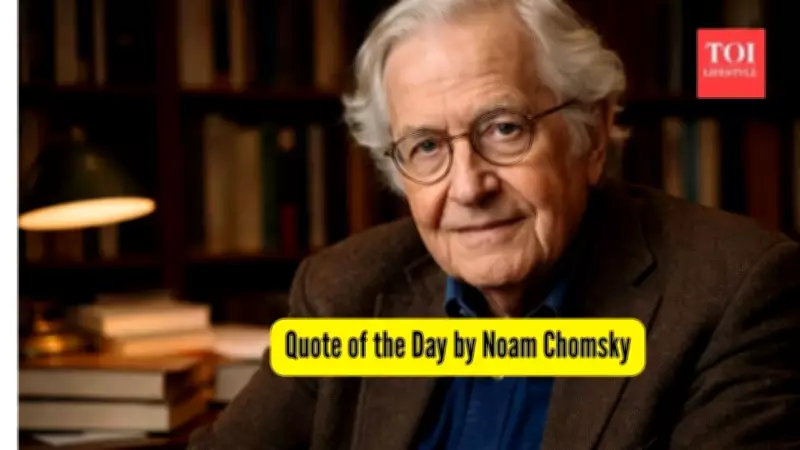
The Enduring Legacy of Noam Chomsky: A Titan of Thought
Noam Chomsky stands as one of the most influential intellectuals of the modern era, whose profound contributions to linguistics, cognitive science, and political activism have fundamentally altered our understanding of language, thought, and power structures. For more than 70 years, his work has shaped academic disciplines and public life, leaving an indelible mark on how we perceive communication and governance.
Early Life and Formative Years
Born in 1928 in Philadelphia, Pennsylvania, to a family of Jewish immigrants, Chomsky was immersed in intellectual pursuits from childhood. His father, William Chomsky, was a respected Hebrew scholar, while his mother, Elsie Simonofsky, was actively engaged in educational and intellectual circles. This environment fostered Chomsky's early development of critical thinking skills and political awareness.
Remarkably, at just ten years old, Chomsky penned his first political essay addressing the rise of fascism in Europe, demonstrating his precocious understanding of global injustices. This early engagement with political issues foreshadowed the dual path his career would take—combining rigorous academic scholarship with passionate social commentary.

Academic Foundations and Breakthrough Theories
Chomsky pursued studies in linguistics, philosophy, and mathematics at the University of Pennsylvania, where he encountered linguist Zellig Harris. While Harris initially influenced his early academic direction, Chomsky soon diverged from structuralist approaches to develop his own revolutionary ideas about language.
After earning his doctorate, Chomsky joined the Massachusetts Institute of Technology (MIT), where he would spend the majority of his academic career. His most significant contribution emerged as the theory of generative grammar, which challenged prevailing linguistic paradigms that focused merely on describing observable language patterns.
The Generative Grammar Revolution
Chomsky proposed that humans possess an innate capacity for language acquisition, which he termed the "language acquisition device." Central to this theory is the concept of "universal grammar"—the idea that all human languages share fundamental structural principles. This perspective transformed linguistics from a descriptive field into a cognitive science investigating how language operates within the human mind.
His 1957 publication Syntactic Structures became a landmark work, introducing the notion that a finite set of rules can generate an infinite number of sentences. This insight not only revolutionized linguistics but also profoundly impacted computer science, psychology, and philosophy, helping to establish modern cognitive science as a distinct discipline.
Influence on Writing and Communication Studies
Beyond theoretical linguistics, Chomsky's work has significantly influenced writing and language analysis. His emphasis on clarity, precision, and syntactic structure has encouraged scholars to examine how meaning is constructed rather than merely analyzing surface-level word arrangements. This approach encourages writers to view language as a cognitive tool rather than simply a communication medium.
Chomsky's critical perspective on media and political communication has been particularly transformative. In his collaborative work Manufacturing Consent with Edward S. Herman, Chomsky introduced the "propaganda model," which analyzes how mass media often serves powerful interests by framing information to support dominant ideologies. This framework has become an essential tool for journalists, writers, and readers seeking to understand bias, perspective, and power dynamics in communication.
Political Activism and Social Critique
Parallel to his academic achievements, Chomsky emerged as a prominent political activist, vocally opposing U.S. foreign policy, corporate power, and social injustices. His activism gained prominence during the Vietnam War, when he spoke out against military intervention and supported anti-war movements.

Throughout his life, Chomsky addressed diverse issues including environmental concerns, human rights violations, and economic inequality. Even in his later years, he remained an engaged commentator on contemporary challenges such as climate change, democratic erosion, and the societal implications of technological advancement. Chomsky passed away in 2023 at age 98, leaving behind a legacy that continues to inspire critical thought and social engagement.
Interdisciplinary Impact and Lasting Influence
Chomsky's work bridges numerous disciplines including philosophy, psychology, computer science, and education. His theories about language and mind have enriched philosophical discussions about human nature and knowledge, while his critique of behaviorism helped shift psychology toward cognitive methodologies.
In computer science, his ideas have proven valuable for natural language processing and artificial intelligence development. As one of the most prolific writers of our time—authoring over 100 books and countless articles translated into numerous languages—Chomsky's work remains accessible to global audiences.
Critical Perspectives on Modern Politics
Chomsky's incisive critique of contemporary political systems is encapsulated in his observation that "political campaigns are designed by the same people who sell toothpaste and cars." This statement highlights how political messaging often employs commercial marketing strategies, prioritizing emotional appeal and image crafting over substantive policy discussion.
This perspective serves as a crucial reminder for citizens to approach political communication with healthy skepticism, looking beyond slogans and imagery to examine policies, evidence, and genuine intentions. Chomsky's analysis also raises concerns about inequality in political representation, where financial resources can disproportionately influence public perception and electoral outcomes.
Noam Chomsky's multidimensional legacy continues to challenge conventional thinking across academic and public spheres, encouraging deeper examination of how language shapes thought and how power structures influence communication. His work remains essential reading for anyone seeking to understand the complex interplay between language, cognition, and society.