

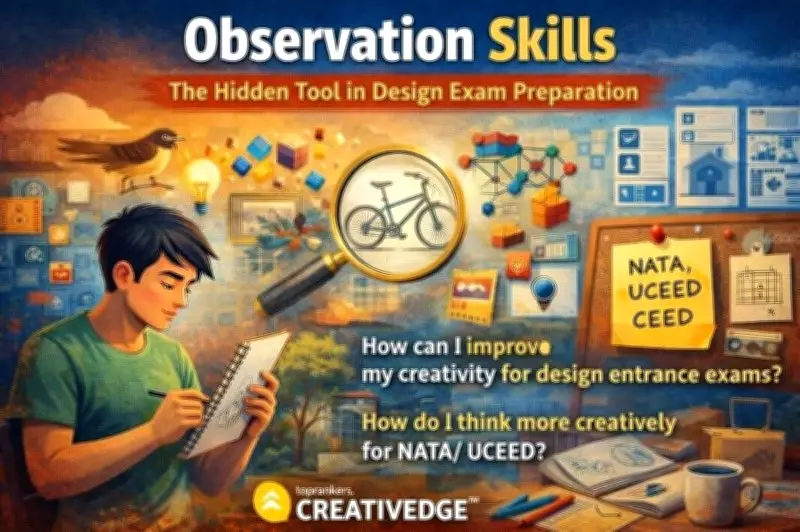
Observation Skills: The Hidden Tool in Design Exam Preparation, Say Experts at Creative Edge by Toprankers
In an era dominated by creativity and visual thinking, design entrance exams such as NATA, UCEED, and CEED serve as critical gateways to India's premier design institutes. With thousands of aspirants vying annually for limited seats at institutions like IITs and NIDs, success is no longer solely about innate talent—it hinges on how effectively students can observe, interpret, and translate the world around them. According to experts at Creative Edge by Toprankers, a leading platform for design preparation in India, observation skills are frequently underrated yet represent a powerful tool for excelling in these competitive exams.
Why Observation Matters More Than Talent
Design exams extend beyond mere drawing abilities or imagination; they rigorously test a student's capacity to:
- Comprehend real-world objects and environments
- Analyze shapes, proportions, and perspectives with precision
- Translate abstract ideas into clear visual representations
- Solve problems through innovative and creative approaches
Exams like UCEED and CEED place a strong emphasis on visualization, logical reasoning, and design aptitude, while NATA evaluates spatial ability, perspective drawing, and aesthetic sensitivity. Data from past exam trends indicates that top performers are not necessarily the most skilled artists but those who can accurately observe details and apply them creatively, making observation a game-changing factor.

The Science Behind Observation and Creativity
Observation is not a passive activity; it is an active cognitive process. When students engage in close observation, they:
- Notice patterns and underlying structures in their surroundings
- Understand the relationships between different objects
- Develop enhanced spatial awareness and visual memory
Research in cognitive psychology supports that creative thinking flourishes when individuals deeply interact with their environment rather than relying solely on imagination. As an expert at Creative Edge by Toprankers explains, "Creativity is not about creating something out of nothing. It is about connecting what you see with what you know."
How to Improve Creativity for Design Entrance Exams
Many students question their creativity, but mentors at Creative Edge by Toprankers assert that creativity is a skill that can be cultivated through consistent practice. Here are actionable steps to enhance creativity:
- Train Your Observation Daily: Focus on everyday objects like chairs, buildings, and textures. Ask probing questions about their design and potential improvements.
- Maintain a Visual Diary: Sketch daily observations to improve detail-capturing abilities, without striving for perfection.
- Break Objects into Basic Shapes: Simplify complex items into fundamental forms such as cubes and cylinders, a common requirement in design exams.
- Explore Different Perspectives: Examine objects from multiple angles to boost spatial understanding, crucial for exams like NATA.
- Solve Previous Year Questions: Use past papers to see how observation translates into exam scenarios.
- Engage with Design in Everyday Life: Analyze design elements in product packaging and architecture to build practical insights.
Students in structured programs at Creative Edge by Toprankers often report significant creativity improvements due to guided exercises focused on observation and application.
How to Think More Creatively for NATA and UCEED
Creative thinking is less about sudden inspiration and more about training the brain to see possibilities. Experts recommend:

- Think in Alternatives: Challenge assumptions by asking, "What else could this be?"
- Combine Unrelated Ideas: Foster innovation by merging concepts like nature and technology.
- Practice Visualization: Mentally transform objects by altering their function, shape, or scale.
- Focus on Problem-Solving: Train to devise practical and innovative solutions for design scenarios.
- Limit Overthinking: Allow experimentation to flow naturally, avoiding the pursuit of perfection.
As experts emphasize, "Creative thinking is a habit. The more you practice it, the more natural it becomes."
The Reality of Design Entrance Exams
Annually, thousands of students appear for exams like NATA and UCEED, but only a small fraction secure admissions into top colleges. NATA is conducted multiple times a year for architecture aspirants, UCEED sees intense competition for IIT seats, and CEED attracts design graduates for advanced programs. This high level of competition necessitates practical, observation-driven skills, as students relying solely on theory often struggle with visual interpretation and creative application sections.
Bridging the Gap: From Observation to Performance
A major challenge for students is translating observations into effective drawings or designs. At Creative Edge by Toprankers, the preparation approach bridges this gap through:
- Structured observation exercises
- Drawing and visualization training
- Real exam-level practice questions
- Personalized feedback from mentors
This structured method helps students not only observe better but also apply their insights confidently in exams, building clarity and reducing anxiety.
Breaking the Myth: "I Am Not Creative Enough"
Many students hesitate to pursue design due to self-doubt about their creativity. Experts strongly counter this belief, stating that creativity stems from attentiveness, curiosity, and consistency. By developing observation skills, students often discover that creativity was always present—it simply needed direction and nurturing.
Conclusion: Observation as the Foundation of Design Success
Design exams are evolving to emphasize thinking, analysis, and problem-solving over mere drawing. At the core of these skills lies observation. For every NATA, UCEED, or CEED aspirant, the key takeaways are to observe more, think deeper, and practice consistently. In the design world, how you perceive your surroundings can define your success. As experts at Creative Edge by Toprankers highlight, observation is not just a skill—it is the starting point of creativity itself.





