Mars, the Red Planet, often appears as a world fully charted and understood in broad terms. Yet, it continues to surprise scientists, challenging our sense of familiarity with unexpected discoveries. The latest such finding is a cluster of mysterious openings that defy easy explanation and could reshape the search for extraterrestrial life.
Unusual Pits That Are Not Craters
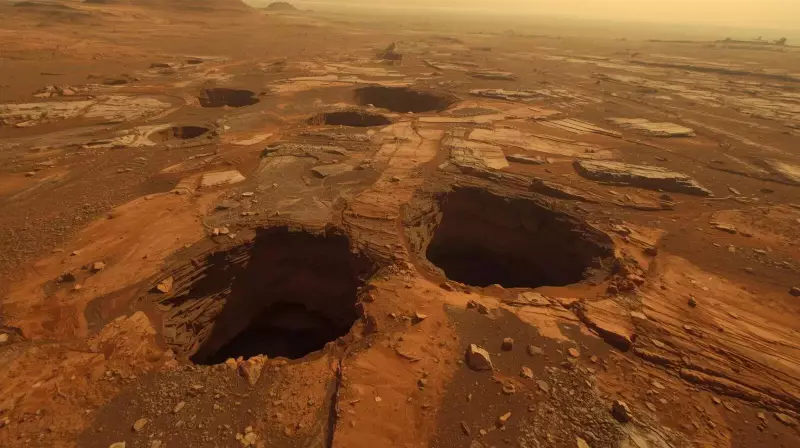
A team of researchers analyzing satellite imagery has pinpointed a small group of eight peculiar features in a remote area of Mars known as Hebrus Valles. Published in the respected journal The Astrophysical Journal Letters, the study details these deep openings. Unlike typical impact craters, these pits lack raised rims or surrounding debris fields. They appear as near-circular holes dropping sharply into darkness, with clean, softened edges.
Scientists describe them as skylights—formations created when the roof of an underground cavity collapses, revealing the void below. While skylights linked to volcanic lava tubes are known on Mars, these newly found ones exhibit different characteristics, suggesting a different origin story.

A Water-Carved Landscape?
The key to the mystery lies in the surrounding terrain. Orbital instrument data detected the presence of minerals like carbonates and sulphates near these pits. On Earth, such minerals commonly form in the presence of water. Landscapes rich in these materials often undergo a process called chemical erosion, leading to karst terrain.
Karst terrain features caves, sinkholes, and underground channels carved by water slowly dissolving rock. The cautious but significant suggestion from researchers is that these Martian caves were shaped by water, not volcanic activity. If confirmed, this would be the first clear identification of such a landscape on Mars.
Ancient Shelters for Life?
The region of Hebrus Valles is ancient, with erosion patterns dating back billions of years to a time when Mars was much wetter. If subsurface water flowed, even intermittently, it could have slowly sculpted these spaces. The collapses that created the visible skylights likely happened much later.
This discovery matters profoundly in the quest for life. The Martian surface is hostile, bombarded by radiation and subject to extreme temperature swings. Underground caves offer a stark contrast: they provide shelter, block harmful radiation, and stabilize temperatures.
On Earth, similar environments support microbial life in the most unexpected places. If life ever arose on Mars, these caves could have served as a refuge as surface conditions deteriorated. More importantly, they might preserve chemical or even biological traces long erased from the exposed surface.
The Path Forward: Possibility Over Promise
It is crucial to note that no direct evidence of life has been found; the idea remains speculative. However, these caves check several boxes scientists look for: association with water-related minerals, a protected environment, and long-term stability. This makes them high-priority targets for future exploration.
Currently, the caves are only observed from orbit. Reaching them poses a major technological challenge, as current rovers cannot descend into steep pits. Future missions would require precise targeting and new engineering solutions. Nevertheless, this discovery helps focus the search, shifting attention from endless plains to specific locations where ancient conditions may have been just right.
The caves themselves do not promise life. Instead, they represent a compelling possibility. On a quiet world like Mars, that possibility carries immense weight, guiding the next chapter of interplanetary exploration.