UGC's New Anti-Discrimination Rules: Can They Truly Address Caste Bias on Campus?
The University Grants Commission (UGC) recently notified the Promotion of Equity in Higher Education Institutions Regulations, 2026, describing this move as an attempt to eradicate discrimination and institutionalize inclusion across Indian campuses. These regulations mandate anti-discrimination committees and formal complaint mechanisms in universities, coming after years of criticism that higher education institutions had failed to respond meaningfully to caste-based bias.
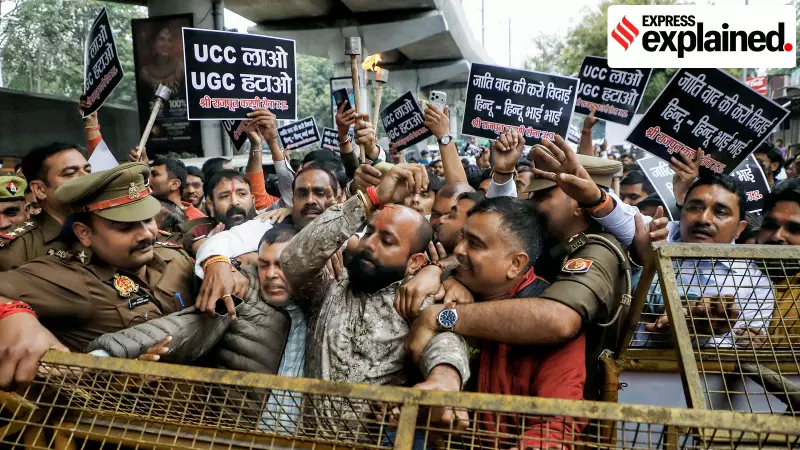
This development occurs in the long shadow of two tragic deaths that reshaped the debate on caste and higher education: Rohith Vemula at Hyderabad Central University in 2016 and Payal Tadvi at a Mumbai medical college in 2019. Since their announcement, the rules have triggered sharp political reactions, with student unions splitting, BJP office-bearers in Uttar Pradesh resigning in protest, and fears of misuse dominating public discourse.
Understanding Campus Discrimination: Beyond Visible Acts
Official regulations and inquiry reports have historically focused on visible acts of discrimination like harassment, ragging, verbal abuse, or hostile behavior by teachers and peers. However, many scholars argue that caste operates far more subtly on campuses.

Latika Gupta, Assistant Professor in the Department of Education at Delhi University, locates the problem in the schooling divide students bring into higher education. Upper-class students usually perform better because their command over written and spoken English is stronger. They come from private schools, while a large number of students in reserved categories come from government and state schools. Their language, articulation and thinking ability are slightly weaker. Over time, this gap is misread as caste, she explained.
Gupta emphasized that performance is related to caste, calling these the largest structural issues that reproduce caste inequality in university spaces. Ragging, harassment, name-calling — that is a very small part of it. The system reproduces inequality much more deeply, she added, arguing that discrimination is rarely only about abuse.
Addressing Behavior Versus Systemic Change
The UGC regulations focus primarily on grievance redressal: identifying discriminatory conduct and disciplining individuals. Many argue this treats caste as a behavioral problem rather than an institutional one.
Gupta calls this the central flaw. Equity cannot be achieved through general guidelines. You cannot achieve equity by treating it as only a behavioral issue. The system is not geared to teach advanced knowledge to students from deprived backgrounds, she stated.
Satish Deshpande, a former Professor of Sociology at the Delhi School of Economics, University of Delhi, agrees that discrimination is deeply embedded but sees value in even naming it. The worst form of oppression is when you are not even allowed to say you are oppressed. For a long time, discrimination was suppressed and could not even be acknowledged. This law makes it difficult to pretend that it does not exist, he observed.
Furqan Qamar, former Vice-Chancellor of the University of Rajasthan and the Central University of Himachal Pradesh, emphasizes that the problem is not only structural but also social. The eruption of protest has brought to surface the deep distrust and sense of insecurity between and among various social groups. No one can deny the urgency of promoting social harmony. But we must win the trust of all stakeholders to assure that there would be justice to all, he added.
Will New Committees Work When Older Ones Failed?
Universities already have multiple committees — anti-ragging cells, grievance redressal bodies, sexual harassment committees — many of which have been criticized as ineffective or symbolic.
Committee on equity may be proposed for the first time, but universities already have many committees. Most have been largely ineffective. I am more concerned about the efficacy of these new regulations, Qamar expressed.

Gupta points to deeper institutional apathy behind this failure. When we know that many ST students come from deprived families, why are their scholarships not disbursed on time? If the system itself is not sensitive, then there cannot be any equity in the system, she questioned.
Deshpande accepts that committees cannot transform institutions overnight. There will be endless problems with implementation, no doubt. But laws describe an ideal. They create a horizon to work toward, he acknowledged.
Does Grouping Categories Dilute Caste Discrimination?
One of the most contested aspects of the regulations is their decision to place SC, ST, OBC, EWS, and persons with disabilities under a single equity framework.
Gupta calls this a serious conceptual error. Equating physical disability with caste and equating poverty-based challenges with caste is sociologically and politically flawed. The challenges that poverty brings are very different from the permanent declaration of your social potential because of caste, she argued.
She warned that this dilutes caste itself. It is not only dilution. It is a gross violation of the legal sensitivity we have developed to protect people from caste discrimination, Gupta emphasized.
Meanwhile, Deshpande called this approach pragmatic and said, In the legal sense, you have to include everybody who can possibly suffer from discrimination. The real question is what will happen in practice.
Concerns About Misuse and Selective Application
Much of the backlash has focused on fears of misuse and selective targeting. Qamar echoes these concerns. University administrations have become rather repressive in their approach to student and faculty grievances. This regulation too could potentially be misused or selectively applied, he cautioned.
Deshpande sees this fear as structurally predictable. Whenever a law is brought for a weaker section, the first cry is misuse. This happened with the Atrocities Act, with reservation, with every empowering law, he noted.
He argued that backlash often reflects threatened privilege. What was earlier accepted and normalized is now being made unacceptable. Much of the protest is about entitlement being violated, Deshpande added.
Will These Rules Actually Reduce Caste Discrimination?
For Gupta, the answer remains bleak. I don't find any benefit in this. It dilutes the whole issue. There cannot be an injection-like solution. Caste is constitutive. It shapes identity very early in life, she stated.
She argues universities need deep curricular reform, academic support systems, and institutional sensitivity, not only grievance committees. Qamar, too, is cautious. The regulations are fine, but they may remain on paper or become a mere formality. Any system is only as good as the people who are at the helm, he remarked.
For Deshpande, however, the regulations represent a necessary beginning. Any form of discrimination ends only when there is resistance, not because of some law. But laws are important as a symbolic thing, he concluded.
The debate continues as India's higher education institutions grapple with implementing these new regulations while addressing the deep-rooted structural inequalities that have persisted for generations on university campuses across the country.