Uttar Pradesh Minister Advocates for Entrepreneurial Revolution at National Startup Conclave
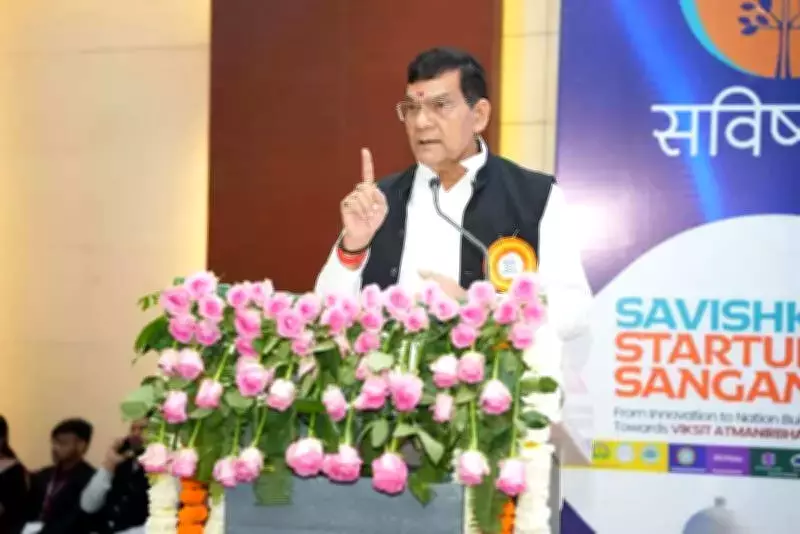
Uttar Pradesh Energy Minister AK Sharma has issued a compelling call for Indian society to transcend conventional career pressures and actively champion the entrepreneurial ambitions of the nation's young innovators. The minister delivered this powerful message during his address at the two-day national conclave, 'Savishkar Startup Sangam 2026', which kicked off on Saturday at Dr. A.P.J. Abdul Kalam Technical University (AKTU) in Lucknow.
Challenging the Status Quo: From Job Seekers to Job Creators
Minister Sharma posed a critical question to the audience, highlighting a significant national paradox. "Today's youth are leading global giants like Google, Microsoft, and Adobe," he stated. "But the pressing question remains: why have we not built our own Google in India?" He attributed this gap largely to deep-rooted societal preferences that steer young talent away from entrepreneurial ventures.
"There is an ingrained tendency where parents push their children exclusively towards government jobs, the Indian Administrative Service (IAS), engineering, or medicine," Sharma explained. He argued that for India to realize its ambition of becoming a developed nation by 2047, a fundamental cultural shift is imperative. "To achieve this vision, we must collectively support and nurture the entrepreneurial dreams of our youth," the minister asserted.

Sharma emphasized that India's potential to cultivate its own global technology leaders hinges on creating an environment where young people are encouraged to experiment, innovate, and embrace calculated risks without the fear of failure.
Conclave Fosters Collaboration Across Innovation Ecosystem
The Savishkar Startup Sangam 2026 served as a dynamic platform, uniting a diverse array of stakeholders from the innovation landscape. The event brought together budding innovators, seasoned industry leaders, and subject matter experts from prominent organizations including Meta, Edubuck, Voxora Labs, Physics Wallah, and the IIM-Lucknow Incubation Centre.
Across nine intensive technical sessions, participants engaged in deep discussions on the future of entrepreneurship. The inaugural day featured focused sessions on critical topics such as startup mentoring, women's leadership in business, the transformative role of Artificial Intelligence (AI), and the applications of blockchain technology.
Adding a unique cultural dimension to the conclave, programmes like 'Bhajan Clubbing' and 'Open Mike' sessions infused vibrancy and creative energy into the gathering, blending traditional inspiration with modern entrepreneurial spirit.
Historical Context and a Call for Purpose-Driven Innovation
Abhay Pratap Singh, National Secretary of the Akhil Bharatiya Vidyarthi Parishad (ABVP), who attended as a special guest, provided a historical perspective on India's entrepreneurial legacy. "The concept of startups is not a novel phenomenon for India," Singh remarked. "From the first to the 11th century, India was an economic powerhouse, contributing over 30 percent to the global GDP. Our inherent strength lies in innovation and commerce."
He called for a reorientation of educational outcomes, stating that "our academic campuses must evolve to produce proactive problem solvers, not merely passive degree holders." Singh elaborated that the most viable startup ideas often emerge from identifying and addressing critical gaps within society.
"True innovation must extend beyond mere business profitability," he concluded. "It should integrate principles of sustainability and contribute meaningfully to societal welfare, ensuring long-term impact and resilience."
The conclave stands as a significant step in fostering a national dialogue, aligning with Minister Sharma's vision to dismantle traditional career barriers and empower a new generation of Indian entrepreneurs to build globally competitive enterprises from the ground up.