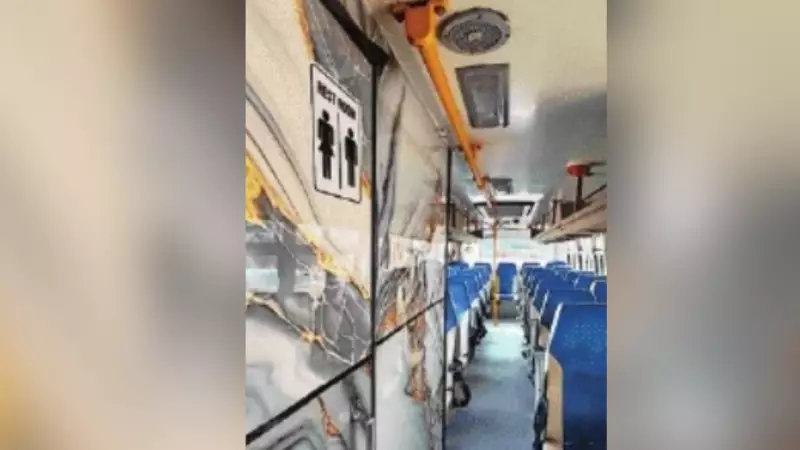
In a novel response to Bengaluru's infamous traffic congestion, a prominent city school has taken a unique step to safeguard student comfort during long commutes. Indus International School in Sarjapur has become a pioneer by installing biotoilets on two of its school buses that ply the longest routes.
A Solution Born from Traffic Snarls
The school's decision directly addresses the grueling reality faced by students traveling to areas like Rajajinagar and Yeshwantpur. These journeys often stretch beyond two hours each way due to the city's relentless traffic. The extended time on the road, without access to basic facilities, was causing significant distress.
Vinoth Kumar, the Director of Administration at Indus International School, explained the rationale. He highlighted that many students spend prolonged periods on the bus, where the absence of toilets can lead to discomfort, anxiety, and potential health issues, especially for younger children. The installation of biotoilets aims to provide a safe, hygienic, and dignified solution, allowing students to meet their basic needs without stress.

The Implementation and Cost
The school collaborated with its transport provider, Padikkal Travels, to bring this idea to life. Manoj Padikkal, CEO of Padikkal Travels, noted that this initiative could be a first for a school bus in the region. When the school approached them with the problem of children suffering during long road journeys, they contacted an agency in Chennai to facilitate the installation.
The biotoilet system employs a decomposition mechanism that uses high-grade bacteria to break down waste. The school invested approximately Rs 5 lakh per bus for this new facility, underscoring its commitment to student welfare over cost.
Positive Reception and Future Plans
The initiative has reportedly received a positive response from parents, who appreciate the school's proactive approach to a practical daily challenge. With a fleet of 37 buses, the school administration has indicated that if this pilot project on the two longest routes proves successful, they hope to extend the facility to other buses operating on lengthy commutes.
This move by Indus International School sets a new benchmark for student transportation, transforming buses from mere vehicles into more considerate mobile spaces. It acknowledges the real-world impact of urban infrastructure problems on children's daily lives and takes a concrete step to mitigate it, potentially inspiring other institutions in traffic-plagued cities across India.