

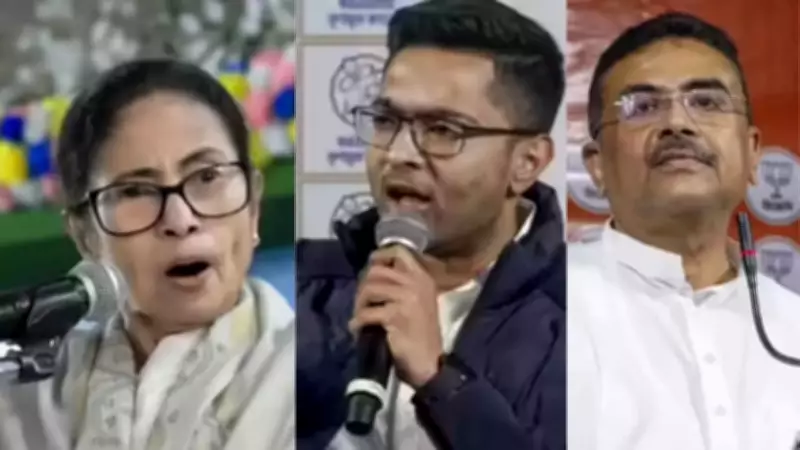
Mamata Banerjee's Political Balancing Act in West Bengal
West Bengal Chief Minister Mamata Banerjee occupies a distinctive political position, simultaneously leading the state government while serving as its most vocal opposition figure. This dual role has become particularly pronounced amid growing tensions over Bengali-speaking migrants, concerns about the Election Commission's Special Intensive Revision (SIR) exercise, and reductions in central funding allocations.
The Street Fighter Returns to Her Roots
Banerjee has instinctively reverted to her combative street-fighter persona, a strategic move that has helped counter the natural anti-incumbency sentiment that typically affects governments after more than a decade in power. She has taken her political battles to multiple fronts—from Bengal's local streets to New Delhi's corridors of power and even the Supreme Court. This confrontational approach resonates across party lines, reinforcing her image as a leader who thrives in political confrontation.
The 2026 Assembly Election Challenge
The road to the 2026 Bengal Assembly election presents fresh challenges for the veteran politician. The SIR exercise is fundamentally reshaping the state's political landscape, unsettling demographic balances particularly in minority-dominated regions where a significant portion of the nearly 60 lakh cases under judicial scrutiny involve Muslim citizens.

Migrant workers and economically vulnerable groups—traditionally among Banerjee's strongest supporters—have found themselves caught in the crosshairs of these administrative changes. Yet this shifting political terrain has also opened new opportunities. Urban Bengali bhadralok voters, once skeptical of Banerjee's leadership, now share frustrations over SIR's disruptions to established systems.
Changing Political Alliances and Strategies
Meanwhile, key communities like Matuas and Rajbangshis—whose support helped elevate the BJP as Bengal's principal opposition—are showing signs of political unease. Sensing this moment of transition, Banerjee has transformed the SIR issue into a broader narrative about Bengali identity and regional dignity.
Despite having access to a formidable party organization and the strategic machinery of I-PAC, which could have allowed her to fight the election from a distance, Banerjee has instead returned to the streets where she has historically been most effective. For the Chief Minister, the stakes extend far beyond Bengal's borders, with the 2026 verdict expected to have national implications reaching all the way to Delhi.
Abhishek Banerjee: The Rising Strategist
Abhishek Banerjee's ascent within the Trinamool Congress has transcended questions of political lineage. Over recent years, he has emerged as one of the party's most influential organizers and strategists, earning the moniker "Senapati Abhishek" among party workers—a reflection of his growing stature as the Chief Minister's most trusted lieutenant.
Organizational Transformation
At 38 years old, Trinamool's National General Secretary has steadily consolidated his position as the party's second-in-command while shaping its organizational and political strategy. The generational shift within the party became unmistakable when Mamata replaced veteran MP Sudip Bandyopadhyay with Abhishek as the Trinamool's Lok Sabha leader six months ago.
Since assuming the role of general secretary in June 2021, Abhishek has pushed the party toward a more structured, data-driven, and technologically agile framework. Party insiders reveal he relies heavily on digital feedback systems, analytics, and a young backroom team to track welfare delivery and district-level performance, reducing dependence on traditional organizational hierarchies.
Innovative Political Outreach
His 60-day Nabajowar campaign before the 2024 general elections signaled a new style of political outreach aimed at reconnecting leadership with grassroots workers while promoting accountability within the party structure. His Diamond Harbour constituency has become a showcase of what colleagues call the "Diamond Harbour model," centered around initiatives such as the Sebashray programme featuring free health camps and social outreach activities.

As Trinamool prepares for the upcoming election, Abhishek is no longer merely the heir apparent but has become the key contributor to the party's evolving political playbook.
Suvendu Adhikari: From Ally to Adversary
Few leaders in Bengal politics embody the dramatic arc from power to opposition as vividly as Suvendu Adhikari. His career has mirrored the shifting tides of the state's political landscape, transitioning from grassroots agitator to cabinet minister and now serving as Bengal's Leader of Opposition.
Political Legacy and Breakthrough
The Adhikari family has long dominated the political belt stretching from Kolaghat along the Rupnarayan River to Ramgarh—a stronghold they have nurtured for more than four decades. During the Left Front era, patriarch Sisir Adhikari symbolized opposition in East Midnapore and later became a founding member of Trinamool Congress. However, it was Suvendu who translated that resistance into a formidable ground movement.
His political breakthrough came with the 2007 Nandigram anti-land acquisition movement, widely credited with reshaping Bengal's politics and paving the way for Trinamool's rise to power. Soon after, Adhikari won the Kanthi Dakshin Assembly seat in 2006 and later moved to Parliament as MP from Tamluk.
Defection and Political Rebirth
Under Mamata's government, he rose to become a powerful cabinet minister and key organizer behind Trinamool's electoral success in regions such as Jangal Mahal and East Midnapore. However, in December 2020, Adhikari defected to the BJP, marking the beginning of his second innings in opposition politics.
His narrow victory over Mamata in the high-stakes Nandigram contest in 2021 cemented his stature as BJP's most prominent mass leader in Bengal. Adhikari's combative political style—combined with his ability to unify BJP's diverse factions—may prove crucial in shaping the party's electoral fortunes in the upcoming state elections.





