Georgia Students to Stage Walkouts in Protest Against Immigration Enforcement Operations
In Georgia, the traditional school day is being transformed into a platform for political expression as thousands of students across the state prepare to walk out of classes this Friday. The coordinated action represents a protest against Immigration and Customs Enforcement (ICE) operations and forms part of a broader, deliberately disruptive initiative branded the "National Shutdown." According to reports from USA Today, this movement aims to challenge routine American life by encouraging widespread withdrawal from educational, professional, and commercial activities.
The National Shutdown: A Day of Deliberate Refusal
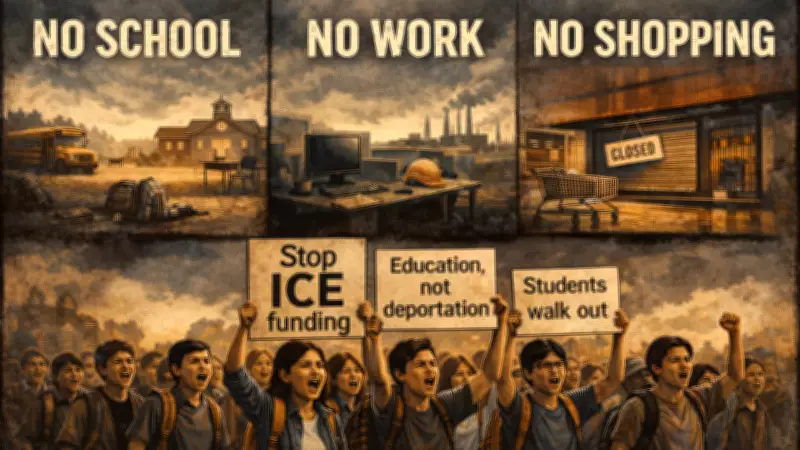
The premise of the National Shutdown is both unambiguous and intentionally theatrical—a complete day of refusal where participants are urged to abstain from school, work, and shopping. The objective extends beyond mere demonstration of displeasure; it seeks to disrupt the very fabric of daily routine, if only temporarily, by encouraging people to withhold their attendance, labor, and consumer spending. This protest strategy is designed to permeate ordinary channels of American life, from classroom roll calls and shift schedules to grocery receipts.
Organizers have crafted messaging built for circulation, framing their appeal as both an act of solidarity and a warning. ICE is positioned not as a neutral enforcement agency but as a force that should be denied public legitimacy and funding. The language emphasizes moral responsibility and collective action against policies perceived as coercive.

School Districts Respond with Procedural Clarity
In metro Atlanta and surrounding areas, school districts are responding with bureaucratic precision as they perceive their institutional boundaries being tested. While acknowledging students' right to hold political views, district communications have emphasized procedural consequences for abandoning instructional time. According to USA Today, these communications explicitly warn of disciplinary action for students who leave class or campus during school hours.
This administrative response follows familiar patterns—acknowledging rights while reasserting rules and enumerating consequences—all delivered in tones attempting to maintain calm while preparing for potentially disruptive events beyond full control. The schools' messaging carefully separates political expression from procedural compliance, creating clear boundaries around acceptable protest behavior.
Scale and Coordination of the Protest Movement
The protest transitions from symbolic action to governance event through its substantial scale. According to participation lists maintained by the Party for Socialism and Liberation (PSL) Atlanta chapter, more than 100 schools across Georgia are expected to participate in Friday's walkouts. Rather than a single synchronized mass exit, organizers have planned a day of staggered departures scheduled at different times—sometimes by specific clock times, sometimes according to school timetable logic.
USA Today notes that Stephenson High School in DeKalb County is listed for one of the earliest planned walkouts at 9:30 a.m., while other locations have looser instructions suggesting departures after third period or during transition points when corridors are already filled with moving students. This strategic timing maximizes visibility while accommodating different school schedules.
High Schools as Primary Venues with College Participation
The walkouts are primarily planned for high schools, where the drama of student protest has historically been most visible. The act of teenagers voluntarily stepping out of institutions designed to contain them transforms mandatory attendance into conscious choice, creating powerful symbolic statements. However, the protest scope extends beyond secondary education.
According to USA Today, the PSL list indicates several colleges are expected to join the action, including Agnes Scott College, Emory University, Georgia State University's Atlanta campus, Georgia State University's Armstrong campus, and the University of Georgia. This adds an older, more politically experienced layer to the day's choreography, potentially increasing the protest's sophistication and media attention.

Clashing Visions of Institutional Order and Protection
This episode represents more than a youth-led flashpoint; it embodies a collision between two competing visions of institutional order, each convinced of its adult responsibility. Students frame the walkout as a moral response to state power they experience as coercive, arguing that when government machinery feels violent, withdrawal becomes necessary testimony. School districts, meanwhile, treat discipline as safety protocol rather than political referendum—a mechanism to maintain campus order, accountability, and insurability.
Both sides employ language of protection but with fundamentally different meanings: protecting communities from perceived harm versus protecting schools from operational breach; protecting speech rights versus protecting learning environments. Thus, the argument extends beyond ICE specifically to address what schools become when politics arrives not as abstract civics debate but as practical instruction—standing up, stepping out, and transforming attendance into dissent.
The Friday walkouts will test how educational institutions balance their dual roles as centers of learning and microcosms of democratic society, while students explore the boundaries of permissible protest within structured environments designed for their containment and development.