Maharashtra Government Reveals Widespread Irregularities in Shalarth ID Scam
The Maharashtra government delivered a shocking revelation to the Nagpur bench of the Bombay High Court on Tuesday, stating that more than 99% of appointments linked to the alleged Shalarth ID scam are now under suspicion. This disclosure came during a hearing concerning the stalled salaries of hundreds of teachers across the state.
Only Five Valid Records Found Among Hundreds
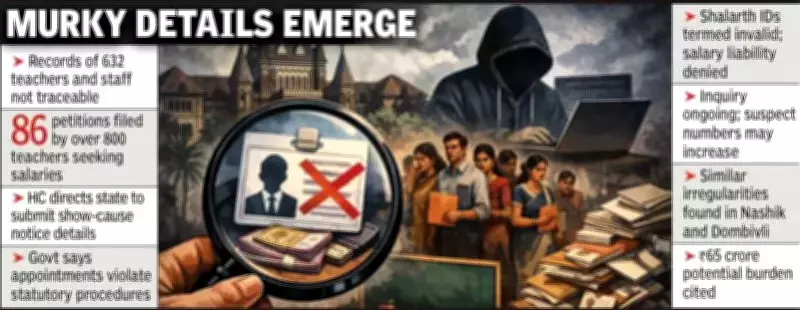
In a detailed affidavit submitted to the court, the government presented alarming findings from its ongoing investigation. Only five teachers' valid appointment records have been confirmed, while documents for 632 teachers and non-teaching staff remain completely untraceable. This represents a staggering failure in the appointment verification process that has left hundreds of educators in financial limbo.
The affidavit was filed by the Deputy Director of Education through senior counsel and government pleader Deven Chauhan, with assistance from additional government pleader Sangita Jachak. Their submission raised serious questions about the legitimacy of these appointments, suggesting systemic failures in the hiring process for government-aided schools.

Court Proceedings and Judicial Response
The matter was heard by a division bench comprising Justices Mukulika Jawalkar and Nandesh Deshpande. The bench is currently dealing with approximately 84 petitions filed by more than 800 teachers who are seeking the release of their stalled salaries. These educators have been caught in a bureaucratic and legal quagmire that has left them without compensation for their work.
After hearing the government's submissions, the court adjourned the matter to April 2 and issued a crucial directive. The bench ordered the state government to submit a detailed chart of show-cause notices issued to individuals allegedly linked to the Shalarth ID irregularities. This documentation will help establish the scope of the investigation and identify those potentially responsible for the fraudulent appointments.
Government's Legal Position on Salary Payments
The government maintained a firm stance in its affidavit, arguing that the appointments under investigation were not made in accordance with prescribed statutory procedures. According to the submission, mandatory requirements under service rules and government resolutions were systematically bypassed, rendering the appointments legally questionable.
"Since the appointments are not legally established, government has no authority to disburse salary," the affidavit stated unequivocally. This position has created a significant impasse, with teachers caught between their need for income and the government's insistence on proper legal procedures.
The government further submitted that Shalarth IDs generated based on such irregular appointments are fundamentally "invalid" and cannot be used as a basis for salary disbursement through the state's payment system.
Details of the Investigation Findings
Detailing the findings of the ongoing inquiry, the state government revealed that the probe has uncovered large-scale irregularities in the generation of Shalarth IDs. These irregularities include approvals issued without official sanctions or proper documentation, creating a parallel system that operated outside established protocols.
The affidavit specifically noted that such IDs were created "without any valid offline orders or approval proposals," often through collusion at institutional levels. This systematic bypassing of established procedures allowed questionable appointments to proceed without proper oversight or verification.
Expanding Scope and Financial Implications
The state government informed the court that the inquiry is ongoing and that the number of suspect appointments could potentially exceed the current count of 632. As the investigation continues to uncover more irregularities, the scale of the problem may grow significantly.

In a significant development, the government clarified that responsibility for payment of salaries in such cases, if any, would lie with the respective school managements rather than the state government. This shifts the financial burden away from the public exchequer and onto individual educational institutions.
Speaking about the broader implications of the case, additional government pleader Sangita Jachak told reporters that similar patterns of irregularities have been detected in other parts of Maharashtra. "A similar scam was noticed at Nashik and Dombivli, and Special Investigation Teams have been constituted to trace the culprits," she revealed, indicating that the problem may be more widespread than initially suspected.
Legal History and Supreme Court Involvement
The current court proceedings follow earlier legal battles that reached the highest judicial levels. The state government previously challenged an interim order from the Nagpur bench, which had directed payment of salaries to approximately 600 teachers, before the Supreme Court of India.
In its argument before the apex court, the state government contended that disbursing salaries during an ongoing probe could impose a financial burden of 65 crore rupees on the exchequer. This substantial amount represents the potential cost of paying questionable salaries while investigations continue.
The delay in implementing the interim order led to the filing of approximately 40 contempt petitions by frustrated teachers seeking enforcement of the court's directive. The Supreme Court has since taken a decisive stance, directing that all related petitions be decided within four months, providing a timeline for resolution of this complex matter.
Origins of the Dispute
The entire dispute originates from approximately 86 writ petitions challenging specific administrative actions. These petitions contest a departmental note dated May 3, 2025, and a joint communication issued on April 29, 2025, by education authorities in Maharashtra.
These documents sought verification of appointment records of teachers linked to the Shalarth system, which is used for salary processing in government-aided schools across the state. What began as a routine verification process has uncovered what appears to be one of the most significant appointment irregularities in recent Maharashtra education history.
The Shalarth ID system, designed to streamline salary processing and ensure transparency, has instead become the center of a major scandal affecting hundreds of educators and potentially costing the state millions of rupees in questionable salary payments.