In a significant move to address persistent absenteeism and dropout rates, the School and Mass Education Department in Odisha has issued a directive requiring school committees to conduct home visits for students missing classes for a week or more.
New Directive to Tackle Absenteeism
The department has instructed district and block-level education officers to ensure that committee members of government and government-aided schools personally visit the homes of pupils who remain absent from school for seven consecutive days or more. The primary aim is to ascertain the exact reasons behind the absenteeism and take corrective measures to reintegrate the child into the education system.
This advisory from the directorate of elementary education was prompted by a recommendation from the Odisha State Commission for Protection of Child Rights (OSCPCR). The commission highlighted the need for this intervention to track and combat three critical issues: the high dropout rate, child marriage, and child labour.

Role of School Committees and Underlying Issues
Every government school has a school committee, a mandatory body under the Right to Education Act, comprising teachers, parents, and local authorities. This committee is responsible for monitoring the school's functioning. According to the new advisory, these committees are now tasked with the specific responsibility of home visits for prolonged absenteeism.
Babita Patra, Chairperson of OSCPCR, stated that financial distress in families often leads to child marriage and child labour, which are primary reasons for students, especially adolescents, dropping out. She noted that while a similar provision existed in Sishu Mandir schools, it was absent in government schools until now. "Based on the information obtained through home visits, necessary intervention can be planned," Patra explained.
The Scale of the Challenge: Alarming Data
The urgency of this measure is underscored by recent reports highlighting Odisha's educational challenges. A Comptroller and Auditor General (CAG) report, tabled in the state assembly in December last year, revealed that Odisha's dropout rate remains persistently high. It pointed out that over 61,000 children were out of school.
The CAG report, analysing data from 2018 to 2023, further stated that while the department identified 1.01 lakh out-of-school children in the 6-18 age group, only 40,120 were readmitted to schools based on their learning levels.
Recent educational statistics paint a concerning picture:
- As per the UDISE+ 2024-25 report, the dropout rate at the secondary level (Classes IX-XII) was 9.8%.
- At the middle level (Classes VI-VIII), it was 3.2%.
- At the preparatory level (Classes III-V), the rate stood at 1.4%.
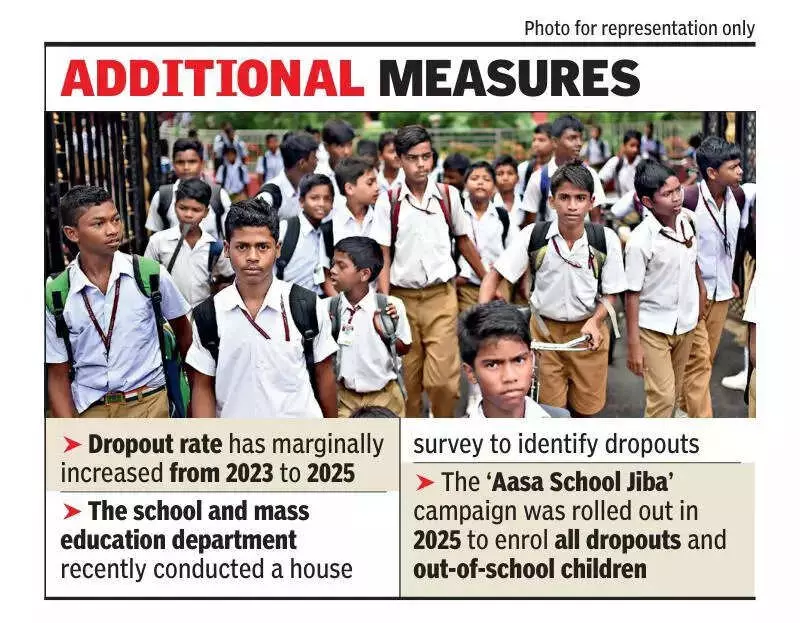
Although these figures showed a marginal improvement from the 2023-24 academic session (9.1%, 2%, and 0.5% respectively), they remain a significant concern. Additionally, the Annual Status of Education Report 2024 found that 6.5% of children in Odisha in the 15-16 years age group were 'not in school', having either never enrolled or dropped out.
The new directive for proactive home visits by school committees represents a ground-level strategy to bridge the gap between identification and rehabilitation of out-of-school children, aiming to tackle the root causes of dropout rates head-on.