Odisha's Special Education Landscape: Enrollment Strength Masks Critical Teacher Deficit
Bhubaneswar: While Odisha maintains substantial enrollment of children with special needs (CwSN) in its schools, education experts are sounding alarms over a severe shortage of adequately trained special educators. Recent parliamentary data reveals both progress and persistent gaps in the state's inclusive education framework.
Institutional Coverage Versus Enrollment Reality
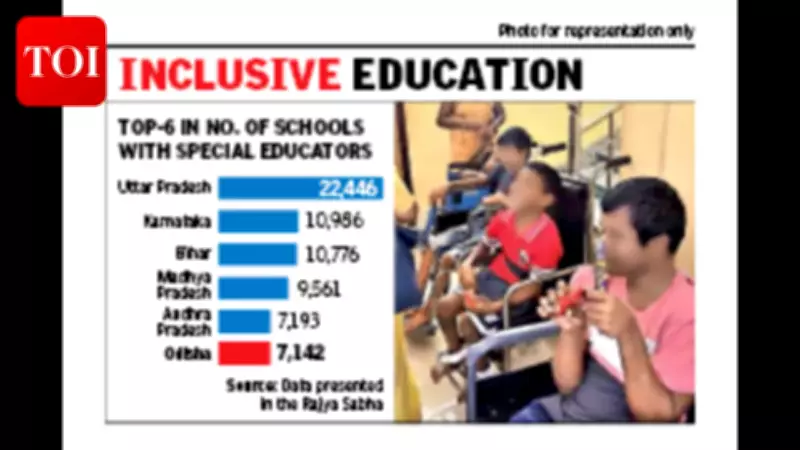
According to information shared by Minister of State for Education Jayant Chaudhary in the Rajya Sabha, Odisha had 7,142 schools with dedicated special educators during the 2024-25 academic year. This places Odisha among India's better-performing states in terms of institutional infrastructure for special education.
However, experts caution that these numbers must be critically examined against actual enrollment figures and statutory requirements. The ministry's Unified District Information System for Education Plus (UDISE+) data shows Odisha enrolled 82,223 children with special needs in 2024-25. While this represents a decline from the peak of 1.46 lakh students in 2021-22, it remains significantly higher than states like Punjab (53,761), Rajasthan (70,200), and Telangana (72,672).

The National Context and Odisha's Position
At the national level, CwSN enrollment reached 21.49 lakh students in 2024-25, with Uttar Pradesh alone accounting for over 3.33 lakh students. While Odisha performs well in enrollment compared to several states, it trails Uttar Pradesh, Karnataka, and Maharashtra in the absolute number of schools equipped with special educators.
Legal Requirements and Ground Realities
Under Right to Education (RTE) norms, schools must provide one special educator for every 10 special children at the primary level and one for every 15 students at upper primary and secondary levels. Educationists calculate that Odisha's current enrollment indicates a need for several thousand additional trained special educators, particularly in rural and tribal districts where access to specialized support remains uneven.
Members of the Odisha Special Educator Federation for Divyang have raised serious concerns, alleging that only a limited number of schools actually have dedicated special educators despite statutory provisions mandating their appointment. According to state government data, the current workforce includes:
- 570 special educators working as block resource persons
- 1,136 in regular schools
- 74 junior teachers with qualifications in special education
All these professionals are registered with the Rehabilitation Council of India.
The Teacher-Student Ratio Crisis
Federation member Rakesh Sahoo emphasized that the existing educator strength falls far short of requirements when student-teacher ratios are properly calculated. "The numbers look promising on paper, but the ground reality reveals a different story," Sahoo noted, highlighting the gap between policy and implementation.
Government Response and Future Plans
A senior official from the school and mass education department disclosed that the government decided approximately two months ago to appoint 4,500 special educators for regular schools over a three-year period. The official confirmed that recruitment advertisements would be issued soon to address the critical shortage.
This planned expansion represents a significant step toward meeting legal requirements, but experts stress that timely implementation and quality training will determine its effectiveness. The disparity between urban and rural access to special education resources remains a particular concern that the new recruitment drive must address.
As Odisha continues to demonstrate strong enrollment of children with special needs, the state now faces the crucial challenge of transforming institutional coverage into meaningful educational support through adequate staffing and resource allocation.