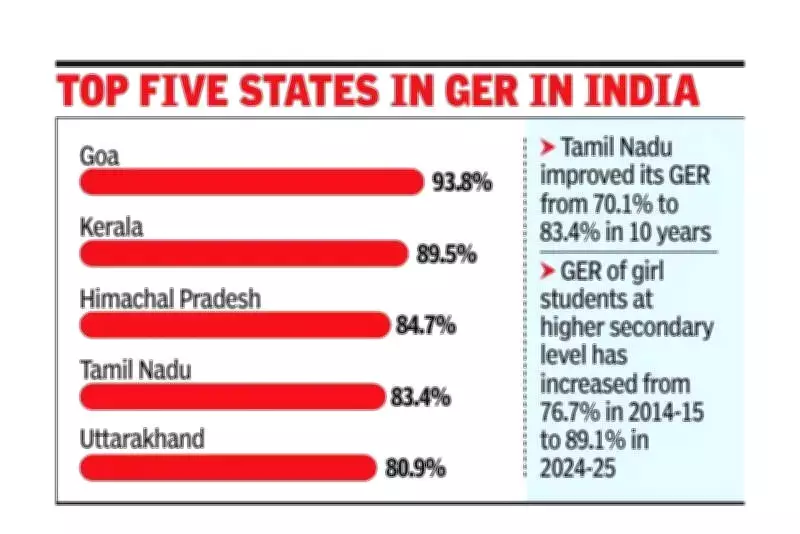
Chennai: Tamil Nadu has secured a position among the top five states in India with a Gross Enrolment Ratio (GER) of 83.4% in higher secondary education, as per a recent Niti Aayog report. The state's performance reflects significant progress in retaining students in the education system beyond the secondary level.
Top Performing States
According to the report, Goa leads the nation with a GER of 93.8%, followed by Kerala at 89.5% and Himachal Pradesh at 84.7%. Uttarakhand closely trails Tamil Nadu with a GER of 80.9%. The data, sourced from the Unified District Information System for Education Plus (UDISE+), highlights the variations in enrolment across states.
Improvement Over the Years
Niti Aayog noted that Tamil Nadu improved its GER in higher secondary schools by 13.1% between 2014 and 2025. The enrolment ratio among girl students rose from 76.7% during this period, indicating a positive trend in female education. Educationists attribute this growth to several factors, including an increase in the number of higher secondary schools, welfare schemes such as free laptops, targeted admission campaigns for dropouts, and incentives for continuing education.

Aruna Rathnam, a former education specialist at Unicef, emphasized that women empowerment and various initiatives by successive state governments have contributed to the rising GER. She stated, "Enabling those who could not clear the board exams to sit for supplementary exams has kept many students in the formal school education system." This policy has been instrumental in reducing dropout rates.
Shift in Preferences
The preference for degree programmes has also played a role. Sami Sathyamurthy, a retired headmaster, explained, "In the past decade, polytechnic colleges and ITIs have lost their sheen, and more students joined colleges to get degrees in arts and science and engineering colleges." This shift has driven higher enrolment in higher secondary schools as a pathway to undergraduate studies.
Infrastructure Gaps
Despite the progress, the state faces challenges in infrastructure. The Niti Aayog report highlighted that Tamil Nadu lacks functional boys' toilets in 9% of schools and functional girls' toilets in 5.5% of schools. Additionally, only half of the schools have functional toilets for children with special needs. Regarding digital infrastructure, 7.4% of schools lack computer facilities, and 15.1% lack internet connectivity. In comparison, Andhra Pradesh has provided internet facilities to 99% of its schools, and Kerala to 91.7%. Tamil Nadu currently has 60.8% functional smart classrooms.
These gaps underscore the need for continued investment in school infrastructure to ensure equitable access to quality education.