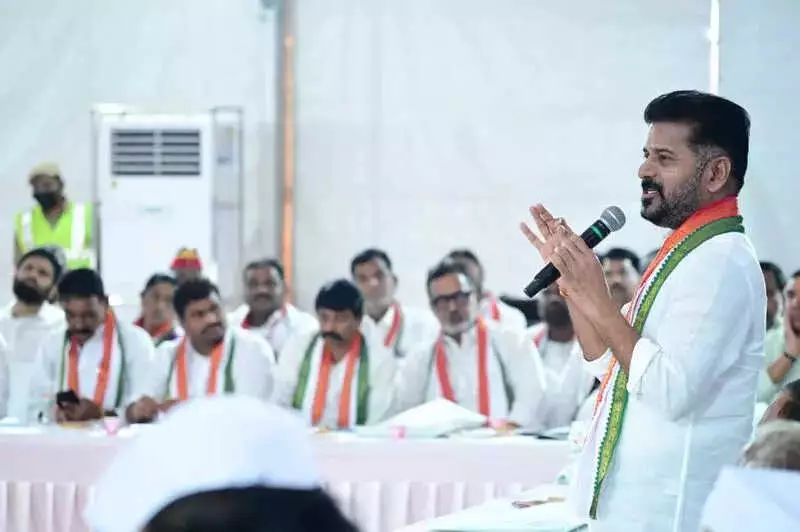
In a significant push to overhaul the education landscape in Telangana, Chief Minister A. Revanth Reddy has issued a series of directives aimed at accelerating the establishment of quality residential schools and implementing comprehensive student welfare schemes. The CM conducted a review of the education department at the secretariat on Thursday, laying out an ambitious and time-bound roadmap.
Priority for Girls' Education and Three-Year Deadline
Chief Minister Revanth Reddy instructed officials to give top priority to establishing more integrated residential schools for girls during the initial phase of the Young India Integrated Residential Schools (YIIRS) programme. This move underscores the state government's dedicated focus on enhancing access to quality education for young women. He set a clear deadline, demanding that the construction of YIIRS for both boys and girls must be finalized in every assembly constituency across Telangana within the next three years.
To ensure equitable development, the CM proposed a phased approach: constituencies that receive girls' schools in the first phase should subsequently focus on constructing boys' schools in the next phase, and vice-versa. Each of these landmark residential schools is being developed on a sprawling 25-acre campus at a cost of approximately ₹200 crore. These institutions are designed to be truly inclusive, bringing together students from Scheduled Caste (SC), Scheduled Tribe (ST), Backward Class (BC), and minority communities on a single, unified campus.

Student Welfare: From Solar Kitchens to Statewide Meals
Beyond infrastructure, the review meeting delved deep into student welfare and sustainable operations. The Chief Minister asked officials to explore the feasibility of setting up solar-powered kitchens in YIIRS under the central government's PM KUSUM scheme, aiming to reduce operational costs and promote green energy.
In a major announcement that could benefit lakhs of students, Revanth Reddy directed the education department to examine the possibility of extending the breakfast and lunch scheme—currently piloted in government schools in Kodangal with help from voluntary organisations—to the entire state. Representatives from the Akshaya Patra Foundation, who were present, informed the CM that the programme could be scaled up statewide if adequate infrastructure and support were provided. Responding to this, the CM asked officials to plan for one centralised kitchen for every two constituencies to ensure efficient delivery.
Curriculum Revamp and Higher Education Push
The CM also addressed immediate academic and infrastructural gaps. He expressed concern over the limited half-acre land parcel earmarked for a school in Bachupally and directed authorities to allocate at least one-and-a-half acres of land nearby. Furthermore, he ordered an immediate revision of the syllabus from classes I to X to align it with contemporary and future needs, ensuring students are prepared for the challenges ahead.
On the higher education front, Revanth Reddy instructed officials to expedite work on the Veeranari Chakali Ilamma Women's University. He also emphasized the swift implementation of the agreement with Tata Technologies to introduce new courses and upgrade infrastructure in polytechnic colleges across the state. The CM stressed that the curriculum at polytechnics and the Young India Skills University must guarantee employment opportunities for every graduating student.
In a meeting with Himachal Pradesh Education Minister Rohit Kumar, CM Reddy revealed that Telangana is drafting its own 'Telangana Education Policy' inspired by the National Education Policy. This policy is being formulated by a committee of education experts. He also outlined broader plans to strengthen government schools to rival private institutions, provide pre-primary education and transport in rural areas, upgrade Industrial Training Institutes (ITIs), and set up Advanced Training Centres (ATCs) in every constituency.