UPSC Mains Answer Practice GS 1: Polar Vortex and Chola Empire | Week 139
Are you gearing up for the Civil Services Exam 2026? This week's GS Paper 1 answer-writing practice offers essential fodder for your preparation, focusing on two critical topics: the Polar Vortex and the Chola Empire. Dive into these questions to enhance your understanding and refine your answer-writing skills. Do not miss the points to ponder and share your answers in the comment section below.
Written by: Nitendra Pal Singh
New Delhi, Jan 31, 2026 04:11 PM IST

If you are preparing for the Civil Services Exam 2026, attempt a question on the polar vortex in today's answer writing practice. This initiative by UPSC Essentials is designed to help you practice Mains answer writing, covering both static and dynamic parts of the UPSC Civil Services syllabus across various GS papers. It serves as a valuable addition to your UPSC CSE Mains preparation. Test your progress by tackling today's questions related to GS-1 topics.
QUESTION 1: What is the Polar Vortex? Explain its structure and functioning. How does its southward displacement lead to extreme winter events in the mid-latitudes, particularly in North America and Eurasia?
Relevance: This question is crucial for understanding global atmospheric circulation, stratosphere–troposphere interaction, and jet stream dynamics, which are core areas of physical geography. It also sheds light on the increasing frequency of extreme weather events, such as cold waves and blizzards, in the context of climate change and Arctic amplification. This topic is directly relevant for disaster geography and climate variability, especially in explaining mid-latitude weather anomalies.
Note: This is not a model UPSC answer. It only provides you with a thought process to incorporate into your answers.
Introduction:
- The polar vortex is a large area of low-pressure and cold air that swirls like a wheel around both of the Earth's polar regions. There are two types: tropospheric and stratospheric.
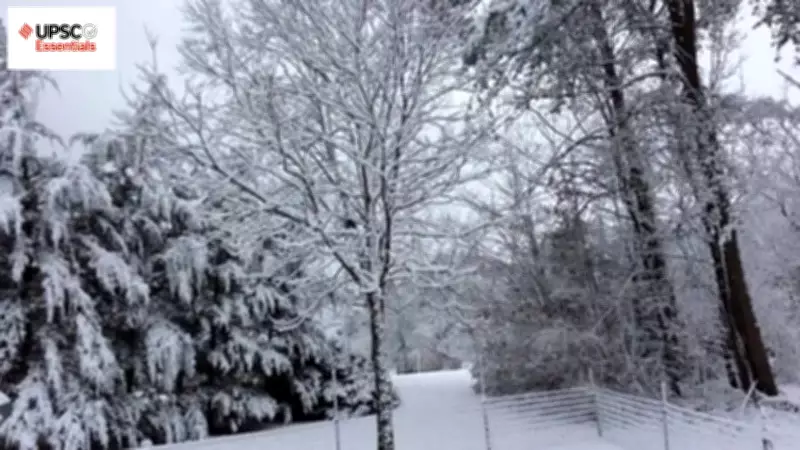
- Recently, a powerful winter storm triggered heavy snow, sleet, and freezing rain from the Ohio Valley and mid-South to New England in the United States, highlighting the impact of polar vortex disruptions.
Body: You may incorporate some of the following points in your answer:
- Structure and functioning of the polar vortex:
- The tropospheric polar vortex occurs at the lowest layer of the atmosphere, extending from the surface up to about 10 km to 15 km, where most weather phenomena occur.
- The stratospheric polar vortex occurs at around 15 km to 50 km high. Unlike the tropospheric version, it disappears during summer and is strongest during autumn.
- When does the polar vortex cause extreme cold?
- The US, parts of Europe, and Asia experience chilly winds when the polar vortex at the North Pole weakens and travels from its usual position. As this system weakens, cold, arctic air can break off and migrate south, bringing arctic weather to areas as far south as Florida, according to NOAA SciJinks.
- When the polar vortex is strong and stable, it keeps the jet stream travelling in a circular path around the planet. The jet stream, a narrow band of strong wind in the upper atmosphere, plays a key role in keeping cold air north and warm air south.
- Without a strong low-pressure system, the jet stream loses force, becoming wavy and rambling. When high-pressure systems obstruct it, a collection of cold air pushes south along with the polar vortex system.
Conclusion:
- Scientists are still researching the precise impact of climate change on the polar vortex and whether rising temperatures are making the low-pressure system buckle more frequently.
- Some researchers believe that as the poles warm faster than the rest of the Earth, the polar vortex and jet stream weaken. Warmer temperatures make it easier for these systems to get disrupted.
Source: Polar vortex: What's behind the lethal winter storm in the United States?
Points to Ponder:

- Read more about the polar vortex and jet streams.
- Related Previous Year Questions:
- What is the concept of a 'demographic winter'? Is the world moving towards such a situation? Elaborate. (2024)
- What is a twister? Why are the majority of twisters observed in areas around the Gulf of Mexico? (2024)
QUESTION 2: Discuss the concept of the 'Chola Empire' as a framework to understand India's historical maritime outreach in Southeast Asia.
Relevance: This question highlights India's maritime traditions, naval power, overseas trade, and cultural diplomacy, moving beyond land-centric history. It demonstrates the peaceful cultural diffusion of Indian civilisation in Southeast Asia, which is crucial for Indian cultural history.
Note: This is not a model UPSC answer. It only provides you with a thought process to incorporate into your answers.
Introduction:
- The 11th-century Chola naval operations remain a touchstone for debates on South Asian history and ancient India's maritime expanse.
- The Chola Empire exemplifies a skilful combination of naval might, economic diplomacy, and cultural development throughout Southeast Asia. Under leaders like Rajaraja I and Rajendra I, the Cholas used a powerful navy to dominate trade routes in the Indian Ocean, protecting business interests from the Srivijaya Empire in Sumatra and fostering cultural interactions.
Body: You may incorporate some of the following points in your answer:
- Historical evidence and campaigns:
- According to Tamil inscriptions, Chola naval campaigns struck at ports of the Srivijaya Empire in Sumatra and parts of the Malay Archipelago. Inscriptions like the Tirukkadaiyur convey ships, gates, and booty as measures of Chola success.
- Historians note that political sovereignty in Southeast Asia was often thalassocratic, organised around ports rather than contiguous land empires. Hermann Kulke emphasises Srivijaya's role as a maritime mandala mediating Indian cultural forms.
- Cultural and economic exchanges:
- India's Southeast Asian influence involved a diaspora of merchants and priestly travellers who transmitted Sanskrit vocabulary and ritual artefacts into the Malay Archipelago. The Chola expedition was a chapter in a longer history of maritime diplomacy and cultural exchanges.
- India's Coromandel ports integrated into an eastern Indian Ocean circuit reaching the Strait of Malacca, underpinning exchanges with Southeast Asian countries.
- Modern implications:
- Contemporary scholars, such as Santarita, suggest that Indian notions of kingship and cultural beliefs influenced the metamorphosis of chiefs into rajas and maharajas in the Malay Archipelago, including precolonial Philippines.
- A deeper understanding of India's long-distance contacts with Southeast Asia can enhance cultural cooperation under India's Act East policy.
Conclusion:
- This maritime-civilizational perspective shows that the Cholas were more than regional rulers; they were essential builders of a maritime network connecting South India to the world.
- The 'Chola Network' could serve as a policy metaphor for institution-building, provided it is based on peer-reviewed research, transparent pedagogy, and multilateral frameworks.
Source: Ports, polities, and partnerships: The history of India-Philippines ties
Points to Ponder:
- Read more about the Chola Empire, including its monuments and administrations, and Chola naval operations.
- Related Previous Year Questions:
- Though the great Cholas are no more yet their name is still remembered with great pride because of their highest achievements in the domain of art and architecture. Comment. (2024)
- Chola architecture represents a high watermark in the evolution of temple architecture. Discuss. (2013)
Previous Mains Answer Practice sessions include GS 3 and GS 2 topics from recent weeks. Stay updated with the latest UPSC articles by subscribing to our newsletter and following relevant channels. This practice is tailored to help aspirants excel in the Civil Services Exam 2026, offering a comprehensive approach to answer writing and topic mastery.