In response to dwindling job opportunities and increasing challenges in securing even part-time work, Indian student alumni in the United Kingdom have launched a crucial new initiative. The Indian National Employability Council (INSEC) aims to arm Indian graduates with the tools needed to succeed in an increasingly competitive and unforgiving employment landscape.
A Unified Response to a Growing Crisis
The council is a collaborative effort between the Indian National Students' Association (INSA) UK and the AI platform Creoo. It seeks to address a significant, long-standing gap in post-graduation support for one of the UK's largest international student communities. Within just 30 days of its establishment, INSEC has already attracted over 400 registrations from Indian students and recent graduates, highlighting the acute need for such services.
"Despite being one of the largest student communities in the UK, Indians have never had a unified body focused on employability," stated Ayesha Goyal, the leader of the initiative. She pointed out a stark reality: "Every year, thousands of Indian students invest heavily in a UK education yet nearly two-thirds of graduates say they feel unprepared for the job market." Goyal, drawing from her own post-study struggles, emphasized that INSEC was created to ensure students no longer face these daunting challenges in isolation.

Comprehensive Support and Ambitious Roadmap
INSEC's strategy is multi-faceted. The council plans to partner with companies across various sectors to unlock valuable internships, job referrals, recommendations, and early-career opportunities. Its support system extends to hands-on mentorship, interview coaching, and tailored career guidance, specifically designed to help students navigate complex visa rules, recruiter silence, and shrinking hiring pipelines.
Mentors for the programme are being drawn from global industry leaders including Google, Goldman Sachs, Amazon, and JP Morgan. Notably, many of these mentors are Indians who once arrived in the UK as students themselves and successfully built careers there, offering relatable and practical insights.
Under its ambitious 2026 roadmap, INSEC plans to engage more than 2,000 students through over 20 events, workshops, and career clinics. A cornerstone of its research will be the UK's first national outcomes study focused exclusively on Indian students, findings from which will be published as a white paper. Over the next two years, the council also aims to forge policy and employer partnerships, deliver programmes directly on university campuses, and establish a national advisory board comprising MPs, educators, and industry leaders.
Mounting Pressures on Indian Students in the UK
The launch of INSEC comes at a critical time of mounting uncertainty for Indian students in Britain. The country currently hosts approximately 1.7 lakh (170,000) Indian students across various academic programmes. However, immigration consultants project a potential 20%-25% drop in future enrolments, driven by hiring slowdowns and unclear post-study work prospects. This is significant, considering Indian students contributed a substantial USD 5.9 billion to the UK economy in 2024.
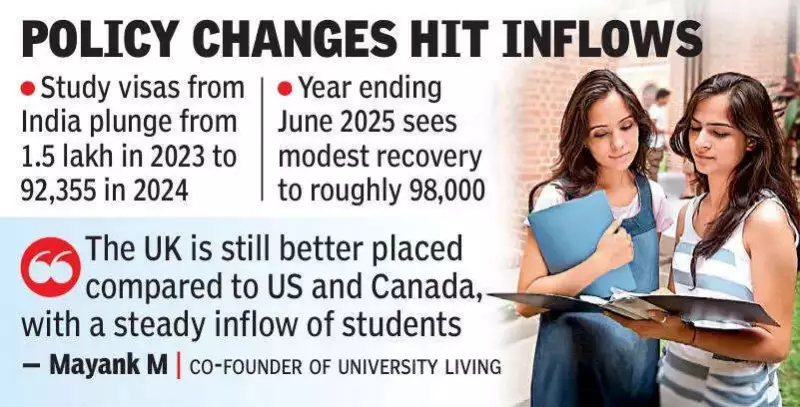
Policy changes have also had a profound impact. Restrictions on dependents and higher financial thresholds led to a sharp decline in Indian study visas, from about 1.5 lakh in 2023 to roughly 92,355 in 2024. A modest recovery to around 98,000 was seen in the year ending June 2025. "However, the UK still remains a better destination compared with the US and Canada with a steady inflow of students," noted Mayank Maheshwari, co-founder of University Living.
Students on the ground describe the pressure as intense and multifaceted. "High tuition fees, rising living costs, visa uncertainty and limited work hours make financial stress unavoidable," explained Nipra Wamanker, a second-year student at King's College London. She added that adjusting to a new academic and cultural environment compounds the strain.

Wamanker stressed that platforms like INSEC are desperately needed, as existing career advice on visa sponsorship or staying back in the UK often feels vague. "This leaves students stuck between trying to stay or planning to return home," she said.
Rhea Khosla, another King's College London student, highlighted INSEC's innovative approaches, such as "anti-networking sessions" for students who struggle with socialising. "Small-group interactions make networking less intimidating and help people grow at their own pace," she remarked, underscoring the council's focus on inclusive and practical support.