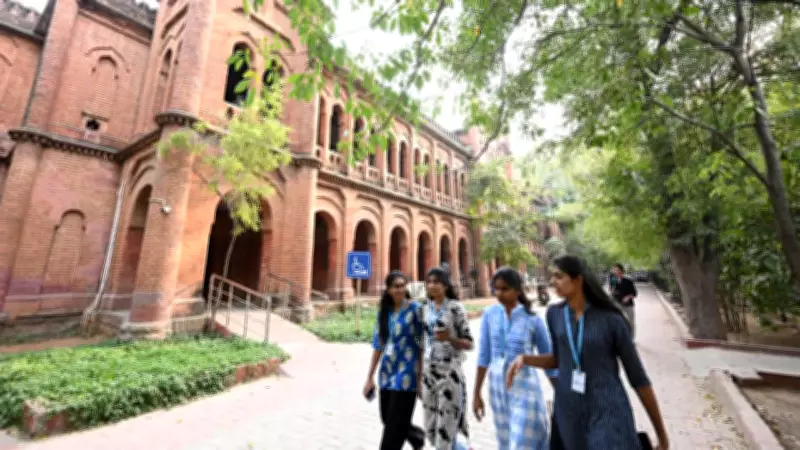
Anna University Tops Global List for Most Retracted Research Papers
In a startling revelation, Anna University in Chennai has secured the top position on a global list, but it is an unwelcome distinction. The university has been identified as having the highest number of retracted research papers worldwide, according to data released in 2025. This development casts a shadow over the academic integrity of one of India's premier institutions.
Alarming Statistics and Key Findings
From 2019 to 2024, a total of 161 research articles published by engineering colleges affiliated with Anna University were retracted by various research journals in 2025. This figure represents a significant concern for the academic community. Notably, nearly 50% of these retracted papers originated from the computer science and information technology domains, highlighting a specific area of vulnerability.
The reasons cited for these withdrawals include unreliable results, concerns about references, computer-generated content, and compromised peer review processes. These details were provided by India Research Watch, a research watchdog that compiled the data using the Retraction Watch Database. The total number of research articles submitted for publication during this period remains unavailable, making it difficult to assess the full scope of the issue.

Broader Implications and Institutional Responses
Anna University is not alone in this predicament. Other prominent deemed universities in India, such as Saveetha Institute of Medical and Technical Sciences (SIMATS), VIT Vellore, and SRM Institute of Technology (SRIMIST), also featured prominently on the list of institutions with the most retractions in 2025. This suggests a systemic problem within the Indian higher education sector.
Achal Agrawal, founder of India Research Watch, emphasized that retractions are merely a symptom of deeper flaws. He pointed to the National Institutional Ranking Framework (NIRF) as a contributing factor, as it places excessive emphasis on research publication volumes, thereby incentivizing quantity over quality. "NIRF introduced a retraction penalty last year, but the penalties are mild. There is an urgent need to change how we evaluate our universities and researchers," Agrawal stated.
The Role of AI and Research Integrity
AI-generated content has emerged as a major challenge for research journals, with no unified guidelines in place. "Every publisher and journal has its own policy regarding AI usage. Some journals ban the use of AI completely, while some allow it for polishing the language. A lot of retractions due to computer-generated content happen because the use was not declared. AI also hallucinates fake references, which were detected by journals," Agrawal explained.
Moumita Koley from the DST-Centre for Policy Research at IISc, Bangalore, highlighted the rigorous nature of genuine research, which typically requires one to two years of dedicated work. She noted that in some colleges, even undergraduate and postgraduate students are publishing papers with manipulated data. "There are flaws with many journals, too, as there is no real peer review in those journals," Koley added.
Institutional Reactions and Future Steps
Former Anna University vice-chancellor M K Surappa expressed shock at the retraction data and urged the university to establish a research integrity office to monitor publication quality and retractions. He described retraction as a form of research misconduct, warning that "in India, it has reached epidemic proportions and can no longer be ignored."
In response, Anna University registrar (in charge) V Kumaresan announced plans to convene the research board to develop new guidelines for affiliated colleges. "As of now, the university departments and constituent colleges were not involved in the retractions. The university is not overseeing the research publication. But we will form new regulations," he assured.

Statements from Other Affected Institutions
SIMATS issued an official statement defending its record, noting that it has a designated research integrity officer and stringent governance policies. The institution argued that retractions are often procedural and aligned with publishing norms, rather than stemming from data manipulation. "Given SIMATS' substantially higher publication volume compared to peer institutions, citing absolute retraction numbers without proportional context is misleading. When evaluated as a percentage of total output, the retraction rate remains within global norms," the statement read.
VIT vice-chancellor B S Kanchana Bhaskaran clarified that the retracted articles were from special editions of journals that did not undergo peer review. "Later, the entire special editions were withdrawn. It is affecting some genuine faculty members as well. The percentage of retracted papers is very low when compared to published papers from our institute," she explained.
SRMIST did not provide a comment on the matter, leaving its stance unclear.
This situation underscores a critical need for enhanced oversight and reform in research practices across Indian universities to restore credibility and ensure academic excellence.