Medical colleges in Bengaluru are deploying a powerful financial strategy to combat a critical shortage of teaching staff. They are rolling out significantly enhanced pay packages and a suite of incentives specifically for faculty in pre-clinical and para-clinical subjects. This move comes as institutions struggle to fill positions in foundational areas of medical education.
Hefty Pay Packages to Attract Talent
The salary disparity is stark. While clinical faculty members, who handle patient care, typically earn around Rs 2 lakh per month, their counterparts in pre- and para-clinical departments are now being offered between Rs 3 to 4 lakh monthly. This represents a near doubling of the compensation for these crucial teaching roles.
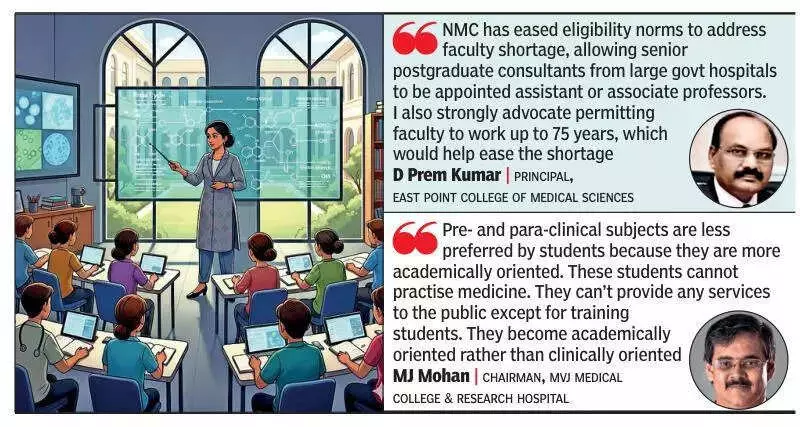
Dr. D Prem Kumar, principal and dean of East Point College of Medical Sciences, highlighted the severity of the crisis. "The highest-paid faculty positions are for specialists in anatomy, which is facing the most acute shortage of teachers," he stated. The shortage is most pronounced in junior positions. With the National Medical Commission (NMC) allowing senior faculty to stand in for juniors, colleges are hiring professors and other senior staff at substantially higher salaries to bridge the gap.

Beyond Salary: A Suite of Retention Incentives
Colleges are not relying on pay alone. They are crafting comprehensive retention packages to keep valuable faculty from being poached. Dr. Kalpaja DA, chairperson of Vydehi Institute of Medical Sciences and Research Centre, outlined the common incentives. These include pay above regulatory norms, housing or location-based allowances, faster promotions and leadership roles, predictable working hours with no emergency duties, as well as research funding and conference support.
Dr. Kumar explained the rationale behind the higher base pay for non-clinical faculty. "In clinical specialities, additional responsibilities such as patient care and procedural exposure can be assigned. However, in pre- and para-clinical programmes, a higher salary remains the only viable option," he added.
The Poaching Challenge and Expanding Demand
The competition for qualified faculty is intense, leading to aggressive poaching between institutions. SNVL Narasimha Raju, chairman of Oxford Educational Institutions, which runs Oxford Medical College, confirmed the trend. "We try to retain them with attractive salaries as poaching between colleges, sometimes even from other states, is a big challenge," he said. His institution pays around Rs 3.5 lakh for pre- and para-clinical faculty versus Rs 2 lakh for clinical staff.
The root of the shortage is linked to a national expansion of medical education. MJ Mohan, chairman of MVJ Medical College and Research Hospital, which pays at least 30% higher for these subjects, connected the dots. "As the Centre wants to increase the number of MBBS seats to 75,000 in five years, NMC has liberalised the opening of medical colleges," he said. This boom creates immediate demand for teachers in first-year pre-clinical subjects like anatomy, physiology, and biochemistry, and second-year para-clinical subjects such as pharmacology and microbiology. "In the last few years, demand has gone up, while supply is still low," Mohan concluded.
Furthermore, with another NEET-PG counselling session underway, colleges are actively encouraging students to consider specialising in these high-demand pre- and para-clinical fields, aiming to build a sustainable pipeline of future faculty.