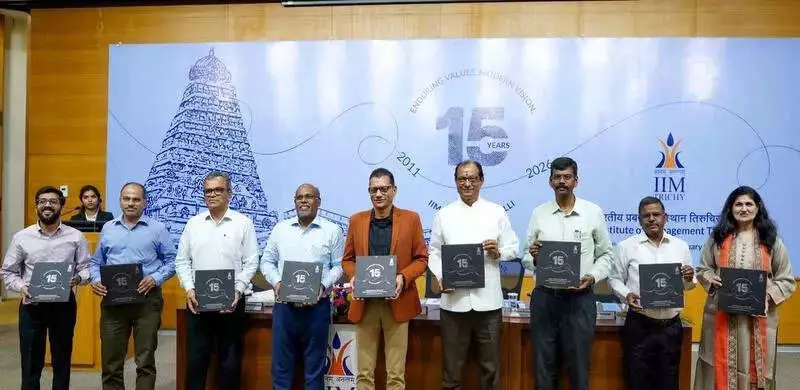
The Indian Institute of Management Trichy (IIM-T) recently became a hub for crucial discussions on the future of leadership, hosting the fourth edition of its leadership conclave, Daksha 4.0. The event centered on a critical theme for our times: 'The Human Element: Redefining Leadership in the Age of AI.' The conclave brought together seasoned leaders and academic minds to dissect the complex interplay between artificial intelligence and the irreplaceable qualities of human guidance.
Keynote Warns Against "Paper Clipping" Humanity
Delivering the keynote address, Air Marshal Chakalayil Rajappa Mohan, PVSM, AVSM, VSM (Retd.), drew powerful parallels from his vast experience in technology, systems thinking, and organisational leadership. He framed artificial intelligence as a transformative force on par with the advent of electricity for industry, a shift that redefines paradigms.
However, the Air Marshal issued a profound caution. He stressed that the immense power of technology must be steered by clear human intention and wisdom. Warning against a myopic obsession with efficiency, he urged current and future leaders to avoid turning intelligence into a "paper clipping of humanity," a scenario where the rich tapestry of human experience is reduced merely to cold data points and checklist items. True leadership, he emphasised, transcends mere technology management.

Leadership, in the age of AI, is an act of creativity and purpose. Leaders must "do art" by creating meaning, cultivating a compelling vision, and intentionally shaping an organisational culture in ways that are inherently beyond the capability of any machine. This human touch, he argued, is the ultimate differentiator.
IIM-T Director Frames India's Global Responsibility
Addressing the gathering, Professor Pawan Kumar Singh, Director of IIM Trichy, reflected deeply on the symbiotic relationship between advancing technology, effective leadership, and heightened human responsibility in a rapidly evolving global landscape. He positioned the institute's vision for nurturing leaders who can navigate this new era.
Professor Singh elevated the discussion to a global scale, invoking the ancient Indian philosophy of Vasudhaiva Kutumbakam (the world is one family). He observed that India, with its vast and ancient reservoir of knowledge meant for all humanity, carries a significant responsibility to the world. This duty, he noted, becomes even more pronounced and critical as powerful technologies like AI continue to reshape societies and economies at an unprecedented pace. The implication was clear: Indian leadership must blend technological understanding with this ethos of universal welfare.
The Path Forward: Integrating Wisdom with Innovation
The conclave served as a vital platform, moving beyond mere fascination with AI's capabilities to address its profound implications for human society. The consensus from Daksha 4.0 pointed towards a future where successful leadership will be defined by the ability to harness AI as a tool without surrendering human judgment, ethics, and creative spirit.
The messages from both the keynote speaker and the institute's director converge on a central idea: the goal is not to create leaders who are merely tech-savvy, but to forge leaders who are wisdom-driven. They must be capable of embedding human values, long-term vision, and a sense of shared global destiny into the very fabric of our technological future. IIM Trichy, through forums like Daksha, is actively preparing its students to meet this complex but essential challenge.