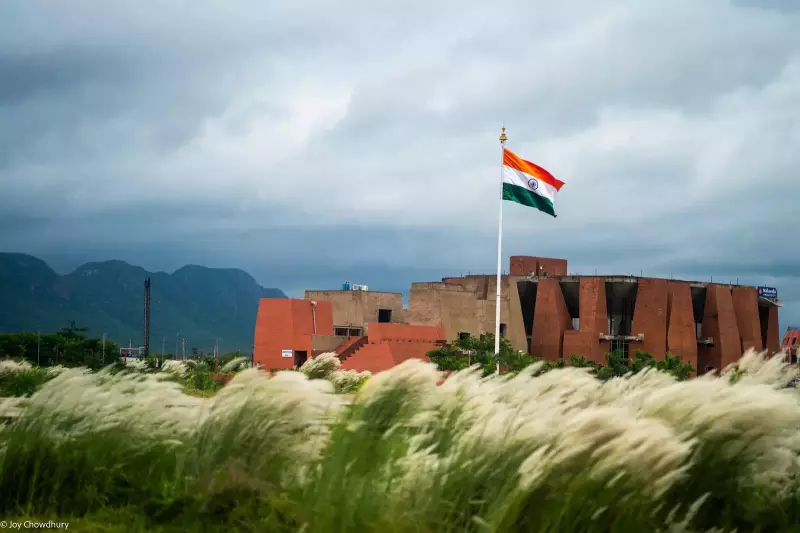
Nalanda University successfully wrapped up a significant two-day national conference this Saturday, focusing on the promotion of Hindi and its potential role in global conversations. The event firmly established the historic institution as a central academic forum for structured discussions on making Hindi an official language of the United Nations.
Academic Deliberations and a Strategic Roadmap
The final day of the conference featured deep discussions across multiple sessions. The fifth session examined the contribution of higher educational institutions, while the sixth looked at the role of organizations dedicated to promoting Hindi. Experts across these sessions stressed the shared duty of universities, cultural bodies, and policy institutions in enhancing Hindi's worldwide presence.
A pivotal academic session centered on "Hindi as an official language of the United Nations: A proposed road map." This session included a detailed presentation by Vinod Kumar Mishra, the former secretary general of the World Hindi Secretariat in Mauritius. Shiv Kumar Singh from the University of Lisbon powerfully presented arguments supporting the establishment of Hindi as a UN language.

Learning from History, Leveraging Global Presence
Participants analyzed the historical evolution of the UN's official languages, noting the expansion from the original five in 1945 to the addition of Arabic in 1973. They highlighted that these transitions were made possible through persistent diplomacy, financial backing, and multilateral agreement. Speakers suggested this historical precedent offers a valuable blueprint for the campaign for Hindi.
The discourse further emphasized Hindi's growing global footprint across continents like Asia, Africa, and the Caribbean, as well as within the vast Indian diaspora. Its demographic weight, technological accessibility, and cultural soft power were cited as key strengths. Special attention was given to the existing 'Hindi @ UN' initiative, which already facilitates Hindi content on UN digital platforms, radio, and news services, creating a de facto presence within the system.
Leadership Vision and Institutional Collaboration
Addressing the gathering, Vice-Chancellor Professor Sachin Chaturvedi stated, "The recognition of Hindi as an official UN language is not just a matter of linguistic pride. It signifies India's civilizational presence and rising intellectual confidence. Accomplishing this goal demands sustained institutional readiness and a long-term strategic vision. With the increasing significance of the Global South, this proposal holds even greater relevance in today's world order."
On the sidelines of the conference, Nalanda University strengthened its academic network by signing a Memorandum of Understanding (MoU) with the Central Institute of Higher Tibetan Studies (CIHTS) in Sarnath. The agreement, signed by Prof. Chaturvedi and CIHTS Vice-Chancellor Professor WD Negi, aims to boost academic and research exchanges, encourage dialogue between knowledge traditions, and enhance interdisciplinary cooperation.
The conference concluded with a reinforced commitment to advancing Hindi as a language for global governance, diplomacy, knowledge creation, and cultural exchange. This mission is deeply connected to Nalanda's own historic legacy as a preeminent center for cross-border learning and intellectual discourse.