VBSA Bill Embodies NEP 2020 Vision for Higher Education Reform
At Bharathidasan University's 40th convocation in Trichy, NAAC director G Kannabiran emphasized that the proposed Viksit Bharat Shiksha Adhisthan (VBSA) Bill carries the fundamental essence of the National Education Policy (NEP) 2020. The bill aims to overhaul India's higher education regulatory landscape by replacing the University Grants Commission (UGC), All India Council for Technical Education (AICTE), and National Council for Teacher Education (NCTE) with a single, unified regulatory body.
NEP 2020 Vision for Autonomous Institutions
Addressing the gathering, Kannabiran elaborated that under NEP 2020, higher education institutions are envisioned as public-spirited, self-governing autonomous entities. This vision is supported by principles of good governance, transparency, and public disclosure, which the VBSA Bill seeks to institutionalize. He highlighted that the bill has encountered strong opposition from Tamil Nadu Members of Parliament and academicians, and it is currently under thorough review by a joint parliamentary committee.
Unified Direction with Decentralized Functions
The NAAC director explained that the proposed overarching commission would ensure a unified direction aligned with national priorities. Simultaneously, the remaining functions of higher education would be decentralized through three specialized councils: a regulatory council, an accreditation council, and a standards council. This structure is designed to maintain harmony in the commission's functioning, as the commission will include presidents of all three councils.

Kannabiran, who also serves as a member of Bharathidasan University's planning board appointed by Governor R N Ravi, noted that the new commission and its verticals mandate representation from states through membership and representatives from state universities. This inclusion aims to foster collaborative governance and address regional educational needs.
Accreditation Challenges and New Framework
Continuing his address at the university, where NAAC accreditation expired in 2024, Kannabiran pointed out that more than 75% of colleges and 55% of universities in India have yet to undergo accreditation. To address this gap, a simplified framework called basic accreditation will be launched soon. This initiative is part of a broader maturity-based system designed to categorize institutions into levels ranging from 1 to 5.
Level 5 institutions are expected to emerge as global centres for multidisciplinary education and research. The committee also plans to provide handholding support to first-time institutions seeking accreditation and to mentor those in rural and remote locations, ensuring equitable access to quality education standards.
Convocation Ceremony and Political Absences
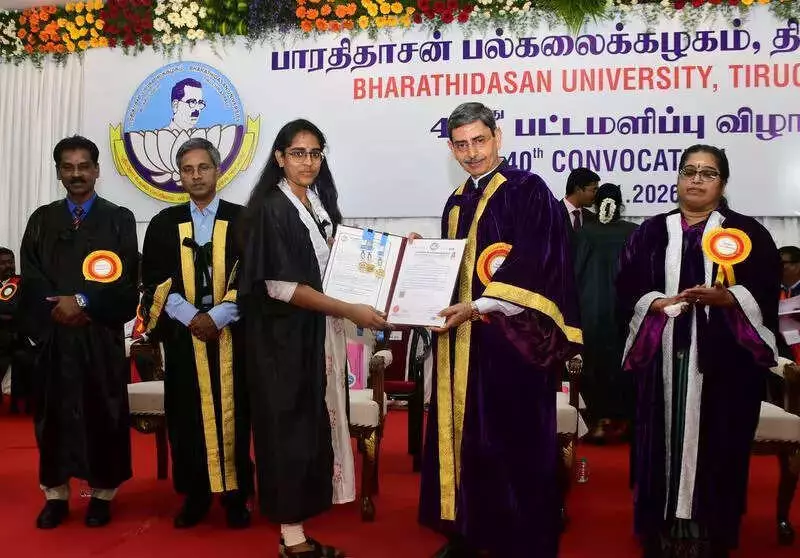
During the convocation, Governor R N Ravi distributed degree certificates to 780 candidates, including 690 PhD scholars and 90 rank holders. Additionally, 96,818 students from approximately 150 affiliated institutions were awarded degrees in absentia. The event was attended by syndicate members, VC committee convenor E Sundaravalli, and Registrar R Kalidasan.
However, notable absences included Higher Education Minister Govi Chezhian, who also serves as pro-chancellor, and School Education Minister Anbil Mahesh Poyyamozhi, who was conferred a PhD but did not attend. Out of the 691 PhD students conferred in person, Minister Poyyamozhi was the only one awarded the degree in absentia.
This marks the third instance this year of a higher education or concerned minister skipping a convocation, following Governor Ravi's walkout from the assembly earlier this month. Previously, Chezhian did not attend the Madras University convocation, and Fisheries Minister Anitha Radhakrishnan stayed away from the Tamil Nadu Veterinary and Animal Sciences University convocation.
A Bharathidasan University professor remarked that the last time the governor and minister were seen together at a convocation was in 2023, during Prime Minister Narendra Modi's presence. This pattern of absences underscores ongoing tensions in Tamil Nadu's educational and political spheres, reflecting broader debates over governance and policy implementation in higher education.