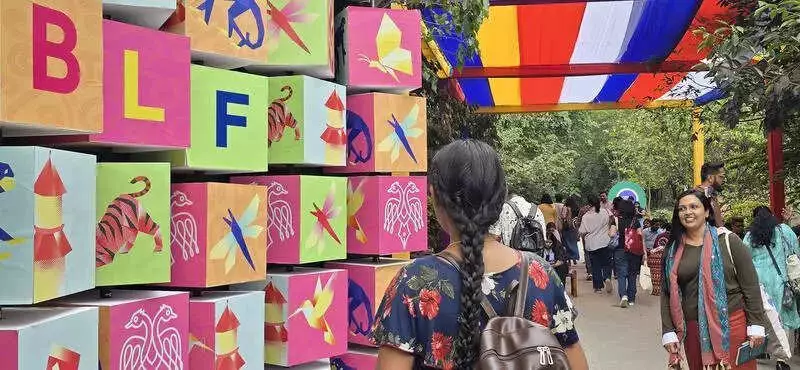
Booker Prize-winning author Banu Mushtaq set a powerful, reflective tone for the Bangalore Literature Festival (BLF) on Saturday, transforming its opening stage at Freedom Park into a compelling call for conscious, everyday action. She moved beyond ceremonial remembrance, asserting that equality and fraternity must be lived daily practices, not just legal terms or recited verses.
A Date of Duality: December 6 and the Call for Pluralism
Mushtaq began by anchoring her address in the significance of the date, December 6, which marks two profoundly contrasting events in Indian history: the Mahaparinirvana of Dr. B.R. Ambedkar and the demolition of the Babri Masjid. She presented these not as opposing ends but as a convergent demand for a value-based society. "While the two events may seem opposed, they unite in demanding a value-based society," she stated. For her, this duality underscores the urgent need to uphold pluralism. She urged the audience to view history not solely through the lens of pain but as a guide for rebuilding society.
In this context, she positioned literature as the essential emotional bridge. "Literature has the strength to understand the pain of history, imagine the future with courage, and serve as an emotional bridge for people to connect with one another," Mushtaq explained. She warned against the politics of silence, declaring it a form of betrayal in an age where truth is debated and rights are curtailed. "When neutrality becomes a cultural norm, it becomes a refined mask for cruelty," she asserted, defining rebellion (Bandaya) as a refusal to be neutral on issues of inequality.

"Being Banu, Being Bandaya": The Fire That Refuses to Go Out
Her keynote, titled ‘Being Banu, Being Bandaya,’ delved into the personal and political roots of rebellion. She described it as standing before a mirror reflecting not just one woman but an entire lineage of dissent. "It represents a lineage of writers who refuse to be silenced and a geography of struggle and tenderness," she said. For Mushtaq, this identity is an inheritance and a responsibility—"a fire that refuses to go out."
She revealed that her writing is forged not in comfort but in the crucible of courtrooms, contradictions, and the lived realities of people who bring her their defeats, dreams, and dignity. Revisiting the lessons of the Bandaya literary movement, she reiterated that writing is, above all, a "moral necessity."
Quiet Strength and the Expanding Heart of Literature
Mushtaq then masterfully shifted the focus from loud rebellion to the potent force of quiet strength and empathy. "Being Bandaya is not about shouting; it is about believing that literature can create a society where no woman is invisible, no child is voiceless, no minority is disposable, and no truth is unfashionable," she articulated. She highlighted the dangerous shrinkage of empathy in contemporary times, noting that its diminishment fuels extremism. "This is why literature matters—because literature expands the human heart," she affirmed.
Her advice to young writers distilled this philosophy into a clear mandate: "Do not try to impress. Write to expose. Write to illuminate. Write to liberate." She concluded by framing her multilingual identity as her foundational strength, stating, "Kannada has given me the courage to stand up, Urdu has provided me with the patience to experience the world, and English has created a bridge through which I can connect with the entire world." Her address left the audience with a resonant challenge: to make equality an active, daily practice and to wield literature as a tool for connection and courage.