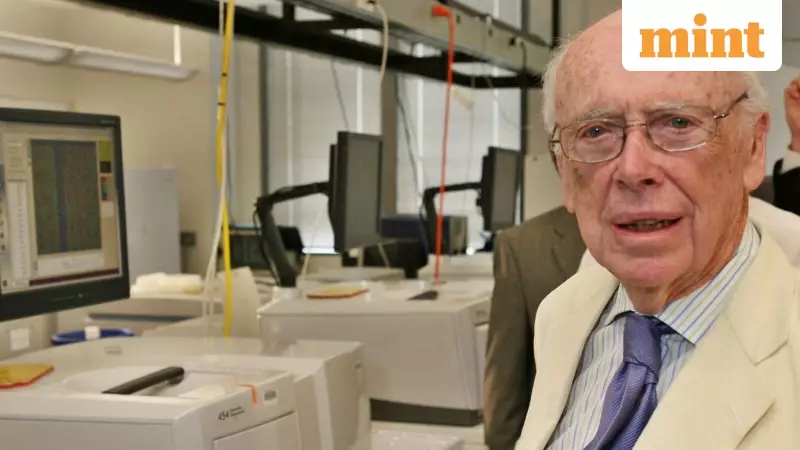
The world of science has lost one of its most monumental figures. James Watson, the Nobel Prize-winning American biologist who co-discovered the double-helix structure of DNA, passed away on Friday at the age of 97.
The news was officially confirmed by the Cold Spring Harbor Laboratory, the institution he led for decades. According to reports from the New York Times, his son Duncan revealed that Watson had been moved to a hospice on Long Island, New York, this week after being treated for an infection in a hospital. It was there that he breathed his last on Thursday.
The Landmark Discovery That Changed Biology
James Watson's legacy is forever intertwined with one of the most important scientific breakthroughs of the 20th century. In 1953, together with British scientist Francis Crick, he deciphered the molecular structure of deoxyribonucleic acid, or DNA.

Their proposal of the now-iconic double-helix model explained how genetic information is stored and replicated in living organisms. This foundational discovery earned Watson, Crick, and their colleague Maurice Wilkins the Nobel Prize in Physiology or Medicine in 1962.
A Complex Legacy and Lasting Impact
Beyond the double helix, Watson played a pivotal role in advancing genetic research on a global scale. He was a driving force behind the Human Genome Project, a monumental international scientific effort that successfully mapped the entire human genetic code.
For much of his professional life, Watson was the director of the Cold Spring Harbor Laboratory (CSHL) in New York, transforming it into a world-renowned centre for genetic research. His career, however, was not without controversy, often marked by contentious statements on race and intelligence that were widely condemned by the scientific community and led to his professional marginalization in later years.
Despite the controversies, his early work remains the bedrock of modern genetics, molecular biology, and biotechnology. The passing of James Watson marks the end of an era, closing the chapter on a life that fundamentally reshaped our understanding of life itself.