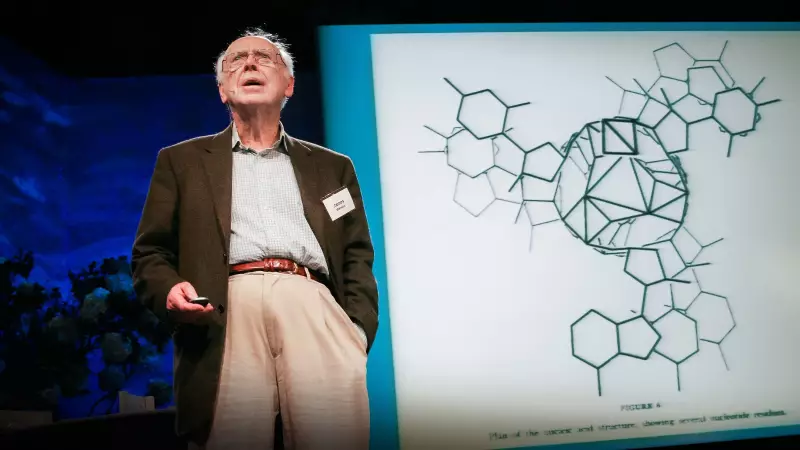
The scientific world mourns the loss of one of its most brilliant yet controversial minds. James Watson, the Nobel Prize-winning scientist who helped unravel the fundamental secret of life by discovering the structure of DNA, has passed away at the age of 97. His death marks the end of an era in molecular biology.
The Groundbreaking Discovery That Changed Science
In 1953, James Watson, then just 25 years old, alongside his colleague Francis Crick, made one of the most significant scientific breakthroughs of the 20th century. Working at Cambridge University's Cavendish Laboratory, they deciphered the double helix structure of DNA, the molecule that carries genetic instructions for all living organisms.
Their discovery revealed how genetic information is stored and transmitted from generation to generation. This monumental achievement, published in the journal Nature, laid the foundation for modern genetics and molecular biology. The elegant spiral staircase structure they proposed explained how DNA could replicate itself with astonishing accuracy.

In 1962, Watson, Crick, and Maurice Wilkins received the Nobel Prize in Physiology or Medicine for their revolutionary work. Notably absent from the Nobel recognition was Rosalind Franklin, whose X-ray diffraction images were crucial to understanding DNA's structure but who had passed away before the prize was awarded.
A Complex Legacy and Controversial Career
While Watson's scientific achievements earned him global acclaim, his later career was marked by controversial statements about race and intelligence that drew widespread criticism from the scientific community. These remarks led to his suspension from Cold Spring Harbor Laboratory in 2007, where he had served as director for decades and transformed it into a world-leading research institution.
Despite the controversies surrounding his later years, Watson's contribution to science remains undeniable. His 1968 book The Double Helix became an international bestseller, providing a candid, personal account of the DNA discovery process that captivated readers worldwide.
In his final years, Watson's family reported that he had minimal awareness of his surroundings due to cognitive decline following a car accident in 2018. The scientific community now reflects on both his extraordinary achievements and the complex nature of his legacy.
The Enduring Impact on Modern Science
Watson's work continues to influence numerous fields, from medicine and biotechnology to anthropology and forensics. The double helix model fundamentally transformed our understanding of life itself and paved the way for:
- Genetic engineering and gene therapy
- DNA fingerprinting in criminal investigations
- Personalized medicine based on genetic profiles
- The Human Genome Project
- Advanced understanding of hereditary diseases
Current researchers stand on the shoulders of Watson and Crick's discovery, which opened doors to manipulating genetic material and developing treatments for previously incurable conditions. The field of genomics, which has become central to modern medical research, owes its existence to their foundational work.
As the scientific community bids farewell to this towering figure, James Watson's legacy remains a testament to both the brilliant potential of scientific inquiry and the complex relationship between scientific achievement and personal conduct. His death closes a significant chapter in the history of science, but the knowledge he helped uncover continues to shape our world in profound ways.