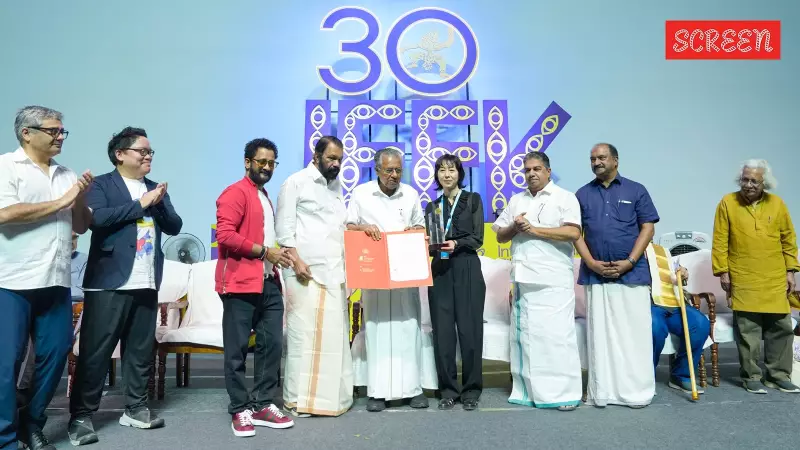
The 30th edition of the International Film Festival of Kerala (IFFK) drew to a spectacular close in Thiruvananthapuram on Friday, December 19, 2025, but not before navigating a significant controversy over film censorship imposed by the central government. The festival's top honour, the Suvarna Chakoram for Best Film, was awarded to Japanese director Sho Miyake for his work Two Seasons, Two Strangers.
A Grand Finale Marred by Political Tensions
Chief Minister Pinarayi Vijayan, who inaugurated the closing ceremony at the Nishagandhi Auditorium, launched a sharp critique against the Union Ministry of Information and Broadcasting. The Centre had initially denied censor exemption to 19 films scheduled for the festival. Although 13 were later cleared, the screenings of six films were ultimately cancelled. The CM framed this as a direct attack on creative freedom.
"It was an attempt to stifle IFFK," Vijayan stated emphatically. He highlighted specific cases, including the Spanish film Beef, whose title was misinterpreted by authorities. "To them, the word 'beef' has only one meaning. Actually, beef also means struggle. They denied the screening without understanding any of this," he explained. The CM also criticized the ban on Sergei Eisenstein's classic Battleship Potemkin (1915), calling it a reflection of the Centre's "lack of understanding of world cinema."

Vijayan further alleged that the Centre denied visas to guests from certain countries and insisted on political clearance, effectively trying to dictate who could attend. "Such incidents bring a lot of shame to our country in front of the world," he remarked. He vowed that the festival would persist in opposing what he termed "anti-democratic, fascist moves."
Celebrating Cinematic Excellence: The Award Winners
Despite the political storm, the festival celebrated outstanding global cinema. The coveted Suvarna Chakoram for Best Film was claimed by Sho Miyake's Japanese narrative, Two Seasons, Two Strangers. The Rajata Chakoram for Best Director was awarded to Carina Piazza and Lucía Bracelis for the Spanish film Before The Body.
Other notable winners included:
- Best Debut Director (Rajata Chakoram): Tanushree Das and Saumyananda Sahi for the Bengali film Baksho Bondi (Shadowbox).
- Special Jury Mention for Performance: Tillottama Shome for Baksho Bondi.
- Special Jury Mention for Technical Excellence: Shahram Mokri's Black Rabbit, White Rabbit.
- Jury Prize (International Competition): Unnikrishnan Avala's Thanthapperu (Life of a Phallus).
- Best Malayalam Film (Joint Winners): Sanju Surendran's Khidki Gaav (If On a Winter's Night) and Unnikrishnan Avala's Thanthapperu.
- Audience Poll Award: Thanthapperu.
In a poignant moment, the Lifetime Achievement award was presented by the Chief Minister to the acclaimed Mauritanian filmmaker Abderrahmane Sissako.
Overcoming Crises and Looking Ahead
Kerala's Cultural Affairs Minister, Saji Cheriyan, who presided over the closing event, stated that the festival concluded after overcoming significant crises. He alleged a "deliberate conspiracy" from the outset to censor films and undermine the event, reaffirming that the state government would not yield to such pressures.
The ceremony was attended by a host of dignitaries, including legendary filmmaker Saeed Akhtar Mirza, International Competition jury head Mohammad Rasoulof, several state ministers, and Culture Department Director Dr. Divya S. Iyer. The presence of KSCA chairperson Resul Pookutty, after his physical absence in the initial days, marked a unified front for the festival's organisers.
The 30th IFFK, while concluding on a grand note, has undoubtedly set the stage for a continued debate on artistic freedom, federal cultural policies, and the role of film festivals as spaces for progressive discourse and dissent.