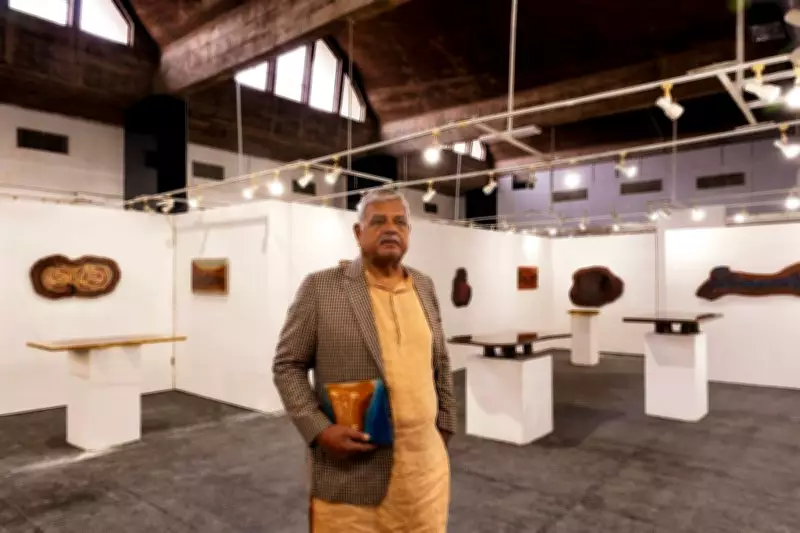
At the heart of the present exhibition lies the artist’s belief that every indigenous tradition is rooted in an intimate relationship with land.
Exhibition Overview
Created during the Covid pandemic, ‘Indigenous Accents’ marks a new chapter in artist Raj Kishore Gupta’s artistic journey. Curated by Uma Nair, the exhibition brings together a remarkable body of work that transforms indigenous visual traditions into a deeply personal exploration of memory, landscape, and material form. The exhibition is on view at Bikaner House, New Delhi, from July 2–6.
Artist Background
Gupta is a Chandigarh-based artist whose practice spans over four decades. Trained in printmaking at the Government College of Art, Chandigarh, he has developed a distinctive artistic language rooted in experimentation, material exploration, and careful attention to detail. His early engagement with woodcuts and linocuts continues to inform his approach to composition, layering, texture, and pattern-making.

Indigenous Influences
During years of isolation, Gupta immersed himself in the study of Warli, Gond, Phulkari, Pahadi, African, and Australian Aboriginal art, discovering not only distinct aesthetic languages but also a shared impulse to record community histories, rituals, dreams, and encounters with nature. These ideas became the catalyst for a body of work shaped as much by reflection as by observation.
Visual Vocabulary
The exhibition unfolds through a dense visual vocabulary of butterflies, flowering forms, trees, animals, geometric structures, and ancestral motifs. Rather than appearing as isolated symbols, these elements weave together across resin and wooden surfaces, creating layered compositions that oscillate between abstraction and narrative. While informed by indigenous visual cultures from across continents, the works remain deeply personal, drawing upon recollections of childhood, family histories, and the landscapes that have shaped Gupta’s life and artistic practice.
Live-Edge Wood as Medium
Central to this body of work is Gupta’s engagement with live-edge wood. Working with sheesham and kikar slabs, circular tree trunks, and elongated wooden beams whose contours remain intact, he treats the material not as a passive support but as an active collaborator. Grain patterns become pathways, knots become focal points, and natural fissures shape the direction of the image. The resulting works occupy a unique space between painting, relief, and sculpture, where the life of the tree remains embedded within the artwork itself.
Artistic Process
A defining aspect of the exhibition is the artist's willingness to relinquish complete control over the pictorial surface. Responding to the wood's natural contours, striations, cracks and bark, Gupta allows the material to guide the final composition. These organic substrates transform the works from flat images into sculptural forms, creating a dialogue between artistic intervention and the material memory of the tree.
Return to Printmaking Roots
The exhibition also revisits concerns that have informed Gupta’s practice since his student years in Chandigarh. As a young printmaker, he was drawn to the precision of woodcuts and linocuts, whereby he was fascinated by the power of line, structure, layering, and repetition. Decades later, those same principles resurface in ‘Indigenous Accents’, where intricate mark-making, rhythmic patterning, and carefully constructed surfaces become the foundation of a mature visual language.
Sculptural Beams
Among the exhibition's most distinctive works are a series of vertical wooden beams that extend Gupta’s exploration of indigenous traditions into sculptural space. Layered with motifs, symbols, and visual references gathered from years of study, these works function as repositories of memory, ancestry, and cultural continuity, reflecting the movement of traditions across generations and geographies.

Artist's Quote
Reflecting on the works, Gupta says, “I found that the paintings of all the tribals were about their soil, their land, and their traditions. They paint what they love and what they feel, and I realised that everything is about the stories of one's own place. During the Covid days, as I studied these traditions, stories of my childhood, my family, and the landscapes where I grew up began finding their way into these works.”
Curator's Perspective
Curator Uma Nair notes: “To engage with these works is to witness a profound dialogue with the arboreal form. The choice of live-edge wood as a substrate elevates the practice beyond mere image-making, transforming each piece into a sculptural exploration of time and mutability. By leaving knots, cracks, and the vestigial bark intact, the artist embraces a wabi-sabi aesthetic that celebrates imperfection. The result is a series of works suspended in a state of arrested decay, where human gesture and dendrochronological narrative beautifully collide.”
Medley Series
The exhibition's ‘Medley’ series comprises indigenous styles gathered across years of study, converging within a single visual field. The resulting works transcend individual traditions, revealing a practice rooted not in imitation but in dialogue between cultures, materials, memories, and ways of seeing.
Photographic Portraits
Complementing the exhibition is a series of portraits of the artist by photographer Avani Rai. Presented alongside the artworks, the photographs offer an intimate glimpse into Gupta’s creative world, tracing the presence of the artist behind the works and the artistic journey that informs his practice.