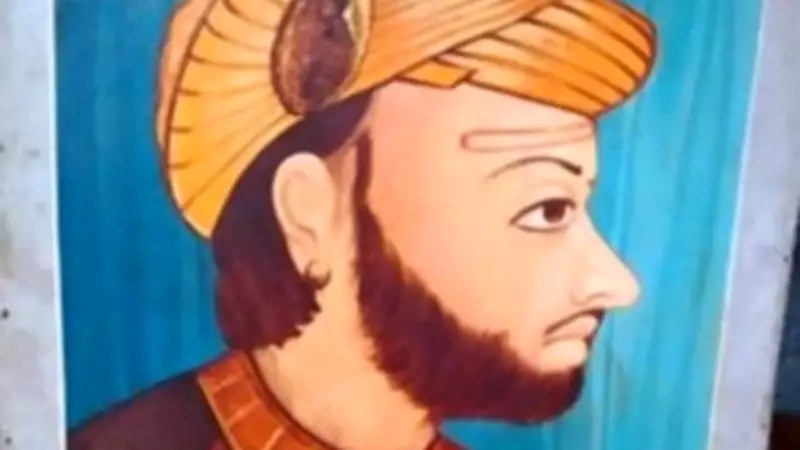
The freedom to walk freely in your city, exercise your national rights, and call yourself an 'Indian' is a privilege that many before us could only dream of. During British colonial rule, calling oneself an 'Indian' or 'Bharati' was a fervent aspiration that fueled the sacrifices of countless freedom fighters. While some names are etched in history, others, like Amar Chand Banthia, remain in the shadows of whispered remembrance.
Who Was Amar Chand Banthia?
Amar Chand Banthia was born in 1793 in Bikaner, Rajasthan, into a Jain business family. His ancestors, known as Oswals, were renowned for distributing wealth among the poor, earning the title 'Banthiya', meaning 'one who distributes generously'. Due to business expansion, the family frequently traveled to and from Gwalior. When Amar Chand was ten, his family moved to Gwalior after a business loss, settling in the Bullion market.
Over the next four decades, Banthia built a reputation for financial acumen and business success. His prowess reached Dewan Rao, an influential minister under Maharaj Jayajirao Scindia, the 10th Scindia ruler. Impressed, the maharaja appointed Banthia as chairman of the Scindia Treasury, known as 'Gangajali'. The Scindia rulers, famed as 'Peral Kings', possessed a treasury overflowing with wealth, diamonds, and jewels. Banthia's exceptional management earned him the title 'Nagarseth'.

The Coming of the British
As Banthia's influence in Gwalior grew, the British were expanding their oppressive control. Anger against British suppression simmered across India, and the 1857 uprising was gaining momentum. However, the Scindia princely state remained allied with the British. Discussions often arose about taking up arms against the colonizers. An officer reportedly urged Banthia to abandon non-violence and join the fight. Banthia replied that while he could not wield weapons, he would do something immensely beneficial for the revolutionaries when the time came.
In 1858, Rani Lakshmibai of Jhansi, along with Tantia Tope, the Nawab of Banda, and Rao Saheb, declared war on the British and captured Gwalior. The queen's army faced severe shortages: soldiers had not been paid for months, and food and water were dwindling. At this critical juncture, Banthia handed over the keys to the Gangajali treasury, buried within Gwalior Fort, to the queen as financial aid. He also donated his personal wealth accumulated through business to support the war effort. Thus, he contributed to India's independence while adhering to his principles.
The Decisive Battle and Aftermath
On June 16, 1858, a decisive battle took place at Murar near Gwalior, where Rani Lakshmibai, Tantya Tope, and their army fought against British forces led by Hurose. The queen fought valiantly, earning the immortal tribute: 'Khoob ladi mardani woh toh Jhansi wali rani thi'. Although the Indian forces were defeated, their fierce resistance marked the first major uprising against British oppression.
The Death of a Freedom Fighter
When the British recaptured Gwalior, they recovered the treasury, but it was largely empty. Investigations revealed Banthia's role in emptying it. He was tried for treason and hanged on June 22, 1858. His body was left hanging on a neem tree for three days in the Sarafa Bazar, near his residence, to instill fear among the populace. This was the same Bullion market where he had spent his life contributing to the city's economy.
Today, Seth Amar Chand Banthia is honored with a statue in Gwalior's Bullion market. His sacrifice is commemorated annually on June 22 by local residents. Many consider him the first martyr from the Marwar region of Rajasthan to fight against British rule.