The Unlikely Tamil Voice That Captured a Generation
In 1987, a melodic phenomenon began in the most unassuming corners of Tamil Nadu. From humble tea shops in the state's smallest towns to vibrant wedding halls and the crackling transistors of remote villages, a song called "Shenbagame Shenbagame" from the film 'Enga Ooru Pattukaran' spread like cultural wildfire. Listeners were captivated by what sounded unmistakably like the legendary singer S Janaki's signature lilt—except it wasn't her at all.
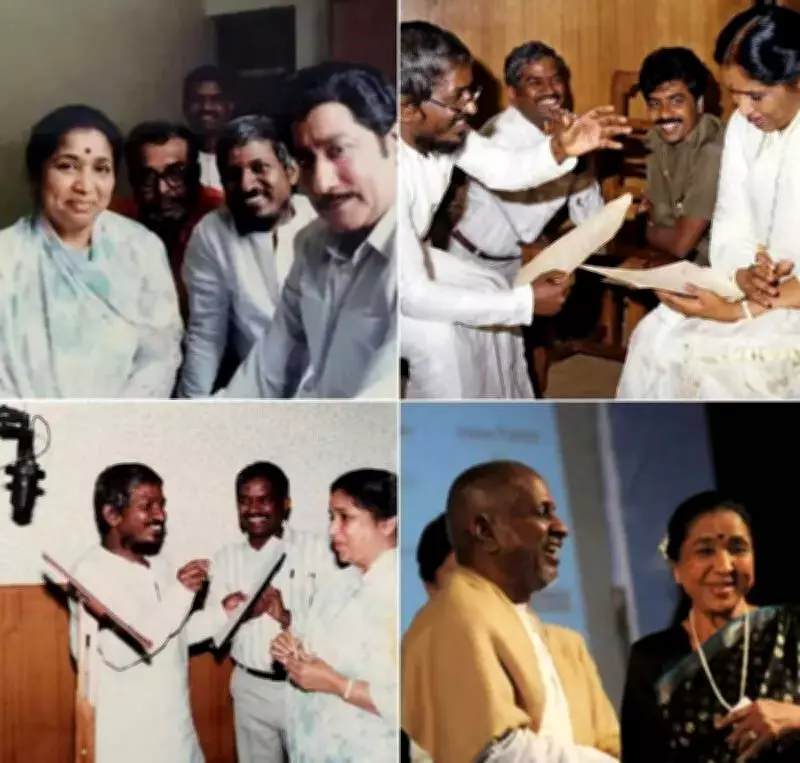
It was Asha Bhosle, the Marathi-speaking musical icon from Bombay, singing Tamil with such natural fluency that she seemed born to the language. For an entire generation of Tamil music lovers, this revelation was nothing short of astonishing. For the maestro Ilaiyaraaja, who had championed her voice against initial skepticism, it represented a profound artistic vindication.
A Selective Yet Impactful Kollywood Portfolio
Despite recording only about 20 songs throughout her Tamil film career, Asha Bhosle's contributions were remarkably significant. The composers she worked with—Ilaiyaraaja, A R Rahman, S A Rajkumar—read like a veritable who's who of Tamil cinema's musical elite. Her Tamil repertoire included memorable numbers such as the playful "Oh Butterfly" for 'Meera', the rhythmic "Saatha Nada Saatha" from 'Sethupathi IPS', and the evocative "Mazhai Megham" from 'Sakkarai Pandal'.

Ilaiyaraaja's initial hesitation about using Asha for 'Enga Ooru Pattukaran' is well-documented by his brother and lyricist Gangai Amaran. "When I suggested Asha for the film, which had a rural theme, my brother refused, believing her voice wouldn't be suitable," Amaran recalls. "But ultimately, the musical score aligned perfectly with her vocal delivery."
The Artistry Behind the Accent
Gangai Amaran also penned "Enga Ooru Kadhala" for the 1990 film 'Puthu Paatu', specifically tailoring it for a heroine character portrayed as a girl raised abroad with a sophisticated accent. "I was absolutely thrilled to write lyrics for Asha," he says. "The marriage between the lyrics and her voice was flawless." He shares a particularly poignant memory of Asha weeping after recording the pathos-filled version of "Shenbagame Shenbagame."
"She made a genuine effort to understand the Tamil lyrics deeply," Amaran emphasizes. "Not knowing the language didn't deter her. She would diligently clear her doubts, make corrections, and master the pronunciation of difficult words with remarkable precision."
A Family Bond That Transcended Music
The Mangeshkar-Bhosle family's connection with South India extended far beyond recording studios. Ram Kumar Ganesan, son of the legendary actor Sivaji Ganesan, traces this bond back to 1961 when Lata Mangeshkar, Asha Bhosle, and their family watched the film 'Paava Mannippu'. A scene where Sivaji Ganesan wore a traditional Marathi topi stirred nostalgic memories of their late father.
"Every year, as long as my parents were alive, the sisters would send beautiful saris for Diwali, and they would tie rakhi for my father," Ram Kumar recounts. "After his passing, I continued this tradition for some time." He also fondly remembers Asha's culinary talents. "Whenever I visited her in Mumbai, she would personally prepare mouth-watering meals that were simply unforgettable."
Artistic Collaborations and Lasting Impressions
Actress Rekha, who lip-synced to "Shenbagame Shenbagame" as a teenager, considers it a career-defining moment. "I believe I did justice to her incredible voice," she reflects. "The music directors and Asha did their part magnificently, and I had to rise to match their caliber."
Actor-producer Chitra Lakshmanan, who met Asha on the sets of 'Lovers' (1983) and 'Saveraywali Gaadi' (1985)—Bharathiraaja remakes with scores by R D Burman—remembers her as a superstar without pretensions. "She was at the absolute pinnacle of stardom, yet remained remarkably humble, always approachable and genuinely amiable," he says.
Asha Bhosle's Tamil musical journey, though brief in quantity, left an indelible mark on Kollywood's soundscape. Her ability to transcend linguistic barriers with emotional authenticity and technical perfection created timeless classics that continue to resonate with audiences, proving that true artistry knows no regional boundaries.