Beyond Fiction: The Enduring Structure of Cartels from Forsyth's Cobra to El Mencho
In the realm of spy thrillers, Frederick Forsyth's later works often face criticism for lacking the groundbreaking genius of his early masterpieces. Familiarity can indeed breed contempt, and this adage holds true even for Forsyth's novels, where his meticulous attention to detail once set a high bar for the genre, yet over time, his style has become somewhat predictable. However, one standout in his later tapestry is Cobra, the sequel to his classic Avenger. This novel features an unlikely alliance between spymaster Paul Devereux III and former Tunnel Rat-turned-bounty hunter Calvin Dexter, who join forces to dismantle a global cocaine cartel. In Forsyth's fictional world, when Devereux devises a strategy to sever the cocaine supply, cartels across Europe, North America, and South America erupt into violent chaos, with thousands caught in the crossfire. This narrative eerily parallels real-world events, such as the aftermath of the killing of Nemesio Oseguera Cervantes, known as El Mencho, in Mexico, where cartel violence surged dramatically.
Netflix's Mythologized Portrayals and the Illusion of Order
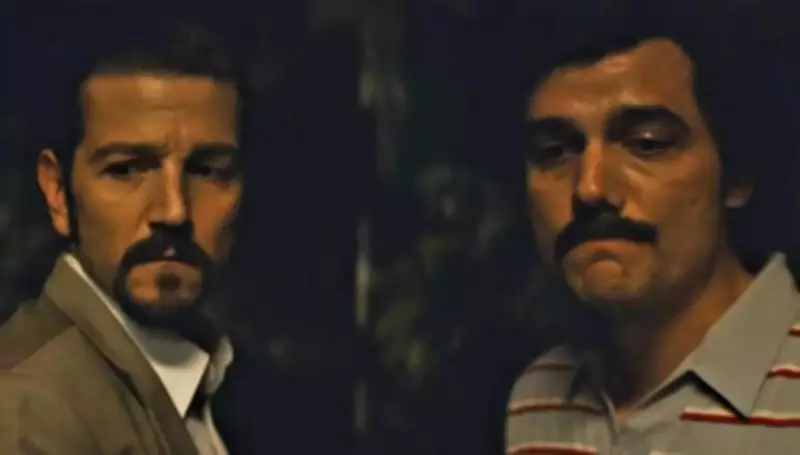
For many globally, Mexican cartels are first encountered as images shaped not by journalists or historians, but by Netflix series like Narcos: Mexico and El Chapo. These shows do more than dramatize events; they provide a visual grammar that makes cartel power intelligible to outsiders. When Diego Luna's Miguel Ángel Félix Gallardo calmly explains the logic of plazas, he appears as a rational entrepreneur imposing order on a chaotic marketplace. Similarly, Michael Peña's Enrique "Kiki" Camarena's realization of the system's scale highlights a structural confrontation between parallel sovereignties. Marco de la O's portrayal of Joaquín "El Chapo" Guzmán as an inevitable successor reinforces a feudal-like continuity. These portrayals endure because they present cartels as hierarchical organizations with clear founders, lieutenants, betrayals, and succession plans, making a complex world legible.
Yet, the reality of cartel systems is far less orderly than television suggests. They are not corporations with organizational charts but constantly shifting ecosystems of traffickers, transporters, financiers, corrupt officials, and opportunistic entrepreneurs. Cooperation occurs when beneficial, and conflict arises when interests diverge. The illusion of coherence stems from profit, not discipline, and this illusion persists only as long as the system continues to expand. Netflix captures the mythology, but reality remains inherently unstable and fragmented.

The Colombian Origins and Mexican Ascendancy
The rise of Mexican cartels is deeply intertwined with Colombian needs. In the late twentieth century, Colombian traffickers like Pablo Escobar, portrayed with unnerving magnetism by Wagner Moura in Narcos, perfected cocaine production but struggled with distribution into the United States. Mexico offered the ideal combination of geography and institutional vulnerability, with smugglers who had decades of experience transporting marijuana and heroin. Initially, Colombian producers paid Mexican traffickers in cash for transportation services. Over time, Mexican networks demanded payment in product, transforming from intermediaries into market participants who controlled pricing, supply, and access. This shift turned Mexico from a mere corridor into a center of gravity, a transformation that proved irreversible and foundational to cartel power.

Architectural Innovations and Territorial Control
Narcos: Mexico presents Miguel Ángel Félix Gallardo as the unifier of plazas, and while the real process was more diffuse, the structural innovation was genuine. Gallardo understood that trafficking routes could be organized territorially, dividing geography into jurisdictions governed by criminal authority rather than formal law. By allocating plazas to trusted associates like Rafael Caro Quintero and Ernesto Fonseca Carrillo, he created a system that minimized internal conflict and allowed for expansion. These figures were not just criminals but architects of an underground economy that would outlast their personal fates. When Gallardo was arrested in 1989, the state believed it had removed the system's central node, but what followed demonstrated that the system no longer required a single leader to function.
Post-9/11 Transformations and Cartel Resilience
The attacks of September 11, 2001, reshaped global security, with the United States intensifying border enforcement, intelligence capabilities, and financial surveillance. Initially, these changes threatened drug traffickers by making traditional routes riskier and money laundering more complicated. However, the deeper effect was to concentrate power rather than eliminate it. As Caribbean routes became heavily monitored and U.S. attention shifted to wars in Afghanistan and Iraq, Mexico's land border emerged as the dominant corridor for narcotics. Cartels adapted by investing in tunnels, maritime routes, and compartmentalized logistics, with larger organizations consolidating dominance. The post-9/11 environment accelerated their evolution into more sophisticated and resilient enterprises, inadvertently reinforcing the very criminal systems it aimed to combat.
Fragmentation and the Rise of El Chapo
Following Gallardo's arrest, the unified structure dissolved into competing organizations, paving the way for figures like Joaquín "El Chapo" Guzmán. Guzmán's ascent reflected both personal ambition and structural opportunity, as he leveraged decentralization to allow networks to operate semi-autonomously while remaining economically integrated. Under his leadership, the Sinaloa organization became one of the most durable trafficking systems, with resilience rooted in distributed operations rather than individual leadership. His capture and imprisonment were symbolic victories but did not dismantle the underlying infrastructure, highlighting that removing individuals does not remove the system that produced them.
Industrialization and the Shift to Synthetic Drugs
The transition from cocaine to synthetic drugs like methamphetamine and fentanyl marked a fundamental shift in cartel economics. Unlike cocaine, which depends on agricultural cultivation in South America, synthetic drugs can be manufactured in controlled environments with chemical precursors, allowing production closer to distribution markets. This shift enabled cartels to become manufacturers rather than mere distributors, increasing profit margins and reducing dependence on external suppliers. Smaller shipment volumes made detection more difficult and logistics more efficient, embedding cartels deeper within global illicit markets. This evolution from agricultural trafficking to industrial production signifies the maturation of cartel capitalism.
El Mencho and the Culmination of Cartel Evolution
Nemesio Oseguera Cervantes, known as El Mencho, emerged from this mature system, representing the fully industrialized phase of cartel power. His organization, the Cartel de Jalisco Nueva Generación, combined decentralized operations with technological adaptation and diversified revenue streams, operating as a multi-sector criminal enterprise. By the time of his death in 2026, CJNG had achieved structural resilience that extended beyond any single individual. His leadership symbolized the system at its most advanced stage, but it did not define its limits, as the organization continued to adapt and thrive.
The Aftermath and Persistent Structural Forces
The killing of El Mencho in 2026 was a tactical success for the Mexican state, yet history shows that such victories rarely produce permanent structural change. The immediate surge in violence reflected reorganization, not collapse, as factions vied for territory and authority. This response is predictable in a system designed to survive disruption. Netflix series endure because they focus on individuals like Diego Luna's Gallardo or Marco de la O's Guzmán, allowing audiences to understand complex systems through personal stories. However, the deeper truth is that cartel systems are never dependent on single leaders. Gallardo organized it, Guzmán expanded it, and El Mencho refined it, but the system persists due to its embedding in geography, economics, and demand.
Frederick Forsyth grasped this principle in Cobra, where removing a cartel leader unleashed forces previously held in balance by hierarchy. The lesson, both in fiction and reality, is that systems built on structural incentives do not disappear when individuals fall. In Cobra, authorities halt the war on drugs when too many innocents are caught in the crossfire, but in the real world, cartels are unlikely to come to heel. They reorganize, adapt, and continue, indifferent to the fate of those who once appeared to control them. Even now, the next successor is emerging from within the same structure, shaped by the forces that produced his predecessors.