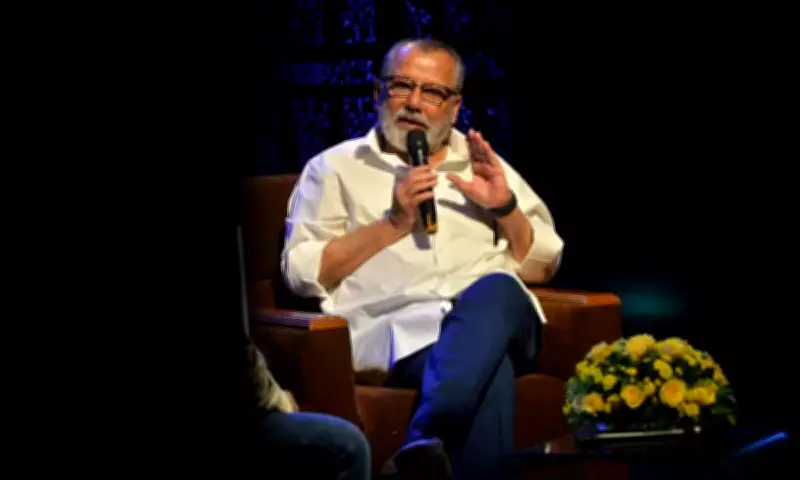
Pankaj Kapur's Acting Odyssey: A Five-Decade Reflection
At the age of 18, when Pankaj Kapur expressed his ambition to become an actor, his father, an English professor, posed a pivotal question: was it the allure of glamour or a genuine talent for performance that drove him? To seek the answer, Kapur embarked on a journey by enrolling at the National School of Drama (NSD). As he prepared to leave home, his father imparted a lasting piece of advice: 'Now, don't look back.' True to those words, Kapur never did, forging a remarkable career that has spanned over five decades and excelled across diverse genres.
Nagpur Interaction: Recalling Milestones and Memories
During a recent moderated discussion in Nagpur with Ajey Gampawar, Kapur delved into his extensive journey in showbiz, reflecting on his formative days at NSD and beyond. The conversation highlighted his evolution as an artist and the pivotal moments that shaped his path.
Crafting Abbaji in Maqbool: A Collaborative Effort
The talk naturally turned to Kapur's powerful screen performances, with a focus on his iconic role as Abbaji in Vishal Bhardwaj's Maqbool. Interestingly, Kapur was initially hesitant to take on the character. 'When Vishal Bhardwaj approached me with the role, I wasn't sure of doing it. But he was insistent,' Kapur recalled. He asked for time to review the script, eventually agreeing after a month.

Kapur later learned that Naseeruddin Shah had been offered the role first but suggested Kapur's name instead, preferring another character. The development of Abbaji was a collaborative process, with multiple meetings and discussions refining the portrayal. Kapur shared a key insight: 'I suggested to Vishal that Abbaji, who is short in height, be surrounded by tall, well-built bodyguards. The thought was that it will subtly reflect Abbaji's authority and power.' This nuanced approach contributed to the film's impact, starring alongside Irrfan and Tabu.
Praising Shahid Kapoor: A Father's Perspective
Appreciating his son Shahid Kapoor's career choices, Pankaj Kapur, who directed him in Mausam, offered heartfelt praise. 'It is not easy to direct him because he is a huge star and a fine artiste,' he said. 'I would like to say that he is the best actor in his age-group. The kind of characters he is picking need a lot of courage considering the fact that he is a star. He is constantly finding his way, which is a sign of growth for an actor.'
Jaane Bhi Do Yaaro: A Timeless Classic
Kapur, who played the builder Tarneja in Kundan Shah's cult comedy Jaane Bhi Do Yaaro, reflected on the film's enduring legacy. He noted that while many have considered remaking it, no one has succeeded to date. 'I think such films are made only once in a lifetime,' Kapur shared. 'Many have contributed significantly to the film, but Kundan Shah's name comes first in that list. It was commendable for him to think, write, and then execute with so much hard work and little money. It's a film which will stay with the audiences for a long time to come.'
A Career Setback: The Gandhi Film Incident
After graduating, Kapur served in the Repertory Company of NSD for four years. However, his involvement in Richard Attenborough's Gandhi (1982) led to an unexpected job loss. Initially granted permission by NSD to work on the film, Kapur was halfway through the project when management demanded his return for a theatre festival in Goa. 'I had to refuse as I had my commitments for the film,' he explained. When asked to resign, he declined, feeling he was not at fault, and ultimately received a termination letter. Despite this, Kapur played Mahatma Gandhi's secretary Pyarelal and even dubbed for Ben Kingsley in the Hindi version, showcasing his resilience and dedication.
Through these anecdotes, Pankaj Kapur's journey emerges as a testament to perseverance, artistic integrity, and the transformative power of storytelling in Indian cinema.