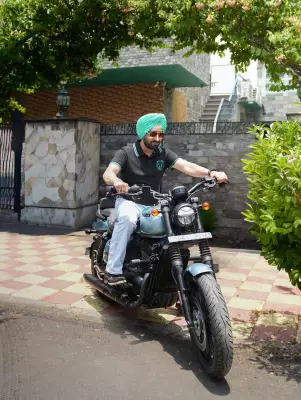
Farhan Akhtar's Casting as Ravi Shankar Revives a Legacy of Musical Transformation
The announcement that actor Farhan Akhtar will portray sitar maestro Ravi Shankar in an upcoming project brings to mind an iconic image: Shankar on stage at The Concert for Bangladesh in 1971. This historic event, organized by George Harrison at Shankar's urging, marked the first major charity concert in rock history and was far from a late-career footnote. It represented the culmination of an influence that began years earlier when a sitar entered The Beatles' world and refused to conform to Western pop conventions.
Beyond Sound: Introducing Discipline and Moral Weight
Ravi Shankar did not merely lend The Beatles an exotic sound. He introduced them to musical discipline, seriousness, and the revolutionary idea that music could carry moral weight without becoming mere spectacle. When the sitar first appeared in Beatles music, Western audiences immediately treated it as a symbolic prop. For Shankar, however, it was never symbolic—it was a demanding classical instrument rooted in centuries of lineage, rigorous apprenticeship, and a teacher-student relationship that permitted no shortcuts.
This fundamental difference in attitude created early tension. Shankar would later confess about the first sitar-heavy Beatles track, "I was very shocked. I didn't like it at all." With characteristic bluntness, he added that it sounded "so terrible" to his trained ears. This honesty mattered profoundly—it was not a spiritual guru indulging a pop experiment, but a classical musician refusing to flatter fame.

George Harrison: The Sincere Student
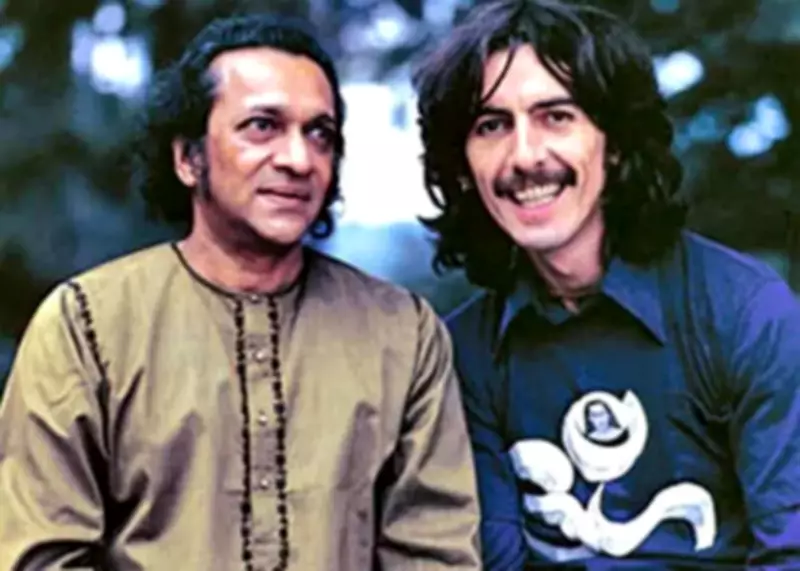
What changed Shankar's mind was not the sound itself, but the sincerity behind it. When Ravi Shankar first met The Beatles, he connected with all four members, but he would later emphasize, "I clicked immediately with George." The reason was simple: Harrison wanted to learn properly. Shankar warned him that mastering the sitar was fundamentally different from guitar, requiring at least a year just to understand proper posture and tone, with fingers bleeding before they hardened.
Harrison did not walk away. "He was so sweet and sincere," Shankar recalled, "that I believed him." This decision established a relationship built not on collaboration between equals, but on genuine apprenticeship. Harrison became a global superstar willingly placing himself in the position of a beginner, submitting to discipline in a way that fame typically prevents.
Influence Without Imitation: Transforming Musical Imagination
The most common misunderstanding of Ravi Shankar's influence is that it turned The Beatles into Indian musicians. This was never the case. Instead, Indian classical music fundamentally changed their musical imagination, introducing concepts that Western pop had little use for at the time: drones instead of constant chord changes, circular structures instead of linear builds, patience instead of immediate payoff. These ideas seeped into The Beatles' work even when no sitar was present.
By the time Harrison wrote songs like "Within You Without You," the influence was no longer decorative. The song was not trying to sound Indian—it was attempting to think differently about time, ego, and self, reflecting deeper philosophical engagement.
From Music to Worldview: Spirituality and Discipline
For George Harrison, Ravi Shankar's influence quickly transcended music. Through the maestro, Harrison encountered a culture where spirituality permeated every aspect of daily life. "Their religion is every second and every minute of their lives," Harrison observed after spending time in India. This immersion sharpened his discomfort with the emptiness of fame, leading him to reflect that while psychedelic drugs offered glimpses of unity, "LSD isn't a real answer." Discipline mattered more than sensation; practice mattered more than revelation.

Shankar embodied this distinction, expressing deep unease with how Indian music became entangled with drugs in the Western imagination. When Indian culture collided with the hippie movement, he noted it got mixed up with "drugs and Kamasutra and hash and all that," something he said he "always fought." His message to Western audiences was direct: "Don't come high. I will make you high."
The Beatles as Delivery System for Indian Philosophy
Ravi Shankar never labored under the illusion that The Beatles had suddenly become classical musicians. However, he understood something more significant: through them, Indian ideas reached audiences that traditional classical concerts never could. Harrison, in turn, comprehended his role as conduit, once stating he felt his job was "to get a message through" and then "get back out of this material world." This sense of artistic vocation—of music as service rather than self-expression—sits squarely within the philosophical framework he absorbed from Indian thought.
An Enduring Relationship Beyond the 1960s
Long after The Beatles disbanded, Harrison remained deeply involved in Ravi Shankar's work, including devotional projects with no commercial safety net. Shankar spoke of their relationship in familial terms, saying, "He is like my son," and noting the "tremendous respect" Harrison always showed him. This longevity punctures the notion that India was merely a fashionable phase for The Beatles. For Harrison, it became a framework for living with fame while resisting its claims on the soul.
The depth of their bond manifested personally when Harrison's son was born in 1978—named Dhani Harrison, drawing on Indian language and symbolism, a quiet testament that Ravi Shankar's influence had moved from music into family and inheritance.
Why Ravi Shankar's Influence Remains Relevant Today
The standard narrative credits The Beatles with opening Western ears to India. A more accurate version is more challenging: Ravi Shankar forced Western pop culture to confront a tradition that could not be easily simplified, accelerated, or consumed without genuine effort. He insisted on seriousness in a world addicted to spectacle, reminding the most famous band on the planet that depth demands submission, not just casual curiosity.
If Farhan Akhtar's casting prompts renewed examination of this influence, it serves as a valuable moment for reflection. Ravi Shankar was not an exotic flourish in The Beatles' story—he was a corrective force, shaping not just how they sounded, but how one of them learned to live with the burden of global fame while maintaining artistic and spiritual integrity.