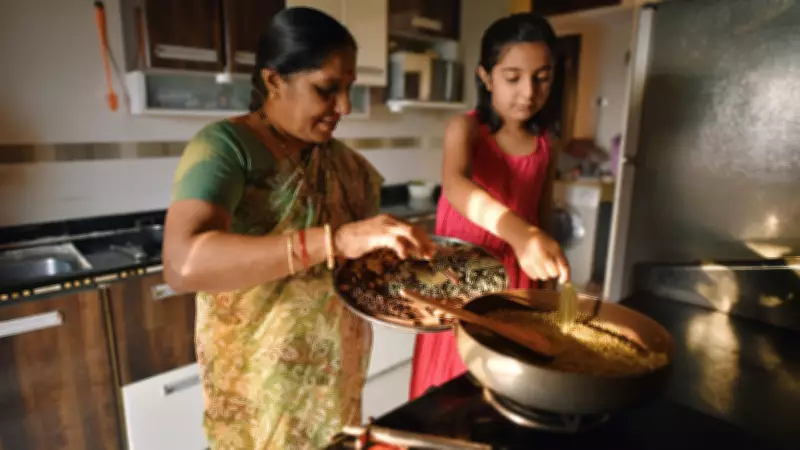
There's a scene that still plays out in many Indian homes every single night. The food is ready, everyone gathers. The children eat, the men eat. And then, once every last person is done, the woman who spent an hour in the kitchen finally sits down, to a cold plate of food, by herself. Nobody thinks of it as a problem. It's just... how things are. But what if some of these everyday "just how things are" moments are quietly teaching girls something nobody actually intended to teach them? Here are five things many Indian households still consider completely normal but they may be quietly shaping how girls see themselves for years to come.
When the mother always eats last
It's one of the most familiar scenes in any Indian home. For generations, this has been held up as the ultimate symbol of a mother's love. And yes, it often is in the eyes of that woman. But children absorb something else too: the person who worked the hardest gets the least priority. When girls grow up watching the women in their lives consistently put themselves last, they can quietly begin to believe that being a "good woman" means your own needs always come second. Sacrifice and care are genuinely beautiful things. But thinking of yourself is a need.
"Beta, sit properly"
Most girls hear this long before they understand what they're doing wrong. A little girl sits comfortably on the sofa. She climbs things, jumps around and takes up space the way children naturally do. And almost immediately, someone steps in. "Sit properly." "Close your legs." "Girls don't sit like that." Manners matter, of course. But these corrections often go well beyond manners. Over time, girls learn to make themselves smaller: physically, socially, emotionally. And years later, that same conditioning quietly shows up when a woman hesitates before speaking in a meeting, holds back from asking for an opportunity or instinctively steps aside to let someone else take centre stage.

Different curfews for sons and daughters
Many Indian parents run two sets of rules under the same roof and most don't even realise it. The daughter must be home by a certain time. The son can roam around till midnight or whenever. The daughter is handed a long list of questions about where she's going, who she'll be with and when she'll be back. The son walks out with barely a word exchanged. Most parents do this out of genuine concern, not deliberate unfairness. But the message still lands. Girls learn that freedom is something they must constantly justify and negotiate. The problem isn't that parents want their daughters to be safe. That instinct is completely understandable. The problem is when safety is always achieved by narrowing a girl's world.
Hiding sanitary pads in black plastic bags
Even today, buying a packet of sanitary pads can feel oddly secretive. It gets wrapped in newspaper or slipped into the iconic black plastic bag. Handed over quietly, as though it contains something to be ashamed of. But periods aren't anything shameful. It is biology. Yet so many girls grow up receiving the opposite message that menstruation is something to hide, to whisper about, to feel uncomfortable discussing out loud.
Calling girls "good" only when they're quiet and agreeable
Think about the compliments girls most often receive. "She's so well-behaved." "She never argues." "She's very adjusting." "Such a good girl." Now think about how confident, assertive boys tend to be described. Bold, smart, a natural leader, independent etc etc. Many families end up praising girls for being agreeable far more than for being ambitious, outspoken or fearless. And slowly, some girls grow up believing that being liked matters more than being heard. But girls who shrink themselves to keep everyone comfortable are usually always unhappy inside.

The little things aren't really little
No single comment or family rule decides a girl's future. But small messages, repeated every single day quietly make home in the girl's mind. The way a family treats its women often becomes the exact blueprint a daughter carries into her friendships, her relationships and her workplace years down the line. The good news is that small changes can shift things too. A mother who eats with the family instead of after them. Equal rules for sons and daughters. A conversation about periods without dropping your voice. A daughter encouraged to speak her mind rather than hold it in. Because the most important thing a girl can learn at home is also the simplest: her voice, her time, her dreams and her needs matter just as much as anyone else's.