At just 11, Ashka Sunil Goyal's world went dark. Literally. One day she was a cheerful, bubbly schoolgirl in Raipur, sitting for her Class 5 examination. The next, she was vomiting blood and being rushed between hospitals. A rare tumour was growing deep inside her nasal cavity. It was already at an advanced stage.
What followed was a battle for survival that took her family across cities and eventually changed the course of her life forever. According to one of her TED Talks, today Ashka is a blind fashion designer. She has launched her own brand and walked the ramp at London Fashion Week. But behind the success lies a story of resilience and refusing society's limits to define her future.
The Day Everything Changed
Looking back, Ashka remembers being the bubbliest little girl in school. Then one day, her life changed. "A cough and cold I'd had for years turned out to be a rare cancer, a tumor in my nasal cavity, at its last stage. Doctors said I wouldn't live long," she recalls. The tumor started damaging her optic nerves.

As per various media and interviews, the family travelled from Raipur to Chennai and then Mumbai, moving between many hospitals. But everywhere they went, doctors said the same thing. The surgery was too risky. Then on a return flight to her home, she suddenly couldn't see anything. "On a flight home, everything went dark," she says. "I turned to Papa and said, 'Papa, I can't see anything.'" Within a month, she had lost her eyesight completely.
For her parents, it felt like watching their daughter's future disappear overnight. "My dad's hands trembled as he held mine," she recalls. "My mom cried at night when she thought I was asleep."
"Bring Her Home and Let Her Die"
The hope of survival was grim. Many people advised the family to stop trying. "When people heard I might not make it, they told my parents to bring me home and let me die in my own bed," said Ashka. But one person refused to accept defeat. Her uncle said something that would become a turning point for the entire family. "Are we really going to sit back and wait for her last breath? No. We will fight. We'll do everything possible. The rest is in God's hands," her uncle said. After that, her parents consulted doctors across the country and abroad. Treatment began immediately. First was chemotherapy. Then came its side effects.
"Losing My Hair Was Torture"
"The one thing I'll never forget is losing my hair," Ashka said. "For a little fashionista like me, that was pure torture." The treatment didn't just affect her body. It affected her identity. "I had always loved my long hair. Watching it fall was heartbreaking."
Also, due to the radiation used in chemotherapy sessions, there were burns inside her mouth, throat and nose. "For a month, I couldn't eat. I couldn't even drink water without pain." She survived on barely 300 ml of liquid a day and lost nearly 30 kilograms of weight.
The Miracle That Gave Her Life, But Not Her Sight
Eventually, doctors concluded that surgery was the only option. The problem was that no one wanted to perform it. The tumour's location made the surgery extremely dangerous. After months, the family found a doctor willing to take the risk. "We prayed for two miracles," Ashka says. "Life and sight."
The surgery was successful and the tumour was completely removed. But only one miracle happened. "My life came back. My eyesight didn't." For many people, that might have felt like the end. For Ashka, it became the beginning of a different journey. "That day I learned that one miracle is enough to light up your whole world," she says.
"Why Did You Waste So Much Money on Her?"
If the medical battle was difficult, society's reactions were often cruel. People questioned whether saving her life had even been worth it. "Why did you waste so much money on her?" some asked her parents. Others wondered who would marry a blind girl. There were whispers that her future was over. But her family stood with her like a rock. "My parents, relatives and closest friends became my army," she says.
They encouraged her to return to school and continue living like any other child. Then came another painful moment. One that would unexpectedly shape her future.

The Teacher Who Said No to Her Dreams
Back at school, a teacher asked students what they wanted to study. Ashka answered immediately. "Fashion." Then came the response she still remembers clearly. "My teacher laughed and said, 'Your life is finished. You're blind. You can't study fashion.'" The words hurt her badly. "I cried endlessly that day."
But somewhere between all the grief, she made a decision. "I decided I would prove her wrong someday." That promise would become the fuel behind everything she did next.
Fashion Beyond Eyesight
For most people, fashion is associated with visual beauty. For Ashka, it became something much deeper. "Fashion is not just visual," she says. "It's about texture, touch and emotion." Instead of seeing colours and patterns, she learned to experience design through feel, structure and detail. She developed her own methods. She used special markers and safety pins to identify placements and understand garment construction.
She then explored the business side of the industry and discovered Fashion Management. Soon, she set herself a goal. She wanted to study at the London College of Fashion, one of the world's leading fashion institutions. When she shared the dream with her father, he agreed, but with two conditions. "No donations. No shortcuts."
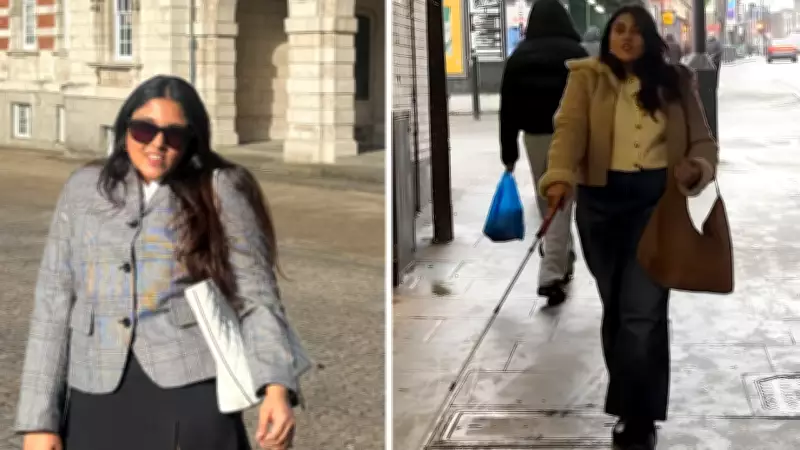
At a young age, Ashka moved alone to Mumbai for Classes 11 and 12. The transition was not easy. She had to live in an unfamiliar city without sight. She learned to use a white cane and adapted to the 'normal' world. "Mumbai was harsh," she says. "It made me fearless. It polished me, broke me and rebuilt me." Alongside academics, she pursued certification courses, completed internships and worked relentlessly towards her dream.
Walking the Ramp at London Fashion Week
At just 22, Ashka launched her own fashion brand. She went on to become a blind fashion designer and later walked the ramp at London Fashion Week. The girl who had once been told she couldn't study fashion was now creating it. Today, she's studying at the London College of Fashion.
But Ashka is careful about how people view her journey. She doesn't want sympathy. And she doesn't want to be reduced to an inspirational headline. "I'm not here to inspire," she says. "I'm here to change perspectives."
She challenges society's obsession with defining women through marriage and conventional expectations. "When people ask, 'Who will marry her?' I think, is that really the biggest concern?" She wants people to rethink how they view disability. Her dream is simple. A world where a blind child is welcomed with confidence instead of pity. For Ashka, blindness is not the tragedy people often assume it is. "If someone asks me today what my biggest fear is, it's not blindness," she says. "My biggest fear is having no purpose in life."
Her story is not about darkness. It is about determination. It is about a little girl who lost her eyesight, survived cancer, endured society's doubts and built a future on her own terms.
As Ashka puts it: "Life may take your sight, but it can never take your vision."