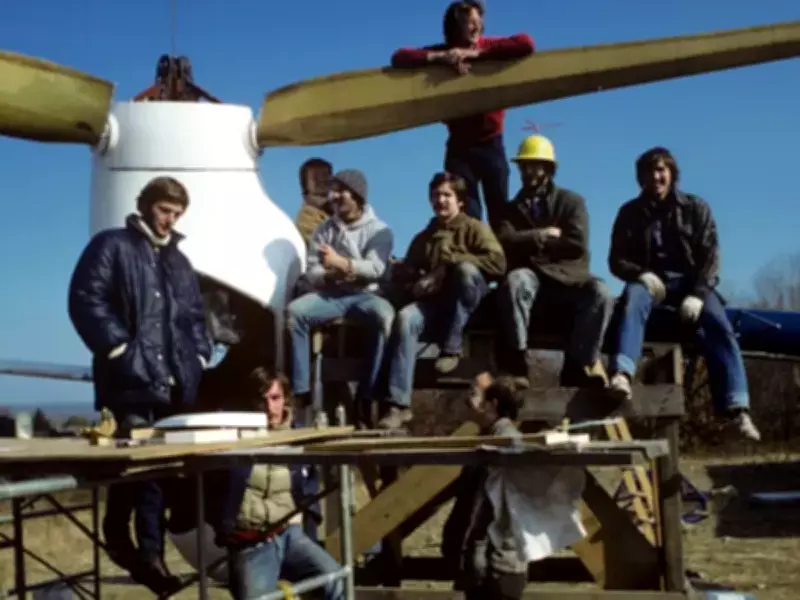
Long before giant offshore wind farms became a familiar sight along many coastlines and renewable energy became an international goal, students and researchers at a university in Massachusetts were fiddling with a contraption fashioned from quite simple parts. In 1976, a team at UMass Amherst built a 25-kilowatt wind turbine out of humble pieces, including the rear axle from a Ford truck, a donated generator, a steam pipe, and hand-made rotor blades. It was a small-scale experiment, but its influence on wind power’s history would prove far greater than its size suggested.
According to IEEE Spectrum, the turbine became one of the most influential experiments in American wind-power history, helping transform wind energy from a fringe idea into a major industry.
The professor who saw wind power's future
William Heronemus was the professor behind it all, a former US Navy officer, submarine engineer, and University of Massachusetts professor. At a time when the United States was struggling to overcome the fallout from the 1973 oil crisis, Heronemus believed that wind power could dramatically cut our reliance on fossil fuels. His ideas were a little out of sync with the times; many policymakers and engineers were banking on nuclear power for our future energy supply in the early 1970s. According to IEEE Spectrum, Heronemus proposed large-scale wind farms across the Great Plains and predicted offshore floating wind turbines decades before they began to be deployed commercially. Many of Heronemus's predictions seemed to come straight out of science fiction then. Today, they're increasingly reflected in technologies being developed by companies worldwide.

The "Wind Furnace" experiment
The turbine the UMass Amherst students built came to be known as the "Wind Furnace". Researchers erected it next to a modular house on Orchard Hill, the highest point on campus, with the simple goal of demonstrating that wind power was capable of generating enough heat for homes throughout the cold New England winters. Even they were surprised by what the machine could do. According to IEEE Spectrum, the turbine produced so much heat that researchers occasionally had to open doors during winter because the house became uncomfortably warm. Its ability to adjust blade angle and perform well at various wind speeds introduced engineering concepts that would soon become standard practice in wind power.
The instructors of the first generation of a new industry
It is fair to say that the turbine's most significant legacy was not the heat it produced, but the students it trained. Many of the young engineers who worked on the turbine became pioneers in the burgeoning wind sector. Some founded early wind power companies, and several went on to work at the US National Renewable Energy Laboratory (NREL). Alumni from the project were instrumental in developing some of the world's first modern wind farms during the 1980s wind boom in California, IEEE Spectrum noted. The group became so influential that many within the industry began referring to them as the "UMass Mafia".
A vision that arrived a few decades later
It turns out that many of Heronemus's ideas seemed quite a long way off in the 1970s. Now they seem eerily prescient. He suggested the feasibility of floating offshore wind farms, hydrogen generation from renewables, and multi-rotor wind turbines. Floating offshore wind is often described as a major emerging area of wind-power development because it can access deeper waters and stronger offshore winds. Wind power investment, both in floating and other designs inspired by Heronemus' ideas from over 50 years ago, is pouring in from Europe, China, and other regions.

The extraordinary rise of wind power
The world envisioned by Captain Heronemus is far from a completed reality, but wind power is undoubtedly one of the fastest-growing forms of electricity in the world. According to Ember's Global Electricity Review 2025, the global electricity generated by wind power has approximately tripled from 830 terawatt-hours in 2015 to nearly 2,500 terawatt-hours in 2024. Recent Ember reports confirm that renewables are steadily gaining ground on fossil fuels and that wind and solar combined are meeting a substantial portion of the growth in global electricity demand. Half a century after a handful of university students assembled a homemade turbine on a wind-swept university hill, the experiment stands as a reminder that major technological breakthroughs can begin with modest experiments.