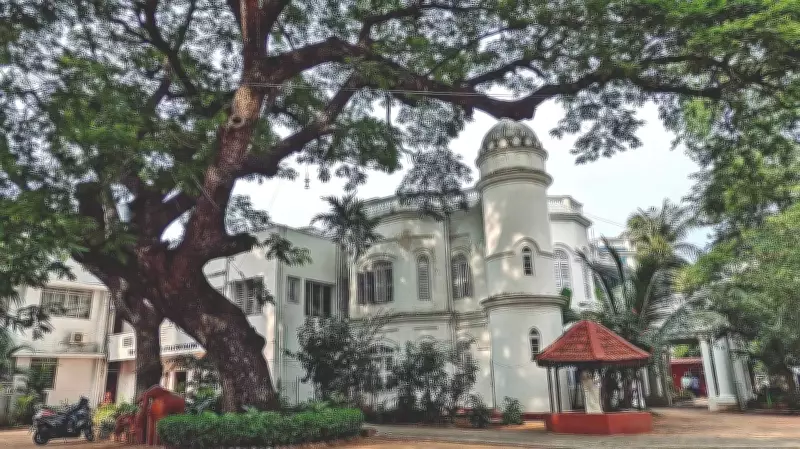
The C P Ramaswami Aiyar Foundation, located on Eldams Road in Chennai, is celebrating its 60th anniversary this year. Housed in a 200-year-old bungalow that once featured the first flush toilets in Madras, the foundation sits on a sprawling green campus in the heart of Alwarpet. The property is shaded by ancient trees and populated by Indie dogs lounging about. Among its many treasures is a library open to the public, containing a book of poems signed by William Wordsworth. The foundation, established in memory of the eminent politician and administrator C P Ramaswami Aiyar, is a hub of diverse activities and institutions.
Origins and Evolution
Interestingly, although the family home was donated by C R Pattabhi Raman, the eldest son of CPR and a former advocate and minister of law, the foundation itself was founded by a group of citizens including senior lawyers and dancer Rukmini Devi Arundale. In its first year, the foundation operated from a building on Mount Road, focusing solely on lectures on religion and philosophy. Nandita Krishna, the foundation's director and great-granddaughter of CPR, recalls that she moved from Bombay to Chennai in 1974 and sought to start an art gallery. With no galleries for craft at the time, she established the CP Art Centre, which began with craft bazaars.
Saraswati Kendra: Pioneering Education for Special Needs
In 1985, a young woman approached Nandita Krishna asking for space to teach children with learning difficulties. At that time, such conditions were largely unrecognized. Nandita provided a room upstairs with basic furniture, which eventually evolved into the Saraswati Kendra, one of India's first schools for children with learning disabilities. Today, the centre serves 120 students, many of whom later transition to the regular school on campus, Grove School. Originally, Grove School was intended for siblings of Saraswati Kendra children, who received admission priority.

Indological Research and Library
Nandita, having studied ancient Indian culture at Bombay University, sought a job as a research officer in history but found none. This led to the founding of the C P Ramaswamy Aiyer Institute of Indological Research in 1978. The institute's library houses a collection of rare books, palm-leaf manuscripts, and reference works on Indian philosophy and religion. Affiliated with Madras University for PhD programs in history and environmental science, it currently supports eight doctoral students.
Environmental Education and Sacred Groves
In 1989, inspired by then minister T N Seshan and with friend Shamim Padamsee, Nandita started the CPR Environmental Education Centre. Over the years, the centre has restored 53 sacred groves across villages in Tamil Nadu. Currently, the foundation is documenting the ecological traditions of various Indian states. Additionally, the foundation has worked to revive folk art forms in Tamil Nadu schools, training teachers and engaging children in folk songs and music.
Compassionate Community
Children from both schools regularly volunteer at the Blue Cross of India, helping animals. The campus hosts Indie dogs, and students from the regular school interact with special needs children. Nandita emphasizes that the foundation's greatest achievement is raising compassionate children who grow into adults caring for animals and humans alike. The Dr Dog programme at Saraswati Kendra uses pet therapy, allowing children with special needs to interact with approved dogs. One memorable instance involved a non-verbal child speaking to a puppy, asking what it had eaten, astonishing parents and teachers.
Historical and Architectural Highlights
The bungalow's history is rich: it originally belonged to British lawyer John Bruce Norton, advocate-general of Madras from 1863 to 1872. His son, Eardley John Norton, known as the 'Lion of the Madras Bar', was a founder of the Indian National Congress and a civil liberties champion. He practiced at the Madras High Court from 1879 to 1907 before moving to Calcutta, where he served as a prosecutor in the famous Alipore Bomb Case. The building features Italian floor tiles and a false roof imported from Belgium. At one time, the wooded premises were home to jackals, civet cats, and even occasional leopards.