Elon Musk became the world's first trillionaire on Friday after SpaceX's blockbuster Nasdaq debut pushed the rocket company's valuation to nearly $2 trillion.
A surge in SpaceX shares lifted Musk's estimated net worth above the $1 trillion mark, with most of his wealth tied to equity holdings in his businesses.
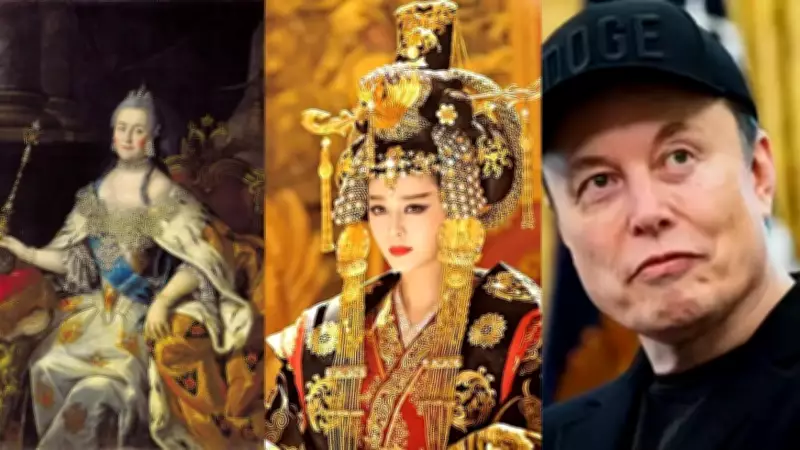
Yet, despite this unprecedented milestone, Musk's fortune is still dwarfed by several historical rulers.

Comparing fortunes across centuries remains difficult, however, as wealth in the past was often tied to land, resources, taxation and political power rather than publicly traded assets.
Based on 2022 estimates, these eight historical figures were wealthier than Elon Musk is today.
1. Catherine the Great (1729–1796) - Estimated US$1.5 trillion
The longest-reigning female ruler of Russia, Catherine the Great controlled vast territories, estates and state resources after ascending to the throne in 1762. Historians estimate that the wealth under her control amounted to roughly 5 per cent of Russia's economic output at the time, equivalent to about US$1.5 trillion in 2022 as per Luxuo.
2. Augustus Caesar (63 BC–14 AD) - Estimated US$4.6 trillion
The first Roman emperor transformed Rome from a republic into a powerful empire and presided over one of the most prosperous periods in ancient history. The Roman Empire is estimated to have produced between 25 and 30 per cent of global economic output, with Augustus personally controlling around a fifth of that wealth. In modern terms, his fortune was valued at roughly US$4.6 trillion in 2022.
3. Joseph Stalin (1878–1953) - Estimated US$7.5 trillion
As leader of the Soviet Union, Stalin wielded near-total control over one of the world's largest economies. While he did not personally own Soviet assets, historians argue that his authority over the country's resources effectively made him one of the wealthiest individuals in history. The USSR accounted for around 9.5 per cent of global economic output in 1950, equivalent to about US$7.5 trillion.
4. Empress Wu Zetian (624–705) - Estimated US$16 trillion
China's only female emperor ruled during a period when the country generated nearly 23 per cent of the world's economic output. Despite her reputation for ruthlessness, Wu strengthened trade along the Silk Road, expanded imperial territory and consolidated state power. The economic might of her empire has led some historians to estimate wealth under her control at around US$16 trillion in 2022.
5. Akbar the Great (1542–1605) - Estimated US$21 trillion
The third Mughal emperor presided over one of the richest and most sophisticated empires of the early modern era. During his reign, the Mughal Empire accounted for roughly a quarter of global GDP. Akbar's administration improved tax collection, encouraged trade and fostered cultural development, helping create immense wealth that modern estimates place at around US$21 trillion.
6. Emperor Shenzong of Song China (1048–1085) - Estimated US$30 trillion
Emperor Shenzong ruled during the height of the Song Dynasty, one of the most economically advanced societies in medieval history. The empire generated an estimated 25–30 per cent of global GDP through technological innovation, efficient governance and strong tax systems. Historians estimated that the economic resources under his rule was approximately US$30 trillion.
7. Genghis Khan (1162–1227) - Estimated US$120 trillion
The founder of the Mongol Empire built the largest contiguous empire in world history, stretching across vast regions of Asia and into Europe. Some estimates place the equivalent value of his economic influence at around US$120 trillion, making him one of history's richest figures.
8. Mansa Musa (1280–1337)
Widely regarded as the richest person who ever lived, Mansa Musa ruled the Mali Empire at a time when it controlled vast gold and salt reserves. Mali was among the world's leading gold producers, and Musa's wealth became legendary during his pilgrimage to Mecca, where his spending reportedly affected regional economies. Historians often describe his fortune as 'incomprehensible', arguing that it is impossible to accurately calculate its modern equivalent.
Catch the latest world news and top headlines. Download the TOI App.

About the Author: TOI World Desk - At TOI World Desk, our dedicated team of seasoned journalists and passionate writers tirelessly sifts through the vast tapestry of global events to bring you the latest news and diverse perspectives round the clock. With an unwavering commitment to accuracy, depth, and timeliness, we strive to keep you informed about the ever-evolving world, delivering a nuanced understanding of international affairs to our readers. Join us on a journey across continents as we unravel the stories that shape our interconnected world.