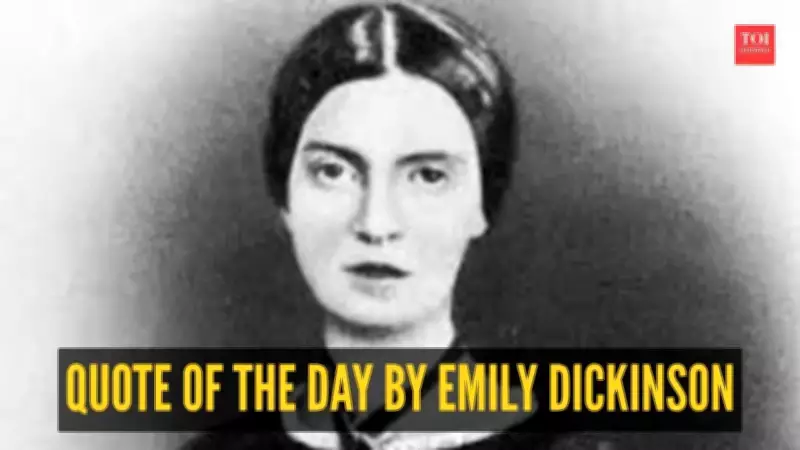
Emily Dickinson, a renowned American poet, left an indelible mark on American literature through her profound and influential poetry. Despite leading a reclusive and solitary life, she produced nearly 1,800 poems, the majority of which were published posthumously. Her work masterfully captures emotions, nature, and the inner human experience using simple yet powerful language.
The Quote: 'Hope is the Thing with Feathers'
The famous line, "Hope is the thing with feathers that perches in the soul – and sings the tunes without the words – and never stops at all," is from Dickinson's poem "Hope is the Thing with Feathers." In this poem, she employs the imagery of a bird as an analogy to express her perspective on hope. Through delicate wording, she articulates the essence of hope and its role in human lives.
What This Quote Conveys
This quote highlights that hope is a quiet yet powerful force that resides within us at all times. It does not demand attention, yet it continuously supports and uplifts us, especially during challenging moments. Dickinson suggests that hope is natural, constant, and deeply rooted in the human spirit.

Hope Is Always Present Within Us
Hope can be compared to a bird that is "perched in the soul." Just as a bird sits on a branch, the concept of hope rests within the individual. This imagery illustrates that, regardless of the difficulties one endures, hope will always exist within them.
Hope Brings Comfort Without Words
The phrase "sings the tunes without the words" elegantly conveys that hope makes us feel good without the need to articulate why. There is no requirement to justify feelings of confidence or security because hope is already embedded within us.
Hope Never Fades, Even in Difficult Times
Dickinson emphasizes that hope "never stops at all." This implies that hope is steady and constant. Even during the most trying times when circumstances appear bleak, hope persists. It may become silent and feeble, but it never ceases to exist.
Conclusion
According to Emily Dickinson, hope is a delicate yet strong, persistent, and consistent entity. She illustrates the nature of hope by comparing it to a singing bird that never stops singing. In essence, Dickinson views hope as a natural component of human existence that should not be underestimated. Hope continues to live within a person, regardless of the challenges they face.