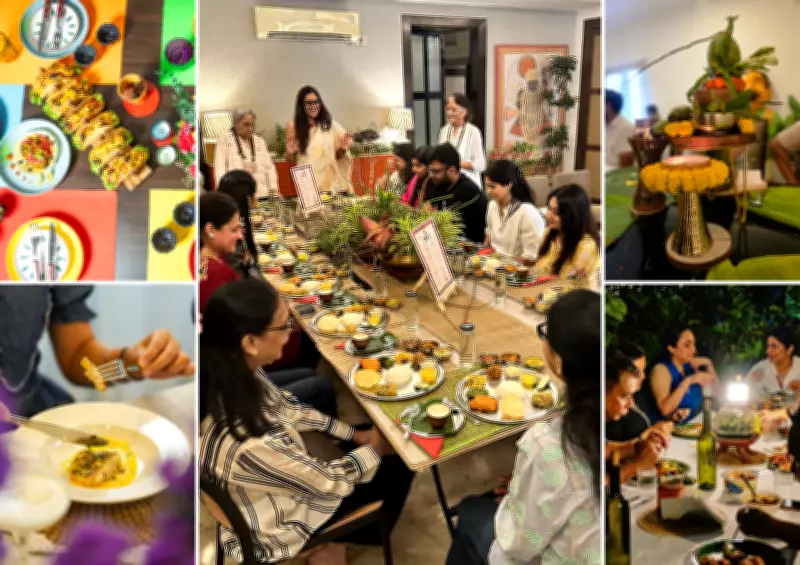
You receive the address the night before and show up to a stranger's home expecting a good meal — what you aren't prepared for is everything else. The door opens and you're immediately struck by how much thought has gone into the evening: every corner considered, the tablescape elaborate and deliberate, soft music drifting through a room that smells of something wonderful being prepared just beyond it. The food is essential, but what lingers long after the last course is something harder to name — the particular ease of relaxing among strangers who, over the course of a few hours, stop being strangers at all. At one supper club we attended, the host put it simply: "I wanted to make new friends, but in a space where I feel most like myself — my home." We spoke to five women who host supper clubs every weekend to find out what makes them open their homes, lay an elaborate table, and cook for people they've never met – while ensuring they're safe while inviting strangers into their well-kept secret haven.
Opening the door: Safety & trust
Opening their homes to strangers isn’t a casual decision – it’s a calibrated leap of faith, softened by instinct and strengthened over time. For many, like Suman Manaksia of Tamarind Tales and Anishka Bose of Salud, the early days came with hesitation; inviting unfamiliar faces into a deeply personal space isn’t second nature. But that discomfort quickly gave way to something more reassuring. “The people who came didn’t arrive like customers,” Suman notes, “they came with curiosity and warmth,” a sentiment echoed across the board. Rachna Bansal of The Dining Room describes the experience as initially “exciting and vulnerable,” but says the very nature of supper clubs filters in guests who are respectful and genuinely invested to connect with each other, and the food. Others, like Esha Agrawal Bidasaria of Sombreros, never felt the fear to begin with – trust, she believes, is baked into Kolkata’s close-knit social fabric, amplified by word-of-mouth and digital familiarity. Across the supper clubs, there’s a quiet system at play: pre-booking conversations, referrals, even a quick scan of Instagram handles. Joyanti Saikia of Joy’s Kitchen sums it up best – “These aren’t just transactions but mutual selections, where both host and guest arrive with the same brief: good food, easy conversation, and a shared understanding that this is more than just dinner.”
Every home has a different energy
If restaurants are about efficiency, supper clubs at home are about energy – and it’s a completely different frequency. In a city that thrives on adda, perhaps it’s no surprise that this slower, more intimate format feels right at home. Across conversations, one thing is clear: a home doesn’t just host a meal, it reshapes how people behave within it. Rachna notes how a home “softens everything,” turning a dinner into an experience where people arrive not just to eat, but to linger and engage. At these meals, the chef sits with you, interacts and explains every little detail of the carefully curated menu. Not to mention the little finishing touches done tableside – like a drizzle of artisanal ghee, or a sprinkling of oregano just for you. For Esha, the difference lies in intent. While restaurants focus on selling food, supper clubs are about building warmth, with guests opening up over the course of a few unhurried hours. The absence of formal barriers also plays a role. Suman says unlike restaurants where diners “eat and leave,” here, they stay back, swap stories, and by the end, strangers are laughing like old friends. That shift from transaction to connection is key. There’s no clear divide between chef and diner, Anishka explains – guests interact, ask questions, and become part of the narrative behind the food. Joyanti has observed how the relaxed setting allows conversations to flow more naturally, often extending beyond the plate to culture, memory, and shared curiosity.


What turns a home into a supper club
What starts as a personal space quickly evolves into a curated, almost living entity—shaped as much by design as by demand. Rachna shares that she expanded her dining table from 12 to 16 seats to keep up with demand – many a time seating last-minute guests in a separate section of her living room because they "just wanted to be a part of the meal". Anishka, working within the heritage home of her great-grandfather, filmmaker Debaki Kumar Bose, has refined layouts, lighting, and tableware without losing its old-world charm. Behind the scenes, the process is deeply intentional. For Joyanti, it comes down to three non-negotiables: fresh ingredients, a well-set table, and the right music. The result is a community as much as a dining experience. From families and artists to travellers and entrepreneurs, Suman’s table sees a diverse mix of new and repeat guests. Esha notes a 40% repeat guest rate, with some diners returning up to ten times a year.
Bringing the table to life
- Suman draws from traditional South Indian aesthetics like brass, banana leaves & earthy textures to make guests feel like they are stepping into a memory.
- Rachna’s table is dressed entirely in local, seasonal produce. Think mocha (banana blossom), coconuts, palm fruits, dry spices, raw mangoes. Designed by her best friend and collaborator Sudha, the feeling is earthy and nature-led.
- Esha begins prep 2-3 days in advance. Fresh flowers, plants, playlist checks, room fragrances, and every corner of the house styled intentionally. The tablescape is colourful and vibrant, designed to make guests feel they've stepped into a slice of Mexico.
- Anishka’s space has been thoughtfully adapted. New tableware, layouts improved for comfort, lighting considered carefully, all while holding on to the old-world charm of the heritage home. Tablescapes are immersive and layered, drawing on textures, glassware, crockery, and how the food itself visually interacts with the table.
- Joyanti’s terrace garden is rearranged, lighting adjusted, and seating carefully considered to create the right ambience through the evening. The approach is intentionally unfussy — cosy and personal, letting the garden and food lead while the details quietly do their work.
Let the food do the talking
The food at Kolkata's home supper clubs is as varied as the women behind them. Menus shift every month, shaped by seasonal produce – meaning no two visits are ever quite the same. Suman cooks from deep memory – authentic South Indian saapad meals, rasam, sambhar, and banana leaf spreads that recreate the warmth of a Hyderabad childhood. A few kitchens away, Rachna’s 10-course lunch menus (featuring the likes of narkel tetul chutney & kumro bhorta), cooked entirely in cold-pressed oils and organic masalas, are designed with one quiet ambition: to earn Kolkata’s most affectionate compliment, the post-meal ghoom bhaat nap. Esha takes a more vibrant route – a structured Mexican journey that features loaded nachos, burritos and churros. Anishka brings a professional kitchen sensibility to her tasting menus, drawing on her training in Switzerland while weaving in storytelling, cultural memory, and locally sourced, gourmet-quality produce – Beguni crisp with avocado velouté & Prawn malai curry chowder for example. As for Joyanti, Naga family recipes – like smoked pork with anishi and black sticky rice dessert – passed down through generations are on the menu.