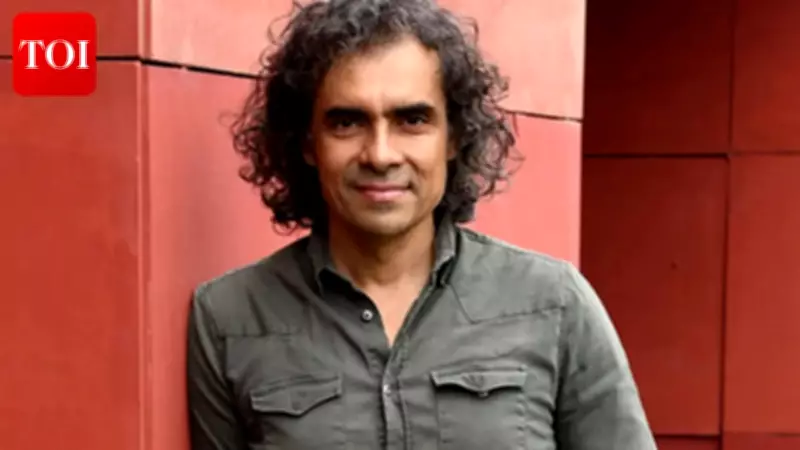
Imtiaz Ali, the acclaimed director known for relationship dramas such as "Jab We Met", "Rockstar", and "Highway", has revealed that all his stories begin as daydreams and what-if scenarios imagined during random musings. In a candid interview, the 54-year-old filmmaker shared insights into his creative process, emphasizing that ideas often strike him during train journeys, bus rides, or even while traveling in an autorickshaw.
The Birth of a Story
Ali explained that once an idea takes root, he feels compelled to discuss it with people around him, finding excuses to narrate the story even in casual settings. "Then there comes a point when I finally sit down and write it," he said during a visit to PTI's headquarters in Delhi. The director, who has written all his films, draws inspiration from his subconscious and the world around him. Quoting the poet Ghalib, he remarked, "Aate hain ghaib se ye mazamin khayaal mein (All that I am writing stems from the invisible). We don't know where these stories come from, mostly from the subconscious."
The Daydreamer's Mindset
Ali described himself as a daydreamer, a trait he has nurtured since childhood. "I sit in the room and imagine things to entertain myself. I've been doing that ever since I remember. In classrooms, in journeys, in trains and everywhere, just daydreaming for entertainment," he said. This habit of imagining "what if" scenarios often begins when he sees something or meets someone, and the thoughts linger long after the encounter ends. He muses about the lives of strangers he glimpses from a train window, such as at Ratlam station, and these fragments coalesce into stories.

From Daydream to Film: "Main Vaapas Aaunga"
His latest film, "Main Vaapas Aaunga", a poignant romance set against the backdrop of the India-Pakistan Partition, originated from his encounters with people during shoots in Delhi and Punjab. Ali found that many individuals who experienced the trauma of Partition carried a treasure trove of memories, a nostalgia that hatred and time could not erase. This inspired him to weave a narrative that captures the enduring pain and longing of that era.
The Role of Train Journeys and DTC Buses
Ali traces many of his ideas back to his student days, when he traveled from his hometown of Jamshedpur to Delhi by train. During his time at Delhi University's Hindu College, he also took countless DTC bus rides. These journeys provided fertile ground for his imagination. "I've been on the train many times and being a young boy going to college in the train, I would invariably have some of the other girl in the compartment and then there would be this 'aankhon aankhon mein' kind of a thing," he recalled. He would then imagine scenarios like missing a train together, leading to unexpected adventures. This thread of thought eventually contributed to the iconic film "Jab We Met", where the protagonists Geet and Aditya are stranded at Ratlam station.
A Common Thread in His Films
While Ali's films appear diverse in mood and setting, he acknowledges a common thread: the absence of a clear villain. "There is a lack of a villain, so to speak. I find that there is no bad person in any of my films. And that's a trait and I don't know what to do about it because everybody who I have met in my life has not turned out to be exactly a bad person," he said. He noted that people often perceived as bad are sometimes lonely or misunderstood.
Breaking Patterns and Entertaining Audiences
Ali has made conscious efforts to break certain patterns, such as avoiding overly expressive dialogue-driven characters after "Jab We Met". However, he admits that some threads remain indelible. Reflecting on what makes a good film, he emphasized that "the light has to go through everything" and that all elements must align under a unified vision. He recalled advice from early in his career: "The tax that gets cut for the ticket is for entertainment. So your film must be entertaining."
From his debut "Socha Naa Tha" to "Main Vaapas Aaunga", which stars Naseeruddin Shah, Diljit Dosanjh, Vedang Raina, and Sharvari, Ali's films continue to explore the complexities of relationships while remaining rooted in his daydreaming nature. As he puts it, daydreaming has become a source of sustenance, allowing him to build stories that resonate with audiences.