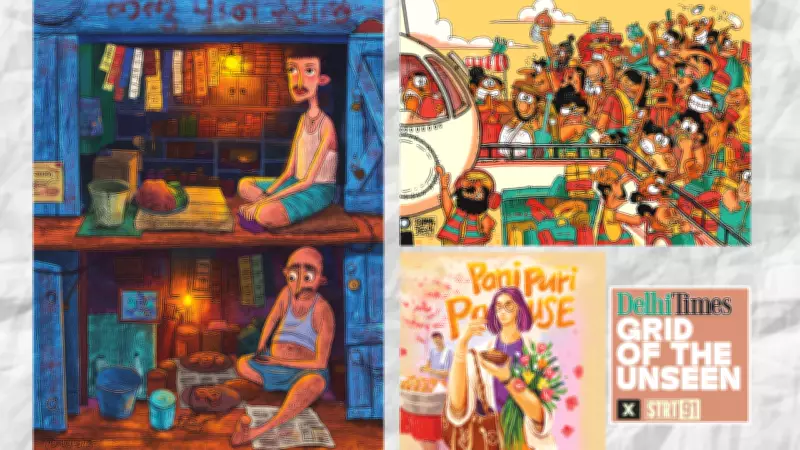
The streets we cross every day – crowded buses, tangled wires, food stalls and fleeting interactions we rarely pause to notice – often inspire artists and illustrators. Everyday life, along with the culture, emotion and human moments woven into it, continues to shape their sketches. For many, illustration begins with slowing down: observing the nuances, rhythm and beauty of ordinary life.
Ahead of the final reveal of GRID OF THE UNSEEN, a new cultural IP created to spotlight emerging artistic voices, we spoke to a few illustrators about how observation, memory and human connection shape their work.
‘You need to activate all your senses while observing a place’
For illustrator Bhavya Desai, observation extends beyond the visual. “You need to activate all your senses while observing a place. It’s not just about seeing. I pay attention to sounds, smells, expressions and small movements. If I’m drawing a smelly garbage bin, for instance, I try to bring that discomfort into the illustration through the expressions of people around it,” he says.

Spending time is key. Adding to this, Lakshman says, “Indian streets carry a beautiful chaos. Before illustrating a place, I spend time understanding its rhythm and emotion. I don’t just observe how a street looks, but how people move, pause and exist within it.”
Bhavya adds, “Most people cross these scenes every day – a stationary auto, a street corner, a sleeping dog under a vehicle seeking shade – but I spend time there noticing what exists beyond the obvious. That attention to detail becomes important because I want my illustrations to feel rooted in a specific place, whether it’s Jaipur, Kerala or Ladakh. I travel with a sketchbook more than a camera now, and over time, sketches have become a form of documentation.”
‘Attention to detail helps make illustrations relatable’
Artists are documenting the poetry hidden in ordinary life. Lakshman Khadapkar, an illustrator, says, “Growing up in a village in Maharashtra, walking through the streets and exploring small corners became second nature to me. My parents encouraged that habit early on. We used to talk about the little things we noticed during the day. That’s where my ‘art of noticing’ really began.”
For illustrator Nayan Kale, the art of observation is what allows an artwork to evolve beyond a single visual style. “It’s the power of observation that helps any artist present an artwork. Imagine putting a prompt into AI and asking it to treat one image in different visual styles. As an illustrator, I do something similar. I like experimenting with one scene, memory or moment in different styles,” he says.
These illustrators remind us that the mundane holds immense creative potential. By paying close attention to the details of daily life, they transform the overlooked into art that resonates universally. Their work encourages viewers to pause and appreciate the beauty in the ordinary, fostering a deeper connection with the world around us.