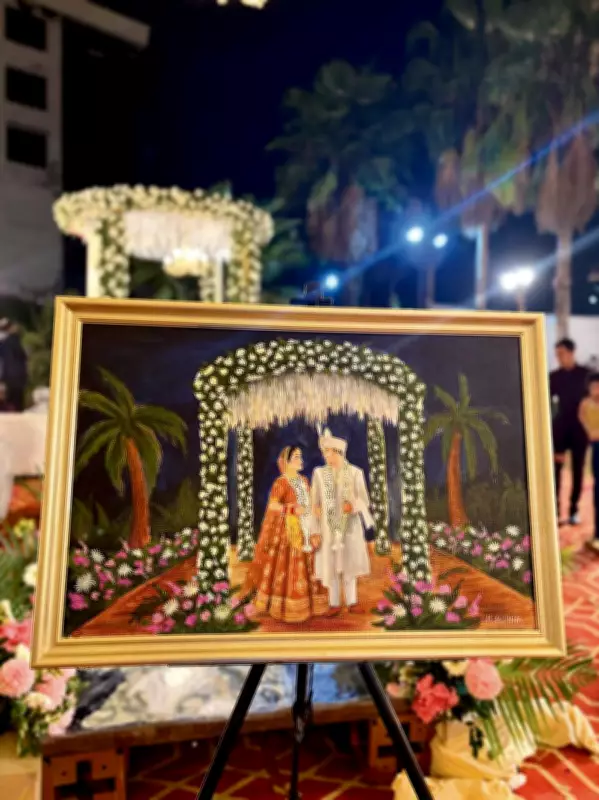
The Indian wedding has always been more than a ceremony. It is a declaration of love, of family, of belonging, of abundance. Nowhere does it announce itself more spectacularly than in Punjab. For generations, that experience was captured in two ways: the photographer darting between tables and the videographer circling the mandap. Between them, they promised to freeze every moment. And they did, in albums stacked on shelves, in hard drives that gather dust, and in reels that play once and are forgotten.
But something new has found its place: an easel, a canvas, a painter who arrives before the guests, sets up in a corner, and turns one extraordinary night into something that will hang on a wall long after the flowers have wilted. The trend of live wedding painting has arrived, and it is stealing the show.
Artists Share Their Experiences
Sarabjeet Singh, from Bathinda, has 15 years of painting behind him and over 300 weddings on his canvas. He was already traveling across the country for his work when Punjab had not yet discovered this world. Then he painted a gurdwara wedding, put it on Instagram, and the phone did not stop ringing. “The enquiries would not stop. That one post started it all,” he recalls.

He speaks about the Sikh ceremony with a reverence that goes beyond craft. For him, painting the laavan, the four sacred rounds around the Guru Granth Sahib, is unlike anything else he has done. “There is stillness to that moment, a purity. Painting inside a gurdwara feels different from anything else. It is not just art. It is something closer to prayer.” His reputation has grown to the point where families now shift their entire wedding timeline around his schedule. For them, the painting is not an add-on; it is part of the day itself.
And that, he says, is what separates a painting from every other memory made at a wedding. “In Punjab, art is not decoration. It is a feeling. They are not buying a painting. They are preserving a moment that will outlive all of us.”
Delhi-Based Artist Harshita Dua
Delhi-based artist Harshita Dua is refreshingly honest about what the work demands. The setup is carefully coordinated — she carries her own lights, positions herself at the front, and waits. “The moment the varmala happens, that is the pose. That is what we are waiting for. Everything before that is preparation.” Sometimes, the canvas is kept hidden from the couple through the night, revealed only when it is complete. The hardest part, she says, is always the face. “We aim for 90 per cent likeness, and that last 10 per cent keeps you honest.” And then there are the nights that test even the most experienced artist: called at 10, still waiting at midnight, brush in hand and exhaustion setting in. “But the canvas does not know that.”
The requests that come her way say everything about how deeply personal this art has become. Couples ask for their pet dogs painted into the scene. Families arrive with a photograph of someone no longer alive. It was one such commission in Jaipur that Harshita says changed how she understood her own work. The groom’s sister had approached her in secret. Their father had passed away, and she wanted him present in the painting during the rituals. “When it was revealed, there was not a dry eye in the room. That is when I understood what this work really means.”
Not every night carries that weight, though. Harshita recalls an Indian groom, an American bride, and a pandit who simply could not get his tongue around her name during the pheras. Every time he reached that moment, he paused and said — “jo bhi inka naam hai, inse shaadi ho rahi hai.” The mandap dissolved into laughter. “It was one of the most joyful canvases I have ever made,” Harshita smiles.
Sunil Kapoor from Phillaur
That joy found in the middle of chaos, pressure, and late nights is something Sunil Kapoor, from Phillaur, Jalandhar, knows well. A winner of the celebrated Hunar Punjab Ka, Sunil came to live wedding painting about a year and a half ago and found, from the very first wedding, that people genuinely valued what he was doing. “They welcome you, they respect you. They make you feel that what you are creating truly matters.”

He brings a sharp observation that cuts to the heart of why this trend has taken hold. People, he says, are tired of the filtered and the artificial. “They want something real made by human hands, in the room, in the moment. When you hold a painting, you can feel that someone was there. The brushstrokes carry the emotion of the day. That is something no camera or algorithm will ever be able to give you.” Like every painter in this space, he knows where the real pressure lies: the face has to be right, the likeness true. “The couple has to look like themselves on the happiest day of their lives. You cannot get that wrong.”
He thinks back to an evening programme in Haryana — brush still moving at 11.30 at night. When the canvas was finally seen, the happiness in that room was something he had not experienced before. For Sunil, moments like that are the answer to every difficult night. “It makes every late night worth it.”
Wedding Planners Weigh In
For the wedding planners coordinating these evenings, live painting has moved from a curiosity to a near-standard conversation. Saakshi Dhir of The Dew Company, based in Chandigarh, received her first request in 2019 from NRI clients. At the time, it felt imported, foreign almost. Today, one in every seven or eight weddings she plans includes a live painter.
“Couples today are not just planning weddings; they are producing experiences, every moment worthy of a frame. People are replicating what they see in Karan Johar films. Live painting fits perfectly because it is the one element that cannot be staged. Everything else at a wedding today can be manufactured, but a painting cannot be faked.”
But Saakshi is candid about the divide she witnesses. For many younger couples, the decision is Instagram-first; they saw it on a reel and they want it, full stop. And yet something shifts the moment the painting is revealed. “The young couple may have booked it for the content. But watch the elders. They go quiet. Some reach into their pockets and offer shagun to the painter.” She pauses. “That is not a trend. That is something much older than Instagram.”
For Hardik Arora of Auroras Events and More in Ludhiana, the emotional pull of live painting goes beyond the couple, the content, and the reels. The moment families want captured most, he says, is almost always the varmala, that singular exchange of garlands when two people become one in front of everyone they love.
Behind the scenes, it is a carefully coordinated effort. Photographers are briefed in advance about the key moments the painter will need. The canvas grows quietly alongside the celebration, and by the time the rituals are done, so is the painting.
The trend that arrived quietly has found its permanent place. And like the paintings themselves, it shows no signs of coming down from the wall.