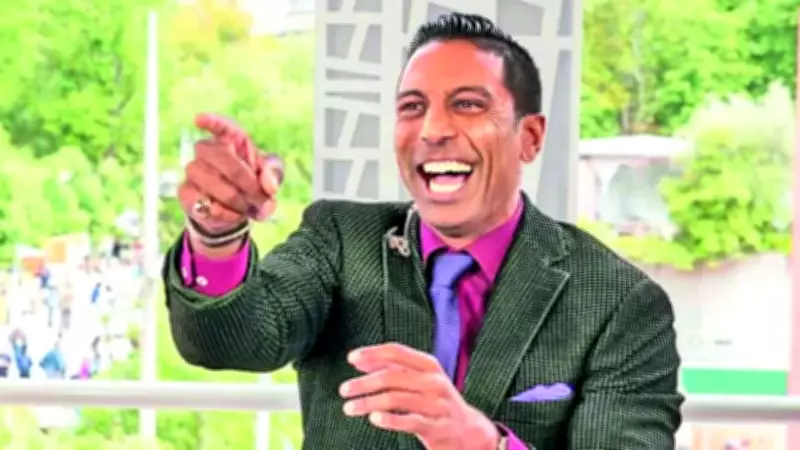
In August 2024, Jannik Sinner had just secured the Cincinnati Masters title. As he stood before a cheering crowd with the trophy, Italian player had every reason to look relieved. Instead, Prakash Amritraj noticed something else. "Man, you've just won the title, why are you so serious?" he asked.
It was an unusual question to pose to a champion moments after victory. Amritraj wasn't chasing a headline. He was following an instinct that has become his trademark as one of tennis television's most distinctive interviewers — paying attention to what others miss. Twenty-four hours later, the tennis world learned that Sinner had twice tested positive for the banned substance Clostebol.
Asking the Right Questions
Amritraj could not have known what was coming. But he had spotted the tension. It is the same instinct that surfaced a few weeks ago in Madrid, when he interviewed teenage sensation Mirra Andreeva after an emotional on-court meltdown. Rather than dwell on what had gone wrong, he began by asking about what she had done well in a match that had tested her mentally.

For Amritraj, the story has always been more interesting than the result. Today, the former player sits on Tennis Channel's flagship desk alongside Martina Navratilova and Jim Courier, interviewing some of the biggest names in the sport. But the journey from professional player to one of the few South Asian faces in international tennis broadcasting was neither straightforward nor painless. "Tennis was my first love," he says. "And it also broke my heart."
An hour before play began at Roland-Garros during this year's French Open, held from May 25 to June 8, Prakash Amritraj sat in a hushed corner of the media restaurant with a now-cold Americano and a pastel green blazer folded beside him. As the tournament buzzed to life around him, he looked back on a journey that began, like his father Vijay's, on a tennis court.
The Indian-American spent much of his teens and twenties listening to the noise around him — criticism, expectations, and constant comparisons. Some came from the media, where he was measured against the towering achievements of his father. Other judgements came from within the player community, where he was often viewed as a product of privilege rather than merit. Those were the pre-social media years, but internet forums still carried opinions and criticism from around the world.
Amritraj stepped away from tennis in 2010, about a year after reaching a career-high ranking of 154. He was beginning to feel that his passion for the sport was on the wane. Nearing 27, he enrolled in acting classes in Los Angeles, where he lived. Two years later, while attending Wimbledon as a spectator, a conversation with Richard Williams altered the way he thought about his career and himself.
"They (Richard's daughters, Serena and Venus Williams) don't even process what other people think about them, especially the negative stuff," Amritraj says of the lessons he took from that afternoon in southwest London. "I thought to myself, what a magical way to exist. Because then, you can focus on what you actually need to do." He returned to Los Angeles, determined to give tennis another shot. But a shoulder injury halted the comeback after about a year. He was nearing 30 and decided it was time to build his next life.
A New Start
That next chapter began in broadcasting. Amritraj's adventure started with commentary for the Champions Tennis League, which his father launched in 2014. Soon after, he received a call from Star Sports, where he interviewed players on the ground at Wimbledon. A couple of years later, he moved to beIN Sports, where Tennis Channel took notice. The network sent him to the ATP Finals in London as part of an experimental travel-reporting project. The concept worked. Soon after, he was offered a new role as Tennis Channel's Worldwide Travel Reporter, a position that became the foundation of his broadcasting career.

The timing could not have been better. Amritraj was still searching for direction when the opportunity arrived, and he threw himself into it with the discipline that had once defined his life as a professional athlete. "Indians have been portrayed in Hollywood, and so forth, as the nerd, the engineer, the guy who doesn't get the girl," he says. "I looked up to the action heroes of my time. So for all those reasons, and the fact that as a tennis player, you train eight hours a day, you're built a certain way. I couldn't continue living life without that." He chased fitness so relentlessly that he turned to bodybuilding. Training became an obsession, giving structure to a life in transition.
"I didn't want to look at a tennis racket right when I quit, because in many ways, that was the first heartbreak I suffered in my life," he says. "I hadn't at that point in my life been in love or gotten my heart broken. Tennis was my first love, and it also broke my heart." "People come up to me and say, 'You had a career where you did many things, played Davis Cup, Wimbledon,'" Amritraj says, leaning forward in his seat. "But for me, it was a dream unfulfilled." Heartbreak, in time, became motivation. Refusing to leave his potential unrealised again, Amritraj rebuilt himself with patience and purpose, learning to trust the inner voice that had once been drowned out.
If Amritraj's route to broadcasting wasn't conventional, the way he approaches the job isn't either. He prepares for interviews as a journalist might, compiling a long list of questions, but also draws on lessons from acting. "In acting," he explains, "performers often know where a scene begins and where it must end, but not necessarily how they will get there. The challenge is to remain present enough to follow the moment wherever it leads." If a player takes the conversation somewhere unexpected, he is willing to abandon the roadmap and follow them. To him, interviews are conversations rather than interrogations. They depend on being alert to mood, tone and the unspoken signals that emerge in the moment.
"The biggest asset is listening," he says. "I'm always listening." Even when they don't say anything. For Amritraj, the appeal of sports broadcasting lies in the stories, emotions and life lessons that sit beneath the results. "I think interviews are probably where I bring the most value," he says.
Yet Amritraj's significance extends beyond his role on television. As one of the few prominent South Asian faces in international tennis broadcasting, he understands the importance of visibility, even if he is careful about how he defines it. "I think representation is unbelievably important, but it almost hurts if it's not done on merit," he says. The subject resonates personally. Growing up, he rarely saw people who looked like him in sports broadcasting, entertainment, or mainstream American media.
Amritraj is standing in his studio at Roland-Garros, across from Court Suzanne-Lenglen, where another Indian-American, Nishesh Basavareddy, had wooed spectators a few evenings earlier. "An Indian-American from Carmel beat Taylor Fritz; he spoke French out there, and they were cheering him," Amritraj says, still pointing at Lenglen. "He didn't change his name to make it more palatable for other people. And guess what? There were thousands of people chanting 'Nishesh, Nishesh.' It was one of the most beautiful moments in this tournament. Stuff like that is unbelievably important, but it's got to be because you've earned it."
When people see someone who looks like them succeeding on merit, whether on a tennis court or behind a microphone, it expands the boundaries of what feels possible. Sometimes that is all it takes.