Through the lens of Raghu Rai, a different India emerged – one veiled in morning mist, rising from heat and dust, flowing with rivers, dancing toward immersion. So it was with the people he photographed. His camera became an invisible presence in intimate spaces, revealing only what a compassionate gaze allowed. From royals to film stars, musicians to artists, Rai captured not just individuals, but the making of each fleeting moment.
Raghu Rai on His Photographic Vision
In an interview from 2016, Raghu Rai explained how he views the world through his lens. He stated, “Sentimentality colours your vision and it is not good for a creative person. You have to be free of personal and emotional sentimentalities. One should be able to look at the world with a clean and pure eye that can reflect the truth of a situation. If you get coloured, the reflection will also have that colour. You have to have a warm heart but cool eye. Thus, there have been no tears but only concerns.”
Capturing Satyajit Ray
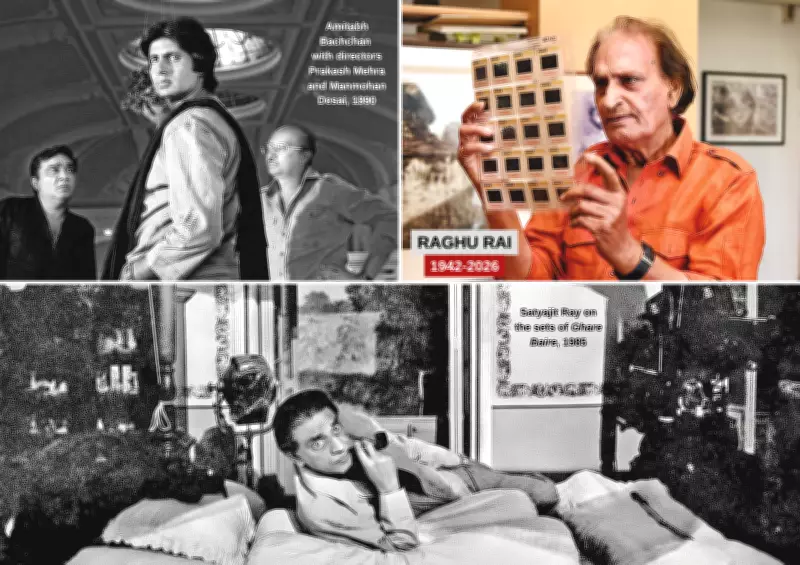
Rai once said, “Satyajit Ray was one of my favourite people to shoot.” This picture was taken on the sets of Ghare Baire. Ray asked, “What do you want me to do?” Rai did not know what to say and took some pictures rather uncomfortably. After a few minutes, Ray said, “That’s enough!” and Rai protested, “No, Manik da, that’s not enough!” When he protested, Ray smiled, and Rai took more pictures. Later, during a break between scenes, Ray lay down on the same bed, smoking his pipe, on which his heroine was sitting. Rai took pictures from the front, then moved to the other side where only Ray’s back was visible. The lighting was very dramatic, with the adjoining room visible through the door and spectacular shadows falling on the wall. Rai said, “Manik da, please look here!” Ray turned with an intense look, and that was it – an excerpt from Raghu Rai’s People on photographing Ray on the sets of Ghare Baire.

Remembering Zakir Hussain
Discussing Zakir Hussain’s death in 2024, Raghu Rai posted this image, saying: “Early this year listening to Zakir’s magical performance after quite a few years, I was not just mesmerised but taken into another space which only happens in meditation and a silence... I wanted to speak to him personally, but... he wasn’t too well at that time... But he has gone now and my experience is left inside me, it is creating a strange upheaval within me that I was not able to complete that conversation with him... Nobody has ever created silence with the tabla like he did…”
Aparna Sen’s Candid Moment
In his book People, Raghu Rai wrote about shooting Aparna Sen: “I kept feeling I was not getting the image I wanted. I kept clicking for quite some time and she kept posing patiently and then suddenly I gave up and said, ‘It’s not working out, Aparna!’ She put her head on her hands on the table and laughed. I clicked in that instant. I felt I’d got the picture I was looking for. You know instinctively when the image has happened.”
Raghu Rai on Kolkata
Rai shared, “I have published three books on Calcutta. This city is just so overpowering and the people are magnificent. My fourth book is on Durga Puja. For Bengalis, nothing else matters when it comes to Durga Puja. The whole city comes to a standstill. The relationship that Bengalis have with their goddesses is amazing; also, Bengali women are equally powerful and beautiful, so the book will be a really special one. Calcutta is one such place that I have a close bond with. The love and affection I get here is more than what I get in Delhi, where I live.”
Raghu Rai on Mumbai
According to Rai, “Mumbai has been like a mini New York – the business hub of an over-crowded nation; a cultural melting pot overflowing with job-seekers, dreamers and dynamic businessmen with a high level of energy almost always palpable in a city wrought with social, cultural, religious and political tensions; and a metropolis that, like Kolkata, had been photographed extensively since the 1850s by some of the finest photographers in the world.” This was an excerpt from Mumbai: Where Dreams Don’t Die.

Raghu Rai on Delhi
Rai described a street scene at Chawri Bazaar in Old Delhi as “an image which could have been taken 200 years ago. It epitomizes the multi-layered India of many religions, environments and people and how they have learnt to co-exist side by side at the same time. There is so much going on: rickshaws, trolleys, horse-drawn carriages, bicycles, labourers, schoolchildren; and down the middle the energy of the crisscrossing carriage tracks.” This was an excerpt from Rai’s Picturing Time.