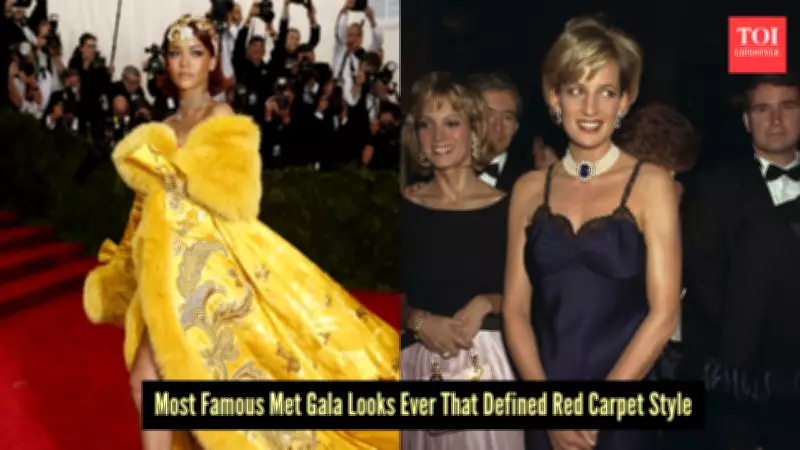
Every May, the steps of the Metropolitan Museum of Art transform into a stage for high-stakes fashion theater. It is a peculiar world where the ultra-wealthy are judged on how well they interpret a dress code—a challenge they often fail spectacularly. Yet, amidst the sea of generic tuxedos and desperate attempts to go viral, a few ensembles manage to rise above the spectacle. These are not merely outfits; they are engineering marvels and bold statements of historical audacity.
Rihanna in Guo Pei (2015): The Imperial Weight
While most attendees in 2015 panicked over the 'China: Through the Looking Glass' theme and settled for lazy dragon motifs, Rihanna chose a different path. She wore a 55-pound golden river of silk by Chinese couturier Guo Pei, which reportedly took two years to construct. Beyond the 'omelet' memes, the garment was a masterclass in thread-work density. It forced a specific, measured gait—the walk of someone who isn't just attending a party but occupying a space.
Princess Diana in Dior (1996): The Quiet Riot
John Galliano's midnight blue slip dress was a study in dangerous minimalism. In the wake of her high-profile separation, Diana moved away from the puffed-sleeve royal aesthetic into something far more razor-sharp. Anchored by a seven-strand pearl choker and a sapphire the size of a pigeon's egg—valued today at roughly 80 crore rupees—the look was a masterclass in using luxury as a shield. It remains definitive proof that you don't need a three-meter train to own a room.

Natasha Poonawalla in Sabyasachi & Schiaparelli (2022): The Gilded Armour
For the 'Gilded Glamour' theme, Poonawalla delivered a rare moment of cultural synthesis that felt genuine rather than forced. She paired a handcrafted gold tulle Sabyasachi sari with a rigid, sculptural metal Schiaparelli bustier. It was a collision of the artisanal and the industrial—treating the red carpet as a battlefield. The look was less about prettiness and more about the structural integrity of the silhouette.
Cher in Bob Mackie (1974): The Blueprint of Illusion
Long before the 'naked dress' became a fatigued red-carpet staple, Cher and Bob Mackie were the architects of the original. This feathered, sheer gown relied entirely on the meticulous placement of crystals to suggest a state of undress while maintaining the garment's actual mechanics. When it landed on the cover of Time, it didn't just cause a scandal; it established a new standard for how much engineering could be hidden in plain sight.
Naomi Campbell in Versace (1995): The Liquid Column
Gianni Versace's silver gown on Campbell was an exercise in pure reduction. It lacked the theatrical fluff that often defines the Gala, relying instead on a perfect bias-cut that moved like liquid mercury. In a room full of noise, this was a silent flex—a reminder that when the tailoring is flawless and the fabric choice is supreme, you don't need a gimmick to be memorable.
Blake Lively in Versace (2022): The Architecture of Decay
Lively's copper-to-verdigris reveal was a rare instance where a literal interpretation of a theme worked because the execution was so precise. The transition from burnished copper to the teal patina of an oxidized building was a direct homage to New York's skyline. The mechanics required to unspool a train of that magnitude on a staircase—without a single snag—was a feat of backstage coordination as much as it was a fashion statement.